



Marcusenius lambouri (Pellegrin, 1904)
Uploaden van uw Foto's en video's
Google afbeelding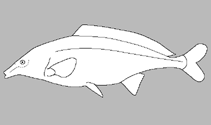 No image available for this species;
drawing shows typical species in Mormyridae.
Google afbeelding
drawing shows typical species in Mormyridae.
Classificatie / Namen Lokale namen | Synoniemen | Catalog of Fishes(Genus, Soort(en)) | ITIS | CoL | WoRMS | Cloffa
> Osteoglossiformes (Bony tongues) > Mormyridae (Elephantfishes)
Etymology: Marcusenius: Becasue of J. Marcusen, author of "Zur Phauna des Schwarzen Meeres", 1867; ichthyologist; lambouri: This species is dedicated to Mr. Lambour, from the Herpetology Laboratory of the Natural History Museum of Paris (Ref. 42494, 124516).
Eponymy: Dr Johann Andreas Marcusen (1817–1894) was a Latvian of German descent who was a physician, ichthyologist and zoologist. [...] Jean-Baptiste Lambour was a ‘préparateur’ in the herpetological department of the Muséum National d’Histoire Naturelle (1891–1924) and Pellegrin’s colleague. (Ref. 128868), visit book page.
Etymology: Marcusenius: Becasue of J. Marcusen, author of "Zur Phauna des Schwarzen Meeres", 1867; ichthyologist; lambouri: This species is dedicated to Mr. Lambour, from the Herpetology Laboratory of the Natural History Museum of Paris (Ref. 42494, 124516).
Eponymy: Dr Johann Andreas Marcusen (1817–1894) was a Latvian of German descent who was a physician, ichthyologist and zoologist. [...] Jean-Baptiste Lambour was a ‘préparateur’ in the herpetological department of the Muséum National d’Histoire Naturelle (1891–1924) and Pellegrin’s colleague. (Ref. 128868), visit book page.
Milieu: milieu / Klimaatzone / Diepte / verspreidingsgebied Ecologie
; zoet water benthopelagisch; pH range: 4.2 - 6.5. Tropical; 23°C - 25°C (Ref. 124516)
Verspreiding Gebieden | FAO regio's | Ecosystemen | Voorkomen | Verspreidingskaart | Introducties | Faunafri
Africa: Middle Congo basin.
Grootte / Gewicht / Leeftijd
Maturiteit: Lm ? range ? - ? cm
Max length : 13.7 cm SL mannelijk / geslacht onbekend; (Ref. 124516)
Max length : 13.7 cm SL mannelijk / geslacht onbekend; (Ref. 124516)
Korte beschrijving Determinatiesleutels | Morfologie | Morfometrie
Dorsale stekels (totaal) : 0; Dorsale zachte stralen (totaal) : 19 - 23; Anale stekels: 0; Anale zachte stralen: 23 - 28; Wervels: 44 - 45. Diagnosis: Marcusenius lambouri belongs to the group of species of Marcusenius with eight large circumpeduncular scales (Ref. 124516). Within this group, it can be distinguished from M. dundoensis, M. fuscus and M. sanagaensis by its low number of lateral line scales, 44-46 vs. 51-61, 54-61 and 49-56, respectively; and from M. intermedius, M. moorii and M. verheyenorum by its high number of lateral line scales, 44-46 vs. 38-43, 40-43 and 38-43, respectively (Ref. 124516). It differs from M. ghesquierei and M. kutuensis by its low number of dorsal-fin rays, 19-23 vs. 32-34 and 27-31, respectively; and from M. schilthuisiae and M. wamuinii by its lower number of anal-fin rays, 23-28 vs. 32-34 and 30-32, respectively (Ref. 124516). Finally, it differs from M. kaninginii by a high total number of vertebrae, 44-45 vs. 43-44, shallow caudal-peduncle depth, 29.6-38.2% of its length vs. 38.4-45.1%, the absence of a longitudinal black band along the flanks vs. band present, and a medial black line on each of the flank scales vs. absence of such a line on the flank scales (Ref. 124516).
Levenscyclus en paargedrag Maturiteit | Voortplanting | Paaien | Eieren | Fecunditeit | Larven
Hoofdreferentie
Upload uw referenties | Referenties | Coördinator | Medewerkers
Mambo Baba, T., T. Kisekelwa, C. Danadu Mizani, E. Decru and E. Vreven, 2020. Hidden species diversity in Marcusenius moorii (Teleostei: Mormyridae) from the Congo Basin. J. Fish Biol. 96(5):1100-1122. (Ref. 124516)
CITES
Not Evaluated
Gevaar voor de mens
Harmless
Gebruik door de mens
FAO - Publication: search | FishSource |
Meer informatie
Trofische ecologie
Voedsel (prooien)
Dieetsamenstelling
Voedselconsumptie
Voedselrantsoenen
Predatoren
Voedsel (prooien)
Dieetsamenstelling
Voedselconsumptie
Voedselrantsoenen
Predatoren
Ecologie
Ecologie
Ecologie
Populatiedynamica
Groeiparameters
Max. leeftijden / maten
Lengte-gewicht rel.
Lengte-lengte rel.
Lengtefrequenties
Massaconversie
Rekrutering
Abundantie
Groeiparameters
Max. leeftijden / maten
Lengte-gewicht rel.
Lengte-lengte rel.
Lengtefrequenties
Massaconversie
Rekrutering
Abundantie
Levenscyclus
Voortplanting
Maturiteit
Rijpheid/kieuwen rel.
Fecunditeit
Paaien
Paaibestanden
Eieren
Ontwikkeling van de eieren
Larven
Larvale populatiedynamiek
Voortplanting
Maturiteit
Rijpheid/kieuwen rel.
Fecunditeit
Paaien
Paaibestanden
Eieren
Ontwikkeling van de eieren
Larven
Larvale populatiedynamiek
Anatomie
Kieuwoppervlak
Hersenen
Otoliet
Kieuwoppervlak
Hersenen
Otoliet
Fysiologie
Lichaamssamenstelling
Voedingsstoffen
Zuurstofverbruik
Type zwemmen
Zwemsnelheid
Visuele pigmenten
Vis geluid
Ziekten en parasieten
Toxiciteit (LC50)
Lichaamssamenstelling
Voedingsstoffen
Zuurstofverbruik
Type zwemmen
Zwemsnelheid
Visuele pigmenten
Vis geluid
Ziekten en parasieten
Toxiciteit (LC50)
Genetica
genoom
Genetica
Heterozygositeit
Erfelijkheid
Genetische diversiteit
genoom
Genetica
Heterozygositeit
Erfelijkheid
Genetische diversiteit
Menselijk gerelateerd
Aquacultuursystemen
Aquacultuurprofielen
Kweeklijnen
Ciguatera gevallen
Postzegels, munten, diversen.
Aquacultuursystemen
Aquacultuurprofielen
Kweeklijnen
Ciguatera gevallen
Postzegels, munten, diversen.
Tools
Speciale rapporten
Bekijk gegevens voor het houden in een aquarium | Bekijk Fact Sheets voor de soort | Bekijk Aquacultuur Fact Sheets
Download XML
Internetbronnen
AFORO (otoliths) | Aquatic Commons | BHL | Cloffa | Websites from users | Bekijk FishWatcher | CISTI | Catalog of Fishes: Genus, Soort(en) | DiscoverLife | ECOTOX | FAO - Publication: search | Faunafri | Fishipedia | Fishtrace | GloBI | Google Books | Google Scholar | Google | IGFA World Record | OneZoom | Open Tree of Life | Otolith Atlas of Taiwan Fishes | PubMed | Reef Life Survey | Socotra Atlas | TreeBase | Tree of Life | Wikipedia: ga naar, zoek | World Records Freshwater Fishing | Zoological Record
Schattingen op basis van modellen
Fylogenetische diversiteitsindex (Ref. 82804): PD50 = 0.5000 [Uniqueness, from 0.5 = low to 2.0 = high].
Bayesian length-weight: a=0.01288 (0.00585 - 0.02838), b=2.88 (2.70 - 3.06), in cm total length, based on LWR estimates for this Genus-body shape (Ref. 93245).
Trofisch niveau (Ref. 69278): 3.1 ±0.4 se; based on size and trophs of closest relatives
Weerstandsvermogen (Ref. 120179): Hoog, minimale populatieverdubbelingstijd minder dan 15 maanden (Preliminary K or Fecundity.).