



Parakneria alytogrammus Kiwele Mutambala, Abwe, Schedel, Chocha Manda, Schliewen & Vreven, 2022
Envoyez vos Photos et vidéos
Images Google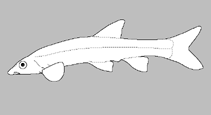 No image available for this species;
drawing shows typical species in Kneriidae.
Images Google
drawing shows typical species in Kneriidae.
Classification / Noms Noms communs | Synonymes | Catalog of Fishes(Genre, Espèce) | ITIS | CoL | WoRMS | Cloffa
> Gonorynchiformes (Milkfishes) > Kneriidae (Shellears)
Etymology: alytogrammus: The name 'alytogrammus' is derived from the Greek 'alytos', meaning uninterrupted, and from the Greek 'gram', meaning line, and refers to the diagnostic uninterrupted lateral mid-longitudinal black band; this band is divided into a series of more or less rounded, black spots in the Congo basin congeners of this species; an adjective (Ref. 127997).
Etymology: alytogrammus: The name 'alytogrammus' is derived from the Greek 'alytos', meaning uninterrupted, and from the Greek 'gram', meaning line, and refers to the diagnostic uninterrupted lateral mid-longitudinal black band; this band is divided into a series of more or less rounded, black spots in the Congo basin congeners of this species; an adjective (Ref. 127997).
Environnement : milieu / zone climatique / profondeur / gamme de distribution Écologie
; eau douce benthopélagique. Tropical
Distribution Territoires | Zones FAO | Écosystèmes | Occurrences | Carte par point | Introductions | Faunafri
Africa: Upper Lufira River, in the Upper Lualaba basin, Congo River basin, in the Democratic Republic of the Congo (Ref. 127997).
Taille / Poids / Âge
Description synthétique Clés d'identification | Morphologie | Morphométrie
Épines dorsales (Total) : 0; Rayons mous dorsaux (Total) : 11; Épines anales: 0; Rayons mous anaux: 9; Vertèbres: 41 - 42. Diagnosis: From all its congeners in the Congo Basin in general and the Upper Lualaba and Luapula-Mweru systems in particular, Parakneria alytogrammus differs by the combination of its lower number of transversal bands on each of the caudal-fin lobes, 2 vs. 3-5, and the presence of an uninterrupted lateral mid-longitudinal black band in fresh and preserved specimens vs. either a lateral mid-longitudinal band interrupted and forming a series of more or less rounded black spots in other species except in Parakneria damasi; in the latter species a lateral mid-longitudinal band with spots not very clearly separated is documented (Ref. 127997). It further differs from the three Parakneria species currently known from the Upper Lualaba basin, P. damasi, P. lufirae and P. thysi, by the narrow base of its pectoral fin, 4.8-5.6% of standard length vs. 8.2-10.1% for P. lufirae, 8.6% for P. damasi and 7.6-7.9% for P. thysi; in addition, it also differs from P. damasi only by its short pectoral fin, 18.6-18.9% of standard length vs. 24.5%, high head height, 49.2-52.9% of head length vs. 45.2%, and short pelvic fin, 15.0-15.4% of standard length vs. 17.8%; and by the low number of pectoral-fin rays, 16-17 vs. 20; likewise, it also differs from P. lufirae only by its narrow mouth width, 29.7-30.4% of head length vs. 34.6-43.7%, and its short pectoral fin, 18.6-18.9% of standard length vs. 21.2-23.6%; in addition, it also differs from P. thysi by the lack of black vertical blotches below the lateral mid-longitudinal black band vs. present in P. thysi (Ref. 127997). In addition, it differs from P. malaissei, the only species known from the Luapula-Mweru system, by its dorsal and pelvic fins being closer to the caudal-fin base, i.e. by a short post-dorsal distance, 36.4-36.6% of standard length vs. 38.6-41.1%, and a short post-pelvic distance, 40.0-40.6% of standard length vs. 41.4-44.1% (Ref. 127997). Furthermore, P. alytogrammus differs from the remaining Congo basin congeners, except P. abbreviata, by the narrow base of its pectoral fin, 4.8-5.6% of standard length vs. 8.7% for P. vilhenae, 7.1-8.1% for P. kissi, 7.6-7.8% for P. ladigesi and 6.7-8.0% for P. cameronensis; it differs from P. kissi by the high caudal peduncle height, 7.7-8.4% of standard length vs. 7.2%, the high number of total and caudal vertebrae, 41-42 and 12-13 vs. 38 and 10, and by its short pelvic-anal distance, 20.8-21.8% of standard length vs. 23.0-23.9%; it further differs from P. vilhenae and P. cameronensis by its short pectoral-fin length, 17.4-19.0% of standard length vs. 24.4% for P. vilhenae and 20.8-23.8% for P. cameronensis; and from P. cameronensis and P. ladigesi by its deep head height, 49.2-52.9% of head length vs. 41.2-43.2% for P. cameronensis and 40.5-43.4% for P. ladigesi; finally, it also differs from P. abbreviata by the high number of scales on the lateral line, 90-98 vs. 75-76 (Ref. 127997). Lastly, P. alytogrammus differs from P. fortuita, its only currently known congener from southern Africa by having a continuous black band along the lateral line, the presence of a vertical transverse band at the base of the caudal fin vs. two spots, the one behind the other at the base of the caudal fin, the last one being larger than the first one, a well indented caudal fin with two pointed lobes, vs. a moderately indented caudal fin, with two more or less rounded lobes, and a slightly more backward position of its pelvic fin, i.e., inserted below the fourth dorsal-fin ray, vs. pelvic fin inserted below the third dorsal-fin ray; in addition, P. alytogrammus differs from P. fortuita by a short post-pectoral distance, 72.8-73.8% of standard length vs. 77.3%, and a deep body height, 13.5-14.8% of standard length vs. 10.3% (Ref. 127997).
Found mostly in calm waters during the seasonal floods; water depth varied between 0.5 and 1.5 m at its locality towards the grassy banks; the water of the river was muddy in appearance towards the banks, but tended to become clearer with increasing depth (Ref. 127997).
Cycle de vie et comportement reproducteur Maturité | Reproduction | Frai | Œufs | Fécondité | Larves
Référence principale
Téléchargez vos références | Références | Coordinateur | Collaborateurs
Kiwela Mutambala, P., E. Abwe, F.D.B. Schedel, A. Chocha Manda, U.K. Schliewen and E.J.W.M.N. Vreven, 2022. A new Parakneria Poll 1965 (Gonorhynchiformes: Kneriidae), ‘Mikinkidi’ from the Upper Lufira basin (Upper Congo: DRC): evidence from a morphologic and DNA barcoding integrative approach. J. Fish Biol. 2022;1-23. (Ref. 127997)
CITES
Not Evaluated
Menace pour l'homme
Harmless
Utilisations par l'homme
Pêcheries: sans intérêt
FAO - Publication: search | FishSource |
Plus d'informations
Écologie trophique
Aliments (proies)
Composition du régime alimentaire
Consommation alimentaire
Rations alimentaires
Prédateurs
Aliments (proies)
Composition du régime alimentaire
Consommation alimentaire
Rations alimentaires
Prédateurs
Dynamique des populations
Paramètres de croissance
Âges / tailles maximales
Longueur-poids rel.
Rel. longueur-longueur.
Fréquences de longueurs
Conversion de masse
Recrutement
Abondance
Paramètres de croissance
Âges / tailles maximales
Longueur-poids rel.
Rel. longueur-longueur.
Fréquences de longueurs
Conversion de masse
Recrutement
Abondance
Cycle de vie
Reproduction
Maturité
Maturité/épines rel.
Fécondité
Frai
Agrégats de frai
Œufs
Développement de l'œuf
Larves
Dynamique des populations larvaires
Reproduction
Maturité
Maturité/épines rel.
Fécondité
Frai
Agrégats de frai
Œufs
Développement de l'œuf
Larves
Dynamique des populations larvaires
Anatomie
Surface branchiale
Cerveau
Otolithe
Surface branchiale
Cerveau
Otolithe
Physiologie
Composition corporelle
Nutriments
Consommation d'oxygène
Type de natation
Vitesse de nage
Pigments visuels
Son de poisson
Maladies et parasites
Toxicité (CL50)
Composition corporelle
Nutriments
Consommation d'oxygène
Type de natation
Vitesse de nage
Pigments visuels
Son de poisson
Maladies et parasites
Toxicité (CL50)
Génétique
génôme
Génétique
Hétérozygotie
Héritabilité
Diversité génétique
génôme
Génétique
Hétérozygotie
Héritabilité
Diversité génétique
Liées à l'homme
Systèmes d'aquaculture
Profils d'aquaculture
Souches
Cas de ciguatera
Timbres, pièces de monnaie, divers
Systèmes d'aquaculture
Profils d'aquaculture
Souches
Cas de ciguatera
Timbres, pièces de monnaie, divers
Outils
E-book | Guide de terrain | Générateur de fréquences de longueur | Outil de dynamique de population | Carte par point |
Capture-MSY |
Articles particuliers
Télécharger en XML
Sources Internet
AFORO (otoliths) | Aquatic Commons | BHL | Cloffa | Websites from users | FishWatcher | CISTI | Catalog of Fishes: Genre, Espèce | DiscoverLife | ECOTOX | FAO - Publication: search | Faunafri | Fishipedia | Fishtrace | GloBI | Google Books | Google Scholar | Google | IGFA World Record | OneZoom | Open Tree of Life | Otolith Atlas of Taiwan Fishes | PubMed | Reef Life Survey | Socotra Atlas | TreeBase | Arbre de Vie | Wikipedia: aller à, chercher | World Records Freshwater Fishing | Zoobank | Zoological Record