



Serranochromis alvum Stauffer, Bills & Skelton, 2021
Blue-headed largemouth bream
Hochladen Photos und videos
Google Bild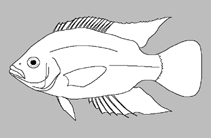 No image available for this species;
drawing shows typical species in Cichlidae.
Google Bild
drawing shows typical species in Cichlidae.
Klassifizierung / Names Namen | Synonyme | Catalog of Fishes(Gattung, Arten) | ITIS | CoL | WoRMS | Cloffa
> Cichliformes (Cichlids, convict blennies) > Cichlidae (Cichlids) > Pseudocrenilabrinae
Etymology: Serranochromis: Latin, serra = saw + Greek, chromis = a fish, perhaps a perch (Ref. 45335); alvum: The specific name, alvum, a noun in apposition, is derived from the Latin, which means blotches and refers to the prominent lateral pigmentation (Ref. 123822).
Etymology: Serranochromis: Latin, serra = saw + Greek, chromis = a fish, perhaps a perch (Ref. 45335); alvum: The specific name, alvum, a noun in apposition, is derived from the Latin, which means blotches and refers to the prominent lateral pigmentation (Ref. 123822).
Umwelt: Milieu / Klimazone / Tiefenbereich / Verbreitungsgebiet Ökologie
; süßwasser benthopelagisch; tiefenbereich 2 - 2 m (Ref. 123822). Tropical
Verbreitung Territorien | FAO Gebiete | Ökosysteme | Vorkommen | Punkt Karte | Einführungen | Faunafri
Africa: junction of the Cuito and Cuanavale rivers, tributary to the Okavango River in Angola (Ref. 123822).
Größe / Gewicht / Alter
Kurzbeschreibung Bestimmungsschlüssel | Morphologie | Morphometrie
Rückenflossenstacheln (insgesamt) : 14 - 15; Rückenflossenweichstrahlen (insgesamt) : 13 - 15; Afterflossenstacheln: 3; Afterflossenweichstrahlen: 9 - 10. Diagnosis: The presence of ocelli throughout the anal fin of breeding males distinguishes Serranochromis alvum from S. robustus and S. jallae in which the ocelli in breeding males are restricted to the posterior 4-5 membranes of the anal fin (Ref. 123822). The exposed teeth of S. alvum differs from those of S. stappersi and S. altus, which possess small teeth that are buried in the lips; Serranochromis alvum has an emarginate caudal fin, while S. macrocephalus, S. janus, and S. angusticeps have rounded caudal fins; the shorter jaw of S. alvum, 43.4-53.5% of head length, separates it from S. spei, 53.5-57.2% of head length; Serranochromis alvum has 34-36 lateral-line scales, while S. thumbergi possesses more than 39 lateral-line scales; the acute angle of the cleft of the mouth, 50-60° of horizontal, of S. meridianus delimits it from the 30° angle of S. alvum; the long dark pectoral fins which reach past the middle of the dorsal fin separates S. longimanus from S. alvum; the interorbital width, 14.3-15.9% of head length, of S. alvum is narrower than that of S. swartzi, 17.6-19.8% of head length, S. cuanza, 16.3-18.0% of head length, and S. cacuchi, 20.0-21.7% of head length (Ref. 123822).
Found in riverbed which was mostly sand substrate with occasional marginal aquatic weed beds and fringing emergent beds of Phragmites (Ref. 123822).
Lebenszyklus und Paarungsverhalten Geschlechtsreife | Fortpflanzung | Ablaichen | Eier | Fruchtbarkeit | Larven
Hauptreferenz
Laden Sie Ihre Referenzen hoch | Referenzen | Koordinator : Kullander, Sven O. | Partner
Stauffer, J.R., Jr., R. Bills and P.H. Skelton, 2021. Four new species of Serranochromis (Teleostei: Cichlidae) from the Cuanza and Okavango river systems in Angola, including a preliminary key for the genus. Zootaxa 4908(1):66-84. (Ref. 123822)
CITES
Not Evaluated
Bedrohung für Menschen
Harmless
Nutzung durch Menschen
FAO - Publication: search | FishSource |
Mehr Information
Trophische Ökologie
Lebensmittel (Beutetiere)
Nahrungszusammensetzung
Nahrungsaufnahme
Lebensmittelrationen
Räuber
Lebensmittel (Beutetiere)
Nahrungszusammensetzung
Nahrungsaufnahme
Lebensmittelrationen
Räuber
Populationsdynamik
Wachstumsparameter
Max. Alter/Größen
Länge-Gewicht-Rel.
Länge-Länge-Verhältnis.
Längenhäufigkeiten
Massenkonvertierung
Rekrutierung
Dichte
Wachstumsparameter
Max. Alter/Größen
Länge-Gewicht-Rel.
Länge-Länge-Verhältnis.
Längenhäufigkeiten
Massenkonvertierung
Rekrutierung
Dichte
Lebenszyklus
Fortpflanzung
Geschlechtsreife
Reifung/Kiemen rel.
Fruchtbarkeit
Ablaichen
Laichaggregationen
Eier
Eientwicklung
Larven
Larven Pop.Dyn.
Fortpflanzung
Geschlechtsreife
Reifung/Kiemen rel.
Fruchtbarkeit
Ablaichen
Laichaggregationen
Eier
Eientwicklung
Larven
Larven Pop.Dyn.
Anatomie
Kiemenoberfläche
Gehirn
Otolith
Kiemenoberfläche
Gehirn
Otolith
Physiologie
Körperliche Zusammensetzung
Nährstoffe
Sauerstoffverbrauch
Schwimmart
Schwimmgeschwindigkeit
Visuelle Pigmente
Fischgeräusche
Krankheiten und Parasiten
Toxizität (LC50s)
Körperliche Zusammensetzung
Nährstoffe
Sauerstoffverbrauch
Schwimmart
Schwimmgeschwindigkeit
Visuelle Pigmente
Fischgeräusche
Krankheiten und Parasiten
Toxizität (LC50s)
Genetik
Genom
Genetik
Heterozygotie
Vererbbarkeit
Genetische Vielfalt
Genom
Genetik
Heterozygotie
Vererbbarkeit
Genetische Vielfalt
Menschenbezogen
Aquakultur-Systeme
Aquakultur Profile
Zuchtlinien
Ciguatera-Fälle
Briefmarken, Münzen, Verschiedenes.
Aquakultur-Systeme
Aquakultur Profile
Zuchtlinien
Ciguatera-Fälle
Briefmarken, Münzen, Verschiedenes.
Tools
Zusatzinformationen
Download XML
Zusammenfassung | Punktdaten | Namen | Photos
Internet Quellen
AFORO (otoliths) | Aquatic Commons | BHL | Cloffa | Websites from users | FishWatcher Einträge suchen | CISTI | Catalog of Fishes: Gattung, Arten | DiscoverLife | ECOTOX | FAO - Publication: search | Faunafri | Fishipedia | Fishtrace | GloBI | Google Books | Google Scholar | Google | IGFA World Record | OneZoom | Open Tree of Life | Otolith Atlas of Taiwan Fishes | PubMed | Reef Life Survey | Socotra Atlas | TreeBase | Tree of Life | Wikipedia: Gehe zu, Suchen | World Records Freshwater Fishing | Zoobank | Zoologischer Rekord
Schätzungen auf der Grundlage von Modellen
Phylogenetischer Diversitätsindex (Ref. 82804): PD50 = 0.5000 [Uniqueness, from 0.5 = low to 2.0 = high].
Bayesian length-weight: a=0.01445 (0.00671 - 0.03113), b=2.99 (2.82 - 3.16), in cm total length, based on LWR estimates for this (Sub)family-body shape (Ref. 93245).
Trophische Ebene (Ref. 69278): 3.8 ±0.6 se; based on size and trophs of closest relatives
Widerstandsfähigkeit (Ref. 120179): hoch, Verdopplung der Population dauert weniger als 15 Monate. (Preliminary K or Fecundity.).