



Lacustricola pygmaeus Bragança, Skelton, Bills, Tweddle & Chakona, 2021
Загрузить свой Фото и Видео
Изображение на Google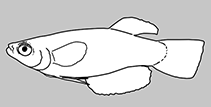 No image available for this species;
drawing shows typical species in Procatopodidae.
Изображение на Google
drawing shows typical species in Procatopodidae.
Классификация / Имена народные названия | синонимы | Catalog of Fishes(род, виды) | ITIS | CoL | WoRMS | Cloffa
> Cyprinodontiformes (Rivulines, killifishes and live bearers) > Procatopodidae (African lampeyes) > Procatopodinae
Etymology: pygmaeus: The epithet pygmaeus, from the Latin pygmaei (singular pygmaeus), is an allusion to the very small or miniature size of Lacustricola pygmaeus, the smallest species within the L. hutereaui complex (Ref. 123968).
Etymology: pygmaeus: The epithet pygmaeus, from the Latin pygmaei (singular pygmaeus), is an allusion to the very small or miniature size of Lacustricola pygmaeus, the smallest species within the L. hutereaui complex (Ref. 123968).
Окружающая среда: среда / климатическая зона / пределы глубины / диапазон распространения экология
; пресноводный пелагический. Tropical
распространение Территории | регионы FAO | Экосистемы | места находок | карта точек | интродукции | Faunafri
Africa: Cuito, Cuanavale, and Okavango rivers, as well as Cuando and small upper Zambezi tributaries in a region comprising Angola and Zambia (Ref. 123968). Also known from Okavango Delta, Chobe River, in Botswana and Namibia and swamps of the Barotse floodplains in the upper Zambezi in Zambia, and Bukalo Channel in Namibia (Ref. 123968).
Размер / Вес / Возраст
Краткое описание определительные ключи | морфология | морфометрия
колючие лучи спинного плавника (общее число) : 0; членистые (мягкие) лучи спинного плавника (общее число) : 10 - 12; колючие лучи анального плавника: 0; членистые (мягкие) лучи анального плавника: 12 - 15; позвонки: 24 - 26. Diagnosis: Lacustricola pygmaeus is distinguished from L. centralis, L. jobaerti, L. johnstoni, L. jubbi, L. katangae, L. macrurus, L. matthesi, L. mediolateralis, L. moeruensis, L. myaposae, L. nigrolateralis, and L. stiassnyae by the possession of banded dorsal, anal, and caudal fins in males and also by the possession of a pointed premaxilla ascending process, in which the premaxilla medial surface is slightly convex (Ref. 123968). It is further distinguished from L. hutereaui, L. chobensis, and L. petnehazyi by an inconspicuous reticulate pattern on scale margins vs. conspicuous; banded anal, dorsal, and caudal fins in females vs. hyaline; faint bands in the middle rays of caudal fin of male vs. conspicuous bands; rounded caudal fin in males vs. elliptical; bright green-blue colour restricted to the area delimited by some of the flank scales vs. bright green colouration not restricted to scale area in L. chobensis and L. petnehazyi, and absent in L. hutereaui; quadrate posterior margin with a deep concavity vs. convex or about straight; first dorsal-fin ray inserted in a vertical to second and third anal-fin ray vs. fourth to eight (Ref. 123968). It is further distinguished from L. hutereaui by the absence of maxilla ventral sharp process vs. presence; retroarticular about the same size as anguloarticular ventral process vs. shorter; posteroventral extension on lachrymal vs. rectangular, without posteroventral extension; infraorbital canal anterior portion open, with three to four neuromasts vs. closed, with four pores; mandibular canal open, with two small neuromasts vs. closed, with four pores; head neuromasts placed in shallow grooves or on the same level as head surface vs. on deep grooves; possession of chromatophores close to eye, along infraorbital region vs. absence of chromatophores; posttemporal ventral arm not ossified vs. ossified; and by a cleithrum posterodorsal bone flap rounded vs. sinuous (Ref. 123968). Lacustricola pygmaeus is further distinguished from L. petnehazyi by the possession of 20-22 scales on longitudinal series vs. 24-27, and from L. chobensis by the possession of 26-30 caudal-fin rays vs. 21-24; 10-12 dorsal-fin rays vs. 6-8; and chromatophores along whole mid-body line of flank, forming an inconspicuous line vs. conspicuous (Ref. 123968).
It is a swamp-dwelling species that does not occur in riverine habitats (Ref. 123968).
Жизненный цикл и брачное поведение половая зрелость | размножение | нерест | икра | Плодовитость | личинки
Основная ссылка
Загрузите свои рекомендации | ссылки | координатор | соавторы
De Bragança, P.H.N., P.H. Skelton, R. Bills, D. Tweddle and A. Chakona, 2021. Revalidation and redescription of "Lacustricola" chobensis (Fowler, 1935) and description of a new miniature species of "Lacustricola" from southern Africa (Cyprinodontiformes: Procatopodidae). Ichthyol. Herpetol. 109(1):123-137. (Ref. 123968)
CITES
Not Evaluated
Угроза для людей
Harmless
Использование человеком
FAO - Publication: search | FishSource |
дополнительная информация
Трофическая экология
Пищевые предметы (добыча)
состав пищи
потребление пищи
Продовольственные пайки
хищники
Пищевые предметы (добыча)
состав пищи
потребление пищи
Продовольственные пайки
хищники
Динамика численности населения
Параметры роста
Макс. возраст / размер
Отношение длины к весу.
Отношение длины к длине.
Размерный состав
Преобразование массы
пополнение
численность
Параметры роста
Макс. возраст / размер
Отношение длины к весу.
Отношение длины к длине.
Размерный состав
Преобразование массы
пополнение
численность
Жизненный цикл
размножение
половая зрелость
Зрелость/Жиры относительно.
Плодовитость
нерест
Нерестовые скопления
икра
Развитие икры
личинки
динамика численности личинок
размножение
половая зрелость
Зрелость/Жиры относительно.
Плодовитость
нерест
Нерестовые скопления
икра
Развитие икры
личинки
динамика численности личинок
Анатомия
жаберная область
Мозг
Отолит
жаберная область
Мозг
Отолит
Физиология
Состав тела
Питательные вещества
Потребление кислорода
Тип плавания
Скорость плавания
Зрительные пигменты
Звук рыбы
Болезни и паразиты
Токсичность (LC50s)
Состав тела
Питательные вещества
Потребление кислорода
Тип плавания
Скорость плавания
Зрительные пигменты
Звук рыбы
Болезни и паразиты
Токсичность (LC50s)
генетика
Геном
генетика
Гетерозиготность
наследуемость
Генетическое разнообразие
Геном
генетика
Гетерозиготность
наследуемость
Генетическое разнообразие
Связанные с человеком
Системы аквакультуры
особенности рыбоводства
степень растяжения
Случаи заболевания сигуатерой
Марки, монеты и прочее.
Системы аквакультуры
особенности рыбоводства
степень растяжения
Случаи заболевания сигуатерой
Марки, монеты и прочее.
инструменты
Специальные отчеты
Проверить содержание в аквариумах | Проверить опубликованные видовые данные | Проверить опубликованные данные по аквакультуре
Скачать в формате XML
ресурсы в Интернет
AFORO (otoliths) | Aquatic Commons | BHL | Cloffa | Websites from users | Проверить FishWatcher | CISTI | Catalog of Fishes: род, виды | DiscoverLife | ECOTOX | FAO - Publication: search | Faunafri | Fishipedia | Fishtrace | GloBI | Google Books | Google Scholar | Google | IGFA World Record | OneZoom | Open Tree of Life | Otolith Atlas of Taiwan Fishes | PubMed | Reef Life Survey | Socotra Atlas | TreeBase | Tree of Life | Wikipedia: Вперёд, поиск | World Records Freshwater Fishing | Zoobank | Зоологическая летопись
Оценки, основанные на моделях
Индекс филогенетического разнообразия (ссылка 82804): PD50 = 0.5000 [Uniqueness, from 0.5 = low to 2.0 = high].
Bayesian length-weight: a=0.01122 (0.00514 - 0.02450), b=3.04 (2.87 - 3.21), in cm total length, based on all LWR estimates for this body shape (Ref. 93245).
Трофический уровень (ссылка 69278): 3.0 ±0.3 se; based on size and trophs of closest relatives