



Rhinogobius tandikan Maeda, Kobayshi & Palla, 2021
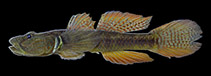
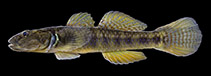
Tandikan goby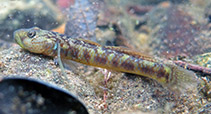
Klassifizierung / Names Namen | Synonyme | Catalog of Fishes(Gattung, Arten) | ITIS | CoL | WoRMS | Cloffa
> Gobiiformes (Gobies) > Gobiidae (Gobies) > Gobionellinae
Etymology: Rhinogobius: Greek, rhinos = nose + Latin, gobius = gudgeon (Ref. 45335); tandikan: Named after the local name of Palawan peacock-pheasant, Polyplectron napoleonis Lesson, known as a symbol of Puerto Princesa City and locally known as Tandikan; referring to the blue markings on the body, suggestive of the plumage of the Palawan peacock-pheasant; noun in apposition.
Etymology: Rhinogobius: Greek, rhinos = nose + Latin, gobius = gudgeon (Ref. 45335); tandikan: Named after the local name of Palawan peacock-pheasant, Polyplectron napoleonis Lesson, known as a symbol of Puerto Princesa City and locally known as Tandikan; referring to the blue markings on the body, suggestive of the plumage of the Palawan peacock-pheasant; noun in apposition.
Umwelt: Milieu / Klimazone / Tiefenbereich / Verbreitungsgebiet Ökologie
; süßwasser benthopelagisch. Tropical
Verbreitung Territorien | FAO Gebiete | Ökosysteme | Vorkommen | Punkt Karte | Einführungen | Faunafri
Asia: Philippines.
Größe / Gewicht / Alter
Geschlechtsreife: Lm ? range ? - ? cm
Max length : 4.7 cm SL Männchen/unbestimmt; (Ref. 125663); 4.6 cm SL (female)
Max length : 4.7 cm SL Männchen/unbestimmt; (Ref. 125663); 4.6 cm SL (female)
Kurzbeschreibung Bestimmungsschlüssel | Morphologie | Morphometrie
Rückenflossenstacheln (insgesamt) : 7; Rückenflossenweichstrahlen (insgesamt) : 8; Afterflossenstacheln: 1; Afterflossenweichstrahlen: 8; Wirbelzahl: 26. This species is distinguished by the following characters pectoral fin 16-17 rays; nape and posterior part of occipital region covered by cycloid scales with the scaled area extending anteriorly to around a vertical line through posterior margin of preopercle or a little posterior to this line; longitudinal scales 29-34, predorsal scales 5-13; total vertebrae 26; cephalic sensory pore system usually with B´, C, D(S), E, F, H´, K´, L´, M´, N, and O´, but often lacking one or both side(s) of pore C; cheek with transverse rows of sensory papillae. Colouration: when preserved, the lateral and dorsal sides of body with no mesh-like markings, obscure markings on cheek, and upper half of pectoral fin with dark brown band vertically across proximal part; when fresh, pectoral-fin base with a bright white vertical band reaching near bottom of fin (Ref. 125663).
Cross section: oval.
Cross section: oval.
This species is found only in the Cayulo River which is a small stream (length approximately 4 km including 1 km of an estuary) flowing into Ulugan Bay on South China Sea-side of the island. The stream system is surrounded by mountains of about 200-400 m above sea level. The Cayulo Falls is composed of a series of small waterfalls, located at the middle reaches of this stream and the species was found at both the lower and upper reaches of this waterfall, as well as pools in the middle of the falls. It was abundant in this site with many other goby species, cyprinids, and a jungle perch species (Ref. 125663).
Lebenszyklus und Paarungsverhalten Geschlechtsreife | Fortpflanzung | Ablaichen | Eier | Fruchtbarkeit | Larven
Hauptreferenz
Laden Sie Ihre Referenzen hoch | Referenzen | Koordinator | Partner
Maeda, K., C. Shinzato, R. Koyanagi, T. Kunishima, H. Kobayashi, N. Satoh and H.P. Palla, 2021. Two new species of Rhinogobius (Gobiiformes: Oxudercidae) from Palawan, Philippines, with their phylogenetic placement. Zootaxa 5068(1):81-98. (Ref. 125663)
CITES
Not Evaluated
Bedrohung für Menschen
Harmless
Nutzung durch Menschen
Fischereien: nicht kommerziell
FAO - Publication: search | FishSource |
Mehr Information
Trophische Ökologie
Lebensmittel (Beutetiere)
Nahrungszusammensetzung
Nahrungsaufnahme
Lebensmittelrationen
Räuber
Lebensmittel (Beutetiere)
Nahrungszusammensetzung
Nahrungsaufnahme
Lebensmittelrationen
Räuber
Ökologie
Ökologie
Ökologie
Populationsdynamik
Wachstumsparameter
Max. Alter/Größen
Länge-Gewicht-Rel.
Länge-Länge-Verhältnis.
Längenhäufigkeiten
Massenkonvertierung
Rekrutierung
Dichte
Wachstumsparameter
Max. Alter/Größen
Länge-Gewicht-Rel.
Länge-Länge-Verhältnis.
Längenhäufigkeiten
Massenkonvertierung
Rekrutierung
Dichte
Lebenszyklus
Fortpflanzung
Geschlechtsreife
Reifung/Kiemen rel.
Fruchtbarkeit
Ablaichen
Laichaggregationen
Eier
Eientwicklung
Larven
Larven Pop.Dyn.
Fortpflanzung
Geschlechtsreife
Reifung/Kiemen rel.
Fruchtbarkeit
Ablaichen
Laichaggregationen
Eier
Eientwicklung
Larven
Larven Pop.Dyn.
Anatomie
Kiemenoberfläche
Gehirn
Otolith
Kiemenoberfläche
Gehirn
Otolith
Physiologie
Körperliche Zusammensetzung
Nährstoffe
Sauerstoffverbrauch
Schwimmart
Schwimmgeschwindigkeit
Visuelle Pigmente
Fischgeräusche
Krankheiten und Parasiten
Toxizität (LC50s)
Körperliche Zusammensetzung
Nährstoffe
Sauerstoffverbrauch
Schwimmart
Schwimmgeschwindigkeit
Visuelle Pigmente
Fischgeräusche
Krankheiten und Parasiten
Toxizität (LC50s)
Genetik
Genom
Genetik
Heterozygotie
Vererbbarkeit
Genetische Vielfalt
Genom
Genetik
Heterozygotie
Vererbbarkeit
Genetische Vielfalt
Menschenbezogen
Aquakultur-Systeme
Aquakultur Profile
Zuchtlinien
Ciguatera-Fälle
Briefmarken, Münzen, Verschiedenes.
Aquakultur-Systeme
Aquakultur Profile
Zuchtlinien
Ciguatera-Fälle
Briefmarken, Münzen, Verschiedenes.
Tools
Zusatzinformationen
Download XML
Zusammenfassung | Punktdaten | Namen | Photos
Internet Quellen
AFORO (otoliths) | Aquatic Commons | BHL | Cloffa | Websites from users | FishWatcher Einträge suchen | CISTI | Catalog of Fishes: Gattung, Arten | DiscoverLife | ECOTOX | FAO - Publication: search | Faunafri | Fishipedia | Fishtrace | GloBI | Google Books | Google Scholar | Google | IGFA World Record | OneZoom | Open Tree of Life | Otolith Atlas of Taiwan Fishes | PubMed | Reef Life Survey | Socotra Atlas | TreeBase | Tree of Life | Wikipedia: Gehe zu, Suchen | World Records Freshwater Fishing | Zoobank | Zoologischer Rekord
Schätzungen auf der Grundlage von Modellen
Phylogenetischer Diversitätsindex (Ref. 82804): PD50 = 0.5000 [Uniqueness, from 0.5 = low to 2.0 = high].
Bayesian length-weight: a=0.00813 (0.00356 - 0.01856), b=3.08 (2.91 - 3.25), in cm total length, based on LWR estimates for this Genus-body shape (Ref. 93245).
Trophische Ebene (Ref. 69278): 3.2 ±0.4 se; based on size and trophs of closest relatives
Widerstandsfähigkeit (Ref. 120179): hoch, Verdopplung der Population dauert weniger als 15 Monate. (Preliminary K or Fecundity.).