



Mollisquama mississippiensis Grace, Doosey, Denton, Naylor, Bart & Maisey, 2019
American pocket shark
Envoyez vos Photos et vidéos
Images Google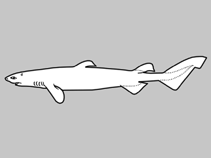 No image available for this species;
drawing shows typical species in Dalatiidae.
Images Google
drawing shows typical species in Dalatiidae.
Classification / Noms Noms communs | Synonymes | Catalog of Fishes(Genre, Espèce) | ITIS | CoL | WoRMS | Cloffa
Élasmobranches (requins et raies) (sharks and rays) > Squaliformes (Sleeper and dogfish sharks) > Dalatiidae (Sleeper sharks)
Etymology: Mollisquama: mollis (L.), soft; squama (L.), scale, referring to its soft scales, apparently unique among sharks (See ETYFish); mississippiensis: -ensis, Latin suffix denoting place: the “vast” North American Mississippi River Basin, a “biologically and geographically rich region that nurtures Gulf of Mexico [type locality] fauna and unites diverse cultures” (See ETYFish).
Etymology: Mollisquama: mollis (L.), soft; squama (L.), scale, referring to its soft scales, apparently unique among sharks (See ETYFish); mississippiensis: -ensis, Latin suffix denoting place: the “vast” North American Mississippi River Basin, a “biologically and geographically rich region that nurtures Gulf of Mexico [type locality] fauna and unites diverse cultures” (See ETYFish).
Taxonomic Remarks
Previously identified as Mollisquama parini Dolganov, 1984.
Environnement : milieu / zone climatique / profondeur / gamme de distribution Écologie
marin bathypélagique. Deep-water
Distribution Territoires | Zones FAO | Écosystèmes | Occurrences | Carte par point | Introductions | Faunafri
Western Central Atlantic: Gulf of Mexico.
Taille / Poids / Âge
Description synthétique Clés d'identification | Morphologie | Morphométrie
This species is distinguished from its congeners by the following characters: a putative pit organ centrally placed just posterior to the lower jaw margin; photophores are irregularly distributed along many areas of the body; with a series of 16 ventral-abdominal photophore aggregations; upper teeth no labial-surface ridge (vs. present in M. parini); lower teeth with a weak or absent basal sulcus (vs. deep sulcus in M. parini) (Ref. 121924).
Cross section: circular.
Cross section: circular.
This species was collected with a midwater trawl during a cetacean research project to assess predator/prey trophodynamics for sperm whales (Physeter macrocephalus) of the Gulf of Mexico. Trawl fishing depths were from 5 m of surface to a maximum trawl fishing depth of 580 m over 3,038 m bottom depth; with the sea bottom relatively flat abyssal plain without significant bathymetric features. Environmental sampling conducted within 10 nautical miles of the trawl location with surface/maximum trawling depth environmental data; temperature 21.5°C/7.2°C, oxygen saturation 6.6 mg/l/ 4.0 mg/l, and salinity 36.5 psu/34.9 psu. Other fauna were captured including 44 species identified to lowest taxon (3.3 kg total catch weight, 731 specimens); 29 finfish taxa, 15 invertebrate taxa. Collection locations of M. mississippiensis captured above an abyssal plain 3,038 m depth is influenced by the relatively warm Gulf Stream while M. parini captured above an extensive seamount ridge 330 m depth is influenced by the relatively cold sub-Antarctic Humboldt Current (Ref. 121924).
Cycle de vie et comportement reproducteur Maturité | Reproduction | Frai | Œufs | Fécondité | Larves
Référence principale
Téléchargez vos références | Références | Coordinateur : Compagno, Leonard J.V. | Collaborateurs
Grace, M.A., M.H. Doosey, J.S. Denton, G.J.P. Naylor, H.L. Bart Jr. and J.G. Maisey, 2019. A new Western North Atlantic Ocean kitefin shark (Squaliformes: Dalatiidae) from the Gulf of Mexico. Zootaxa 4619(1):109-120. (Ref. 121924)
Statut dans la liste rouge de l'IUCN (Ref. 130435: Version 2025-2 (Global))
Préoccupation mineure (LC) ; Date assessed: 21 June 2019
CITES
Not Evaluated
Menace pour l'homme
Harmless
Utilisations par l'homme
FAO - Publication: search | FishSource |
Plus d'informations
Écologie trophique
Aliments (proies)
Composition du régime alimentaire
Consommation alimentaire
Rations alimentaires
Prédateurs
Aliments (proies)
Composition du régime alimentaire
Consommation alimentaire
Rations alimentaires
Prédateurs
Écologie
Écologie
Écologie
Dynamique des populations
Paramètres de croissance
Âges / tailles maximales
Longueur-poids rel.
Rel. longueur-longueur.
Fréquences de longueurs
Conversion de masse
Recrutement
Abondance
Paramètres de croissance
Âges / tailles maximales
Longueur-poids rel.
Rel. longueur-longueur.
Fréquences de longueurs
Conversion de masse
Recrutement
Abondance
Cycle de vie
Reproduction
Maturité
Maturité/épines rel.
Fécondité
Frai
Agrégats de frai
Œufs
Développement de l'œuf
Larves
Dynamique des populations larvaires
Reproduction
Maturité
Maturité/épines rel.
Fécondité
Frai
Agrégats de frai
Œufs
Développement de l'œuf
Larves
Dynamique des populations larvaires
Anatomie
Surface branchiale
Cerveau
Otolithe
Surface branchiale
Cerveau
Otolithe
Physiologie
Composition corporelle
Nutriments
Consommation d'oxygène
Type de natation
Vitesse de nage
Pigments visuels
Son de poisson
Maladies et parasites
Toxicité (CL50)
Composition corporelle
Nutriments
Consommation d'oxygène
Type de natation
Vitesse de nage
Pigments visuels
Son de poisson
Maladies et parasites
Toxicité (CL50)
Génétique
génôme
Génétique
Hétérozygotie
Héritabilité
Diversité génétique
génôme
Génétique
Hétérozygotie
Héritabilité
Diversité génétique
Liées à l'homme
Systèmes d'aquaculture
Profils d'aquaculture
Souches
Cas de ciguatera
Timbres, pièces de monnaie, divers
Systèmes d'aquaculture
Profils d'aquaculture
Souches
Cas de ciguatera
Timbres, pièces de monnaie, divers
Outils
E-book | Guide de terrain | Générateur de fréquences de longueur | Outil de dynamique de population | Carte par point |
Capture-MSY |
Articles particuliers
Télécharger en XML
Sources Internet
AFORO (otoliths) | Aquatic Commons | BHL | Cloffa | Websites from users | FishWatcher | CISTI | Catalog of Fishes: Genre, Espèce | DiscoverLife | ECOTOX | FAO - Publication: search | Faunafri | Fishipedia | Fishtrace | GloBI | Google Books | Google Scholar | Google | IGFA World Record | OneZoom | Open Tree of Life | Otolith Atlas of Taiwan Fishes | PubMed | Reef Life Survey | Socotra Atlas | TreeBase | Arbre de Vie | Wikipedia: aller à, chercher | World Records Freshwater Fishing | Zoobank | Zoological Record
Estimations basées sur des modèles
Indice de diversité phylogénétique (Réf. 82804): PD50 = 0.7510 [Uniqueness, from 0.5 = low to 2.0 = high].
Bayesian length-weight: a=0.00309 (0.00143 - 0.00669), b=3.14 (2.94 - 3.34), in cm total length, based on LWR estimates for this (Sub)family-body shape (Ref. 93245).
Niveau trophique (Réf. 69278): 3.8 ±0.3 se; based on size and trophs of closest relatives
Résilience (Réf. 120179): Haut, temps minimum de doublement de population inférieur à 15 mois (Preliminary K or Fecundity.).