



Hylopanchax thysi Bragança, van der Zee, Sonnenberg & Vreven, 2020
Uploaden van uw Foto's en video's
Afbeeldingen | Google afbeelding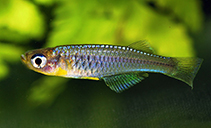 Hylopanchax thysi
Male Afbeelding van Chirio, L.
Afbeeldingen | Google afbeelding
Male Afbeelding van Chirio, L.
Classificatie / Namen Lokale namen | Synoniemen | Catalog of Fishes(Genus, Soort(en)) | ITIS | CoL | WoRMS | Cloffa
> Cyprinodontiformes (Rivulines, killifishes and live bearers) > Procatopodidae (African lampeyes) > Procatopodinae
Etymology: Hylopanchax: Greek, hylo, hyle = material, wood + Panchax, a word created by Meinken in 1932; thysi: The name thysi is in honour of Dirk Thys van den Audenaerde in recognition of his outstanding contributions to our knowledge on African ichthyology as well as for the many expeditions and resulting collections he made in Africa (Ref. 123864).
Eponymy: Professor Dr Dirk Frans Elisabeth Thys van den Audenerde (d: 1934) is a Belgian ichthyologist and Museum Director. [...] (Ref. 128868), visit book page.
Etymology: Hylopanchax: Greek, hylo, hyle = material, wood + Panchax, a word created by Meinken in 1932; thysi: The name thysi is in honour of Dirk Thys van den Audenaerde in recognition of his outstanding contributions to our knowledge on African ichthyology as well as for the many expeditions and resulting collections he made in Africa (Ref. 123864).
Eponymy: Professor Dr Dirk Frans Elisabeth Thys van den Audenerde (d: 1934) is a Belgian ichthyologist and Museum Director. [...] (Ref. 128868), visit book page.
Milieu: milieu / Klimaatzone / Diepte / verspreidingsgebied Ecologie
; zoet water pelagisch. Tropical
Verspreiding Gebieden | FAO regio's | Ecosystemen | Voorkomen | Verspreidingskaart | Introducties | Faunafri
Africa: Ivindo River drainage, a right-bank affluent of the Ogowe River basin, in Gabon (Ref. 123864).
Grootte / Gewicht / Leeftijd
Maturiteit: Lm ? range ? - ? cm
Max length : 2.3 cm SL mannelijk / geslacht onbekend; (Ref. 123864); 1.9 cm SL (female)
Max length : 2.3 cm SL mannelijk / geslacht onbekend; (Ref. 123864); 1.9 cm SL (female)
Korte beschrijving Determinatiesleutels | Morfologie | Morfometrie
Dorsale stekels (totaal) : 0; Dorsale zachte stralen (totaal) : 7 - 8; Anale stekels: 0; Anale zachte stralen: 15 - 17; Wervels: 30. Diagnosis: Hylopanchax thysi is distinguished from all other Hylopanchax species, except H. paucisquamatus, by the presence of 30 vertebrae vs. 31-33 (Ref. 123864). It is further distinguished from H. paucisquamatus and all congeners except H. multisquamatus by the presence of a hyaline urogenital male papilla with small black spots vs. black, and the presence of a conspicuous reticulate pattern in the flank of both males and females vs. absence or less conspicuous; finally, H. thysi is distinguished from H. multisquamatus by a male caudal peduncle depth-length ratio between 53-59% vs. 40-45%, 24-26 scales in the midlongitudinal series vs. 27-30, 13-14 pectoral-fin rays vs. 11-12, body depth 25.2-27.8% of standard length vs. 20.0-23.7%, female predorsal length between 62.0-64.0% of standard length vs. 66.0-74.8%, and female prepelvic length of 33.7-38.0% of standard length vs. 42.1-45.1% (Ref. 123864).
Cross section: compressed.
Cross section: compressed.
Found in shallow creeks (Ref. 123864).
Levenscyclus en paargedrag Maturiteit | Voortplanting | Paaien | Eieren | Fecunditeit | Larven
Hoofdreferentie
Upload uw referenties | Referenties | Coördinator | Medewerkers
Bragança, P.H.N., J.R. van der Zee, R. Sonnenberg and E.J.W.M.N. Vreven, 2021. Description of two new miniature species of Hylopanchax Poll & Lambert, 1965 (Cypriniformes: Procatopodidae) from northeastern Gabon, with an updated diagnosis of the genus based on morphology, colouration and osteology. J. Fish Biol. 98(3):655-667. (Ref. 123864)
CITES
Not Evaluated
Gevaar voor de mens
Harmless
Gebruik door de mens
FAO - Publication: search | FishSource |
Meer informatie
Trofische ecologie
Voedsel (prooien)
Dieetsamenstelling
Voedselconsumptie
Voedselrantsoenen
Predatoren
Voedsel (prooien)
Dieetsamenstelling
Voedselconsumptie
Voedselrantsoenen
Predatoren
Ecologie
Ecologie
Ecologie
Populatiedynamica
Groeiparameters
Max. leeftijden / maten
Lengte-gewicht rel.
Lengte-lengte rel.
Lengtefrequenties
Massaconversie
Rekrutering
Abundantie
Groeiparameters
Max. leeftijden / maten
Lengte-gewicht rel.
Lengte-lengte rel.
Lengtefrequenties
Massaconversie
Rekrutering
Abundantie
Levenscyclus
Voortplanting
Maturiteit
Rijpheid/kieuwen rel.
Fecunditeit
Paaien
Paaibestanden
Eieren
Ontwikkeling van de eieren
Larven
Larvale populatiedynamiek
Voortplanting
Maturiteit
Rijpheid/kieuwen rel.
Fecunditeit
Paaien
Paaibestanden
Eieren
Ontwikkeling van de eieren
Larven
Larvale populatiedynamiek
Anatomie
Kieuwoppervlak
Hersenen
Otoliet
Kieuwoppervlak
Hersenen
Otoliet
Fysiologie
Lichaamssamenstelling
Voedingsstoffen
Zuurstofverbruik
Type zwemmen
Zwemsnelheid
Visuele pigmenten
Vis geluid
Ziekten en parasieten
Toxiciteit (LC50)
Lichaamssamenstelling
Voedingsstoffen
Zuurstofverbruik
Type zwemmen
Zwemsnelheid
Visuele pigmenten
Vis geluid
Ziekten en parasieten
Toxiciteit (LC50)
Genetica
genoom
Genetica
Heterozygositeit
Erfelijkheid
Genetische diversiteit
genoom
Genetica
Heterozygositeit
Erfelijkheid
Genetische diversiteit
Menselijk gerelateerd
Aquacultuursystemen
Aquacultuurprofielen
Kweeklijnen
Ciguatera gevallen
Postzegels, munten, diversen.
Aquacultuursystemen
Aquacultuurprofielen
Kweeklijnen
Ciguatera gevallen
Postzegels, munten, diversen.
Tools
Speciale rapporten
Bekijk gegevens voor het houden in een aquarium | Bekijk Fact Sheets voor de soort | Bekijk Aquacultuur Fact Sheets
Download XML
Internetbronnen
AFORO (otoliths) | Aquatic Commons | BHL | Cloffa | Websites from users | Bekijk FishWatcher | CISTI | Catalog of Fishes: Genus, Soort(en) | DiscoverLife | ECOTOX | FAO - Publication: search | Faunafri | Fishipedia | Fishtrace | GloBI | Google Books | Google Scholar | Google | IGFA World Record | OneZoom | Open Tree of Life | Otolith Atlas of Taiwan Fishes | PubMed | Reef Life Survey | Socotra Atlas | TreeBase | Tree of Life | Wikipedia: ga naar, zoek | World Records Freshwater Fishing | Zoobank | Zoological Record
Schattingen op basis van modellen
Fylogenetische diversiteitsindex (Ref. 82804): PD50 = 0.5039 [Uniqueness, from 0.5 = low to 2.0 = high].
Bayesian length-weight: a=0.01122 (0.00514 - 0.02450), b=3.04 (2.87 - 3.21), in cm total length, based on all LWR estimates for this body shape (Ref. 93245).
Trofisch niveau (Ref. 69278): 3.1 ±0.4 se; based on size and trophs of closest relatives