



Hylopanchax multisquamatus Bragança, van der Zee, Sonnenberg & Vreven, 2020
Hochladen Photos und videos
Bilder | Google Bild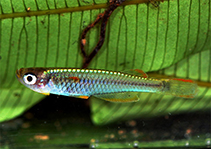 Hylopanchax multisquamatus
Male Photo von Chirio, L.
Bilder | Google Bild
Male Photo von Chirio, L.
Klassifizierung / Names Namen | Synonyme | Catalog of Fishes(Gattung, Arten) | ITIS | CoL | WoRMS | Cloffa
> Cyprinodontiformes (Rivulines, killifishes and live bearers) > Procatopodidae (African lampeyes) > Procatopodinae
Etymology: Hylopanchax: Greek, hylo, hyle = material, wood + Panchax, a word created by Meinken in 1932; multisquamatus: The name is derived from the Latin term multi meaning 'many' and squama meaning 'scale' and refers to the high number in mid-longitudinal scales (Ref. 123864).
Etymology: Hylopanchax: Greek, hylo, hyle = material, wood + Panchax, a word created by Meinken in 1932; multisquamatus: The name is derived from the Latin term multi meaning 'many' and squama meaning 'scale' and refers to the high number in mid-longitudinal scales (Ref. 123864).
Umwelt: Milieu / Klimazone / Tiefenbereich / Verbreitungsgebiet Ökologie
; süßwasser pelagisch. Tropical
Verbreitung Territorien | FAO Gebiete | Ökosysteme | Vorkommen | Punkt Karte | Einführungen | Faunafri
Africa: tributaries of the Ivindo River drainage, a right-bank affluent of the Ogowe River basin, in Gabon (Ref. 123864).
Größe / Gewicht / Alter
Geschlechtsreife: Lm ? range ? - ? cm
Max length : 2.3 cm SL Männchen/unbestimmt; (Ref. 123864); 2.1 cm SL (female)
Max length : 2.3 cm SL Männchen/unbestimmt; (Ref. 123864); 2.1 cm SL (female)
Kurzbeschreibung Bestimmungsschlüssel | Morphologie | Morphometrie
Rückenflossenstacheln (insgesamt) : 0; Rückenflossenweichstrahlen (insgesamt) : 7 - 8; Afterflossenstacheln: 0; Afterflossenweichstrahlen: 13 - 16; Wirbelzahl: 31 - 32. Diagnosis: Hylopanchax multisquamatus is distinguished from its congeners by the presence of more scales along the mid-longitudinal series of scales, 27-30 vs. 19-26, and by the possession of an anterior/posterior flank scale height ration, 140%-150% vs. 170%-220% (Ref. 123864). It is distinguished from H. stictopleuron by the number of scales in transversal row, 6 vs. 5; in addition, H. multisquamatus is distinguished from congeners except Hylopanchax thysi, by the presence of a hyaline urogenital male papilla with small black spots in preserved specimens vs. black, and by the presence of a dark-brown reticulate pattern on the flank of both males and females vs. absence or less-conspicuous pattern; finally, H. multisquamatus is distinguished from H. thysi by the presence of 11-12 pectoral-fin rays vs. 13-14, a male caudal peduncle depth-length ratio between 40-45% vs. 53-59%, a body depth of 20.0-23.7% of standard length vs. 25.2-27.8%, a female predorsal length between 66.0-74.8% of standard length vs. 62.0-64.0%, and a female prepelvic length of 42.1-45.1% of standard length vs. 33.7-38.0% (Ref. 123864).
Cross section: compressed.
Cross section: compressed.
This species inhabits shallow creeks inside dense forest areas (Ref. 123864).
Lebenszyklus und Paarungsverhalten Geschlechtsreife | Fortpflanzung | Ablaichen | Eier | Fruchtbarkeit | Larven
Hauptreferenz
Laden Sie Ihre Referenzen hoch | Referenzen | Koordinator | Partner
Bragança, P.H.N., J.R. van der Zee, R. Sonnenberg and E.J.W.M.N. Vreven, 2021. Description of two new miniature species of Hylopanchax Poll & Lambert, 1965 (Cypriniformes: Procatopodidae) from northeastern Gabon, with an updated diagnosis of the genus based on morphology, colouration and osteology. J. Fish Biol. 98(3):655-667. (Ref. 123864)
CITES
Not Evaluated
Bedrohung für Menschen
Harmless
Nutzung durch Menschen
FAO - Publication: search | FishSource |
Mehr Information
Trophische Ökologie
Lebensmittel (Beutetiere)
Nahrungszusammensetzung
Nahrungsaufnahme
Lebensmittelrationen
Räuber
Lebensmittel (Beutetiere)
Nahrungszusammensetzung
Nahrungsaufnahme
Lebensmittelrationen
Räuber
Populationsdynamik
Wachstumsparameter
Max. Alter/Größen
Länge-Gewicht-Rel.
Länge-Länge-Verhältnis.
Längenhäufigkeiten
Massenkonvertierung
Rekrutierung
Dichte
Wachstumsparameter
Max. Alter/Größen
Länge-Gewicht-Rel.
Länge-Länge-Verhältnis.
Längenhäufigkeiten
Massenkonvertierung
Rekrutierung
Dichte
Lebenszyklus
Fortpflanzung
Geschlechtsreife
Reifung/Kiemen rel.
Fruchtbarkeit
Ablaichen
Laichaggregationen
Eier
Eientwicklung
Larven
Larven Pop.Dyn.
Fortpflanzung
Geschlechtsreife
Reifung/Kiemen rel.
Fruchtbarkeit
Ablaichen
Laichaggregationen
Eier
Eientwicklung
Larven
Larven Pop.Dyn.
Anatomie
Kiemenoberfläche
Gehirn
Otolith
Kiemenoberfläche
Gehirn
Otolith
Physiologie
Körperliche Zusammensetzung
Nährstoffe
Sauerstoffverbrauch
Schwimmart
Schwimmgeschwindigkeit
Visuelle Pigmente
Fischgeräusche
Krankheiten und Parasiten
Toxizität (LC50s)
Körperliche Zusammensetzung
Nährstoffe
Sauerstoffverbrauch
Schwimmart
Schwimmgeschwindigkeit
Visuelle Pigmente
Fischgeräusche
Krankheiten und Parasiten
Toxizität (LC50s)
Genetik
Genom
Genetik
Heterozygotie
Vererbbarkeit
Genetische Vielfalt
Genom
Genetik
Heterozygotie
Vererbbarkeit
Genetische Vielfalt
Menschenbezogen
Aquakultur-Systeme
Aquakultur Profile
Zuchtlinien
Ciguatera-Fälle
Briefmarken, Münzen, Verschiedenes.
Aquakultur-Systeme
Aquakultur Profile
Zuchtlinien
Ciguatera-Fälle
Briefmarken, Münzen, Verschiedenes.
Tools
Zusatzinformationen
Download XML
Zusammenfassung | Punktdaten | Namen | Photos
Internet Quellen
AFORO (otoliths) | Aquatic Commons | BHL | Cloffa | Websites from users | FishWatcher Einträge suchen | CISTI | Catalog of Fishes: Gattung, Arten | DiscoverLife | ECOTOX | FAO - Publication: search | Faunafri | Fishipedia | Fishtrace | GloBI | Google Books | Google Scholar | Google | IGFA World Record | OneZoom | Open Tree of Life | Otolith Atlas of Taiwan Fishes | PubMed | Reef Life Survey | Socotra Atlas | TreeBase | Tree of Life | Wikipedia: Gehe zu, Suchen | World Records Freshwater Fishing | Zoobank | Zoologischer Rekord
Schätzungen auf der Grundlage von Modellen
Phylogenetischer Diversitätsindex (Ref. 82804): PD50 = 0.5039 [Uniqueness, from 0.5 = low to 2.0 = high].
Bayesian length-weight: a=0.01122 (0.00514 - 0.02450), b=3.04 (2.87 - 3.21), in cm total length, based on all LWR estimates for this body shape (Ref. 93245).
Trophische Ebene (Ref. 69278): 3.1 ±0.4 se; based on size and trophs of closest relatives