



Mustelus andamanensis White, Arunrugstichai & Naylor, 2021
Andaman smoothhound
Uploaden van uw Foto's en video's
Google afbeelding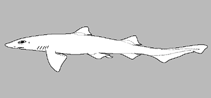 No image available for this species;
drawing shows typical species in Triakidae.
Google afbeelding
drawing shows typical species in Triakidae.
Classificatie / Namen Lokale namen | Synoniemen | Catalog of Fishes(Genus, Soort(en)) | ITIS | CoL | WoRMS | Cloffa
Elasmobranchii (haaien en roggen) (sharks and rays) > Carcharhiniformes (Ground sharks) > Triakidae (Houndsharks) > Triakinae
Etymology: Mustelus: Latin for weasel, an ancient name for sharks, possibly referring to the pointed snouts, swift movements and/or rapacious feeding behavior of smaller predatory sharks [strictly not tautonymous with Squalus mustelus Linnaeus 1758 since type was designated by the ICZN] (See ETYFish); andamanensis: -ensis, Latin suffix denoting place: Andaman Sea, Thailand, only known area of occurrence (See ETYFish).
Etymology: Mustelus: Latin for weasel, an ancient name for sharks, possibly referring to the pointed snouts, swift movements and/or rapacious feeding behavior of smaller predatory sharks [strictly not tautonymous with Squalus mustelus Linnaeus 1758 since type was designated by the ICZN] (See ETYFish); andamanensis: -ensis, Latin suffix denoting place: Andaman Sea, Thailand, only known area of occurrence (See ETYFish).
Milieu: milieu / Klimaatzone / Diepte / verspreidingsgebied Ecologie
marien benthopelagisch; diepte 50 - 100 m (Ref. 124465). Tropical
Verspreiding Gebieden | FAO regio's | Ecosystemen | Voorkomen | Verspreidingskaart | Introducties | Faunafri
Eastern Indian Ocean: Andaman Sea: Myanmar and Thailand.
Grootte / Gewicht / Leeftijd
Maturiteit: Lm ? range ? - ? cm
Max length : 104 cm TL mannelijk / geslacht onbekend; (Ref. 124465); 108.5 cm TL (female)
Max length : 104 cm TL mannelijk / geslacht onbekend; (Ref. 124465); 108.5 cm TL (female)
Korte beschrijving Determinatiesleutels | Morfologie | Morfometrie
This species is distinguished by the following set of characters: palatine processes of palatoquadrates subdivided near the symphysis with a short, separate medial segment on each side; pre-second dorsal length 55.5-57.9% TL; upper labial furrows are shorter than lower ones, the uppers 0.7-1.1% TL and 0.6-0.9 times lowers; buccopharyngeal denticles cover most of the tongue and roof of mouth to about the third or fourth gill arch; no hypercalcification of skeletal elements, but no adult specimens examined; dorsal fins moderately large, upright with first dorsal-fin anterior margin 13.9-15.8% TL, height 9.2-10.1% TL; teeth in 69-80/64-73 files; precaudal vertebral centra 87-91, monospondylous centra 33-39; no small white spots on dorsal surface of body, including along lateral line; first dorsal fin without a white margin, the upper half dusky to blackish; second dorsal fin blackish distally; caudal fin with a narrow white margin and a distinct black tip on terminal caudal lobe (Ref. 124465).
Cross section: angular.
Cross section: angular.
Specimens 37.6-71.7 cm TL were all found to be immature (Ref. 124465).
Levenscyclus en paargedrag Maturiteit | Voortplanting | Paaien | Eieren | Fecunditeit | Larven
Hoofdreferentie
Upload uw referenties | Referenties | Coördinator : Compagno, Leonard J.V. | Medewerkers
White, W.T., S. Arunrugstichai and G.J.P. Naylor, 2021. Revision of the genus Mustelus (Carcharhiniformes: Triakidae) in the northern Indian Ocean, with description of a new species and a discussion on the validity of M. walkeri and M. ravidus. Mar. Biodiversity 51(42):1-24. (Ref. 124465)
Status op de Rode Lijst van het IUCN (Ref. 130435: Version 2025-2 (Global))
Kwetsbaar (VU) (A2d); Date assessed: 21 March 2022
CITES
Not Evaluated
Gevaar voor de mens
Harmless
Gebruik door de mens
FAO - Publication: search | FishSource |
Meer informatie
Trofische ecologie
Voedsel (prooien)
Dieetsamenstelling
Voedselconsumptie
Voedselrantsoenen
Predatoren
Voedsel (prooien)
Dieetsamenstelling
Voedselconsumptie
Voedselrantsoenen
Predatoren
Ecologie
Ecologie
Ecologie
Populatiedynamica
Groeiparameters
Max. leeftijden / maten
Lengte-gewicht rel.
Lengte-lengte rel.
Lengtefrequenties
Massaconversie
Rekrutering
Abundantie
Groeiparameters
Max. leeftijden / maten
Lengte-gewicht rel.
Lengte-lengte rel.
Lengtefrequenties
Massaconversie
Rekrutering
Abundantie
Levenscyclus
Voortplanting
Maturiteit
Rijpheid/kieuwen rel.
Fecunditeit
Paaien
Paaibestanden
Eieren
Ontwikkeling van de eieren
Larven
Larvale populatiedynamiek
Voortplanting
Maturiteit
Rijpheid/kieuwen rel.
Fecunditeit
Paaien
Paaibestanden
Eieren
Ontwikkeling van de eieren
Larven
Larvale populatiedynamiek
Anatomie
Kieuwoppervlak
Hersenen
Otoliet
Kieuwoppervlak
Hersenen
Otoliet
Fysiologie
Lichaamssamenstelling
Voedingsstoffen
Zuurstofverbruik
Type zwemmen
Zwemsnelheid
Visuele pigmenten
Vis geluid
Ziekten en parasieten
Toxiciteit (LC50)
Lichaamssamenstelling
Voedingsstoffen
Zuurstofverbruik
Type zwemmen
Zwemsnelheid
Visuele pigmenten
Vis geluid
Ziekten en parasieten
Toxiciteit (LC50)
Genetica
genoom
Genetica
Heterozygositeit
Erfelijkheid
Genetische diversiteit
genoom
Genetica
Heterozygositeit
Erfelijkheid
Genetische diversiteit
Menselijk gerelateerd
Aquacultuursystemen
Aquacultuurprofielen
Kweeklijnen
Ciguatera gevallen
Postzegels, munten, diversen.
Aquacultuursystemen
Aquacultuurprofielen
Kweeklijnen
Ciguatera gevallen
Postzegels, munten, diversen.
Tools
Speciale rapporten
Bekijk gegevens voor het houden in een aquarium | Bekijk Fact Sheets voor de soort | Bekijk Aquacultuur Fact Sheets
Download XML
Internetbronnen
AFORO (otoliths) | Aquatic Commons | BHL | Cloffa | Websites from users | Bekijk FishWatcher | CISTI | Catalog of Fishes: Genus, Soort(en) | DiscoverLife | ECOTOX | FAO - Publication: search | Faunafri | Fishipedia | Fishtrace | GloBI | Google Books | Google Scholar | Google | IGFA World Record | OneZoom | Open Tree of Life | Otolith Atlas of Taiwan Fishes | PubMed | Reef Life Survey | Socotra Atlas | TreeBase | Tree of Life | Wikipedia: ga naar, zoek | World Records Freshwater Fishing | Zoobank | Zoological Record
Schattingen op basis van modellen
Fylogenetische diversiteitsindex (Ref. 82804): PD50 = 0.5000 [Uniqueness, from 0.5 = low to 2.0 = high].
Bayesian length-weight: a=0.00229 (0.00107 - 0.00491), b=3.14 (2.97 - 3.31), in cm total length, based on LWR estimates for this Genus-body shape (Ref. 93245).
Trofisch niveau (Ref. 69278): 3.6 ±0.4 se; based on size and trophs of closest relatives
Weerstandsvermogen (Ref. 120179): Gemiddeld, minimale populatieverdubbelingstijd 1,4-4,4 jaar (Preliminary K or Fecundity.).