



Envoyez vos Photos et vidéos
Images Google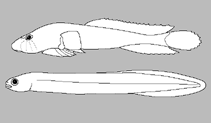 No image available for this species;
drawing shows typical species in Gobiesocidae.
Images Google
drawing shows typical species in Gobiesocidae.
Classification / Noms Noms communs | Synonymes | Catalog of Fishes(Genre, Espèce) | ITIS | CoL | WoRMS | Cloffa
> Gobiesociformes (Clingfishes) > Gobiesocidae (Clingfishes and singleslits) > Lepadogastrinae
Etymology: Gouania: From Antoine Gouan, in Montpellier was the author of a "Historia piscium" (Ref. 45335).
Eponymy: Dr Antoine Gouan (1733–1821) was a French naturalist, a pioneer of Linnaean taxonomy in France, who was born and lived in Montpellier. [...] (Ref. 128868), visit book page.
Etymology: Gouania: From Antoine Gouan, in Montpellier was the author of a "Historia piscium" (Ref. 45335).
Eponymy: Dr Antoine Gouan (1733–1821) was a French naturalist, a pioneer of Linnaean taxonomy in France, who was born and lived in Montpellier. [...] (Ref. 128868), visit book page.
Environnement : milieu / zone climatique / profondeur / gamme de distribution Écologie
marin démersal. Temperate
Distribution Territoires | Zones FAO | Écosystèmes | Occurrences | Carte par point | Introductions | Faunafri
Mediterranean: Adriatic Sea endemic.
Taille / Poids / Âge
Description synthétique Clés d'identification | Morphologie | Morphométrie
Vertèbres: 39 - 40. This species is distinguished from its congeners by the following characters: dorsal head profile in lateral view 'S' curved, concave above the eye and convex at the nape; posterior angle of jaws extends to, or close to, vertical line drawn through anterior edge of anterior nostril; infraorbital invagination below anterior half of eye or below mideye; posterior opercular edge with 2 tips, the upper longer or equal to lower; longitudinal infralateral and suborbital transversal rows of superficial neuromasts located in the well-defined deep groove; body cross-section behind pectoral fin base half oval to pentagonal with a straight ventral side; body granules shallow and inconspicuous; pectoral rays 13-16; upper attachment of disc membrane attached to base of pectoral fin at 12th-15th pectoral ray; principal caudal rays 10-11; head length 19.5-22.9% of SL: pectoral-fin length 5.6-7.5% of SL; prepectoral distance 19.5-23.4% of SL; ventral adhesive disc length, 12.1-14.6% of SL; caudal-fin length 11.1-12.7% of SL; large total number of vertebrae 39-40; pharyngeal jaws with elongated ceratobranchial 5, with several larger elongated conical teeth; nasal bones hook-shaped; star-like pigmentation around eyes absent, pigmentation generally reduced (Ref. 123696).
Cross section: oval.
Cross section: oval.
Inhabits intertidal pebble beaches, where it might be found even above the waterline during low tide, and rarely occurs in fields of larger boulders (Ref. 123696).
Cycle de vie et comportement reproducteur Maturité | Reproduction | Frai | Œufs | Fécondité | Larves
Référence principale
Téléchargez vos références | Références | Coordinateur : Williams, Jeffrey T. | Collaborateurs
Wagner, M., M. Kovačic and S. Koblmüller, 2021. Unravelling the taxonomy of an interstitial fish radiation: Three new species of Gouania (Teleostei: Gobiesocidae) from the Mediterranean Sea and redescriptions of G. willdenowi and G. pigra. J. Fish Biol. 98(1):64-88. (Ref. 123696)
Statut dans la liste rouge de l'IUCN (Ref. 130435: Version 2025-2 (Global))
Vulnérable (VU) (B2ab(iii)); Date assessed: 21 March 2024
CITES
Not Evaluated
Menace pour l'homme
Harmless
Utilisations par l'homme
FAO - Publication: search | FishSource |
Plus d'informations
Écologie trophique
Aliments (proies)
Composition du régime alimentaire
Consommation alimentaire
Rations alimentaires
Prédateurs
Aliments (proies)
Composition du régime alimentaire
Consommation alimentaire
Rations alimentaires
Prédateurs
Écologie
Écologie
Écologie
Dynamique des populations
Paramètres de croissance
Âges / tailles maximales
Longueur-poids rel.
Rel. longueur-longueur.
Fréquences de longueurs
Conversion de masse
Recrutement
Abondance
Paramètres de croissance
Âges / tailles maximales
Longueur-poids rel.
Rel. longueur-longueur.
Fréquences de longueurs
Conversion de masse
Recrutement
Abondance
Cycle de vie
Reproduction
Maturité
Maturité/épines rel.
Fécondité
Frai
Agrégats de frai
Œufs
Développement de l'œuf
Larves
Dynamique des populations larvaires
Reproduction
Maturité
Maturité/épines rel.
Fécondité
Frai
Agrégats de frai
Œufs
Développement de l'œuf
Larves
Dynamique des populations larvaires
Anatomie
Surface branchiale
Cerveau
Otolithe
Surface branchiale
Cerveau
Otolithe
Physiologie
Composition corporelle
Nutriments
Consommation d'oxygène
Type de natation
Vitesse de nage
Pigments visuels
Son de poisson
Maladies et parasites
Toxicité (CL50)
Composition corporelle
Nutriments
Consommation d'oxygène
Type de natation
Vitesse de nage
Pigments visuels
Son de poisson
Maladies et parasites
Toxicité (CL50)
Génétique
génôme
Génétique
Hétérozygotie
Héritabilité
Diversité génétique
génôme
Génétique
Hétérozygotie
Héritabilité
Diversité génétique
Liées à l'homme
Systèmes d'aquaculture
Profils d'aquaculture
Souches
Cas de ciguatera
Timbres, pièces de monnaie, divers
Systèmes d'aquaculture
Profils d'aquaculture
Souches
Cas de ciguatera
Timbres, pièces de monnaie, divers
Outils
E-book | Guide de terrain | Générateur de fréquences de longueur | Outil de dynamique de population | Carte par point |
Capture-MSY |
Articles particuliers
Télécharger en XML
Sources Internet
AFORO (otoliths) | Aquatic Commons | BHL | Cloffa | Websites from users | FishWatcher | CISTI | Catalog of Fishes: Genre, Espèce | DiscoverLife | ECOTOX | FAO - Publication: search | Faunafri | Fishipedia | Fishtrace | GloBI | Google Books | Google Scholar | Google | IGFA World Record | OneZoom | Open Tree of Life | Otolith Atlas of Taiwan Fishes | PubMed | Reef Life Survey | Socotra Atlas | TreeBase | Arbre de Vie | Wikipedia: aller à, chercher | World Records Freshwater Fishing | Zoological Record
Estimations basées sur des modèles
Indice de diversité phylogénétique (Réf. 82804): PD50 = 0.5312 [Uniqueness, from 0.5 = low to 2.0 = high].
Bayesian length-weight: a=0.00513 (0.00200 - 0.01317), b=3.10 (2.88 - 3.32), in cm total length, based on LWR estimates for this (Sub)family-body shape (Ref. 93245).
Niveau trophique (Réf. 69278): 3.1 ±0.5 se; based on size and trophs of closest relatives
Résilience (Réf. 120179): Haut, temps minimum de doublement de population inférieur à 15 mois (Preliminary K or Fecundity.).