



Gouania orientalis Wagner, Kovačić & Koblmüller, 2020
Oriental blunt-snouted clingfish
Hochladen Photos und videos
Google Bild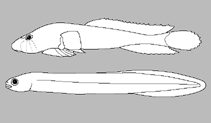 No image available for this species;
drawing shows typical species in Gobiesocidae.
Google Bild
drawing shows typical species in Gobiesocidae.
Klassifizierung / Names Namen | Synonyme | Catalog of Fishes(Gattung, Arten) | ITIS | CoL | WoRMS | Cloffa
> Gobiesociformes (Clingfishes) > Gobiesocidae (Clingfishes and singleslits) > Lepadogastrinae
Etymology: Gouania: From Antoine Gouan, in Montpellier was the author of a "Historia piscium" (Ref. 45335); orientalis: Name from Latin word 'oriens' for 'east', the distribution range of the species. restricted to the oriental Mediterranean basin; an adjective in the nominative singular (Article 11.9.1.1., ICZN, 1999).
Eponymy: Dr Antoine Gouan (1733–1821) was a French naturalist, a pioneer of Linnaean taxonomy in France, who was born and lived in Montpellier. [...] (Ref. 128868), visit book page.
Etymology: Gouania: From Antoine Gouan, in Montpellier was the author of a "Historia piscium" (Ref. 45335); orientalis: Name from Latin word 'oriens' for 'east', the distribution range of the species. restricted to the oriental Mediterranean basin; an adjective in the nominative singular (Article 11.9.1.1., ICZN, 1999).
Eponymy: Dr Antoine Gouan (1733–1821) was a French naturalist, a pioneer of Linnaean taxonomy in France, who was born and lived in Montpellier. [...] (Ref. 128868), visit book page.
Umwelt: Milieu / Klimazone / Tiefenbereich / Verbreitungsgebiet Ökologie
seewasser demersal. Temperate
Verbreitung Territorien | FAO Gebiete | Ökosysteme | Vorkommen | Punkt Karte | Einführungen | Faunafri
Mediterranean: Greece.
Größe / Gewicht / Alter
Kurzbeschreibung Bestimmungsschlüssel | Morphologie | Morphometrie
Wirbelzahl: 35 - 36. This species is distinguished from its congeners by the following set of characters: dorsal head profile straight from nape above eye to upper lip tip; posterior angle of jaws extending to between a vertical line drawn through anterior edge of eye and a vertical line drawn through anterior part of eye; infraorbital invagination vertical to posterior part of eye; posterior opercular edge w-shaped with two equally long tips; longitudinal infralateral and suborbital transversal rows of superficial neuromasts are in the well-defined deep groove; trunk cross-section behind pectoral fin base half oval with straight ventral side; body granules shallow and inconspicuous; upper attachment of gill membrane is opposite to 5th to 6th pectoral ray; pectoral rays 17-19; upper attachment of disc membrane attaching to base of pectoral fin at 16th-18th pectoral ray; principal caudal rays 10-11; head length 25.0-28.9% of SL; pectoral fin length 8.2-10.3% of SL; prepectoral distance 24.7-28.2% of SL; ventral adhesive disc length 14.9-19.0% SL; caudal-fin length 14.2-17.5% of SL; low number of vertebrae 35-36; pharyngeal jaws with small ceratobranchial 5, having a few hardly recognizable small conical teeth; nasal bones with inconspicuous frontal end; in life with star-like pigmentation around eyes, body colouration dark, sometimes marbled or with stripes (Ref. 123696).
Cross section: oval.
Cross section: oval.
Lebenszyklus und Paarungsverhalten Geschlechtsreife | Fortpflanzung | Ablaichen | Eier | Fruchtbarkeit | Larven
Hauptreferenz
Laden Sie Ihre Referenzen hoch | Referenzen | Koordinator : Williams, Jeffrey T. | Partner
Wagner, M., M. Kovačic and S. Koblmüller, 2021. Unravelling the taxonomy of an interstitial fish radiation: Three new species of Gouania (Teleostei: Gobiesocidae) from the Mediterranean Sea and redescriptions of G. willdenowi and G. pigra. J. Fish Biol. 98(1):64-88. (Ref. 123696)
IUCN Rote Liste Status (Ref. 130435: Version 2025-2 (Global))
Daten mangelhaft (DD) ; Date assessed: 21 March 2024
CITES
Not Evaluated
Bedrohung für Menschen
Harmless
Nutzung durch Menschen
FAO - Publication: search | FishSource |
Mehr Information
Trophische Ökologie
Lebensmittel (Beutetiere)
Nahrungszusammensetzung
Nahrungsaufnahme
Lebensmittelrationen
Räuber
Lebensmittel (Beutetiere)
Nahrungszusammensetzung
Nahrungsaufnahme
Lebensmittelrationen
Räuber
Ökologie
Ökologie
Ökologie
Populationsdynamik
Wachstumsparameter
Max. Alter/Größen
Länge-Gewicht-Rel.
Länge-Länge-Verhältnis.
Längenhäufigkeiten
Massenkonvertierung
Rekrutierung
Dichte
Wachstumsparameter
Max. Alter/Größen
Länge-Gewicht-Rel.
Länge-Länge-Verhältnis.
Längenhäufigkeiten
Massenkonvertierung
Rekrutierung
Dichte
Lebenszyklus
Fortpflanzung
Geschlechtsreife
Reifung/Kiemen rel.
Fruchtbarkeit
Ablaichen
Laichaggregationen
Eier
Eientwicklung
Larven
Larven Pop.Dyn.
Fortpflanzung
Geschlechtsreife
Reifung/Kiemen rel.
Fruchtbarkeit
Ablaichen
Laichaggregationen
Eier
Eientwicklung
Larven
Larven Pop.Dyn.
Anatomie
Kiemenoberfläche
Gehirn
Otolith
Kiemenoberfläche
Gehirn
Otolith
Physiologie
Körperliche Zusammensetzung
Nährstoffe
Sauerstoffverbrauch
Schwimmart
Schwimmgeschwindigkeit
Visuelle Pigmente
Fischgeräusche
Krankheiten und Parasiten
Toxizität (LC50s)
Körperliche Zusammensetzung
Nährstoffe
Sauerstoffverbrauch
Schwimmart
Schwimmgeschwindigkeit
Visuelle Pigmente
Fischgeräusche
Krankheiten und Parasiten
Toxizität (LC50s)
Genetik
Genom
Genetik
Heterozygotie
Vererbbarkeit
Genetische Vielfalt
Genom
Genetik
Heterozygotie
Vererbbarkeit
Genetische Vielfalt
Menschenbezogen
Aquakultur-Systeme
Aquakultur Profile
Zuchtlinien
Ciguatera-Fälle
Briefmarken, Münzen, Verschiedenes.
Aquakultur-Systeme
Aquakultur Profile
Zuchtlinien
Ciguatera-Fälle
Briefmarken, Münzen, Verschiedenes.
Tools
Zusatzinformationen
Download XML
Zusammenfassung | Punktdaten | Namen | Photos
Internet Quellen
AFORO (otoliths) | Aquatic Commons | BHL | Cloffa | Websites from users | FishWatcher Einträge suchen | CISTI | Catalog of Fishes: Gattung, Arten | DiscoverLife | ECOTOX | FAO - Publication: search | Faunafri | Fishipedia | Fishtrace | GloBI | Google Books | Google Scholar | Google | IGFA World Record | OneZoom | Open Tree of Life | Otolith Atlas of Taiwan Fishes | PubMed | Reef Life Survey | Socotra Atlas | TreeBase | Tree of Life | Wikipedia: Gehe zu, Suchen | World Records Freshwater Fishing | Zoobank | Zoologischer Rekord
Schätzungen auf der Grundlage von Modellen
Phylogenetischer Diversitätsindex (Ref. 82804): PD50 = 0.5312 [Uniqueness, from 0.5 = low to 2.0 = high].
Bayesian length-weight: a=0.00513 (0.00200 - 0.01317), b=3.10 (2.88 - 3.32), in cm total length, based on LWR estimates for this (Sub)family-body shape (Ref. 93245).
Trophische Ebene (Ref. 69278): 3.1 ±0.5 se; based on size and trophs of closest relatives
Widerstandsfähigkeit (Ref. 120179): hoch, Verdopplung der Population dauert weniger als 15 Monate. (Preliminary K or Fecundity.).