



Galaxias tantangara Raadik, 2014
Stocky Galaxias
Hochladen Photos und videos
Google Bild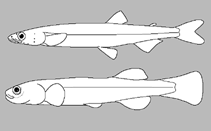 No image available for this species;
drawing shows typical species in Galaxiidae.
Google Bild
drawing shows typical species in Galaxiidae.
Klassifizierung / Names Namen | Synonyme | Catalog of Fishes(Gattung, Arten) | ITIS | CoL | WoRMS | Cloffa
> Galaxiiformes (Southern smelts) > Galaxiidae (Galaxiids) > Galaxiinae
Etymology: Galaxias: Greek, galaxias, ou = a kind of fish (Ref. 45335); tantangara: Named fro its type locality, a small alpine stream, a tributary of the upper Murrumbidgee River draining from Mount Tantangara; noun in apposition.
Etymology: Galaxias: Greek, galaxias, ou = a kind of fish (Ref. 45335); tantangara: Named fro its type locality, a small alpine stream, a tributary of the upper Murrumbidgee River draining from Mount Tantangara; noun in apposition.
Umwelt: Milieu / Klimazone / Tiefenbereich / Verbreitungsgebiet Ökologie
; süßwasser benthopelagisch; standorttreu; tiefenbereich 0 - 1 m (Ref. 98815). Subtropical
Verbreitung Territorien | FAO Gebiete | Ökosysteme | Vorkommen | Punkt Karte | Einführungen | Faunafri
Oceania: Australia.
Größe / Gewicht / Alter
Geschlechtsreife: Lm ? range ? - ? cm
Max length : 10.3 cm FL Männchen/unbestimmt; (Ref. 98815); max. veröff. Gewicht: 13.00 g (Ref. 98815)
Max length : 10.3 cm FL Männchen/unbestimmt; (Ref. 98815); max. veröff. Gewicht: 13.00 g (Ref. 98815)
Kurzbeschreibung Bestimmungsschlüssel | Morphologie | Morphometrie
Rückenflossenweichstrahlen (insgesamt) : 8 - 11; Afterflossenweichstrahlen: 10 - 12; Wirbelzahl: 53 - 56. This species is distinguished from its congeners within the Galaxias olidus complex by the following characters: low mean total gill raker count of 10; body stocky and deep through vent and pectoral fin base (12.6-15.6 and 14.9-17.9 % SL); deep caudal peduncle (8.5-10.2 % SL); head obtuse to slightly bulbous in lateral profile and moderately deep (41.4-48.2 % HL) but wide (63.4-72.8 % HL); gape wide (40.2-51.0 % HL and 59.6-72.2 % HW); eye profiles often not visible laterally from ventral view; nostrils are short, not visible from ventral view; caudal fin weakly emarginate to truncate, about as long or slightly longer than caudal peduncle, vertical width of expanded rays usually equal to body depth through the pectoral fin base; caudal peduncle flanges are long, reaching more than half distance to anal fin base; anal fin long (16.3 % SL); most posterior extent of mouth 0.8 eye diameter below ventral margin of eye; dorsal midline is usually flattened anteriorly from above or slightly posterior to pectoral fin bases; no raised lamellae from ventral surface of rays of paired fins; anal fin origin usually under 0.73 distance posteriorly along dorsal fin base; pyloric caeca usually 2, occasionally 1, relatively thin and long (4.7 % SL); gill rakers are short to very short; no distinct black bars along lateral line (Ref. 98815).
Cross section: oval.
Cross section: oval.
Facultative air-breathing in the genus (Ref. 126274); A freshwater fish that is unable to undertake diadromous migrations. Recorded from a small (0.8 m average width and 0.1 m in average depth), cold, clear and fast flowing alpine creek, flowing through an open forest of Eucalyptus, low shrubs and tussock grass, and which is often snow covered during winter. Flow consisted predominantly of riffle and glide, with smaller amounts of cascades. Substrate composed of bedrock, boulder, and cobble, with smaller amounts of pebble and gravel, and sections of silt. Instream cover provided mainly by rock and by bank and vegetation overhang, and pools averaged 0.3 m in depth. Recorded at a density of 1.8 fish/m2 and the only native fish so far recorded from within its range (Ref. 98815).
Lebenszyklus und Paarungsverhalten Geschlechtsreife | Fortpflanzung | Ablaichen | Eier | Fruchtbarkeit | Larven
Hauptreferenz
Laden Sie Ihre Referenzen hoch | Referenzen | Koordinator : Berra, Tim M. | Partner
Raadik, T.A., 2014. Fifteen from one: a revision of the Galaxias olidus Günther, 1866 complex (Teleostei, Galaxiidae) in south-eastern Australia recognises three previously described taxa and describes 12 new species. Zootaxa 3898(1):001-198. (Ref. 98815)
IUCN Rote Liste Status (Ref. 130435: Version 2025-2 (Global))
vom Aussterben bedroht (CR) (B1ab(ii,iii,v)+2ab(ii,iii,v)); Date assessed: 13 February 2019
CITES
Not Evaluated
Bedrohung für Menschen
Harmless
Nutzung durch Menschen
FAO - Publication: search | FishSource |
Mehr Information
Trophische Ökologie
Lebensmittel (Beutetiere)
Nahrungszusammensetzung
Nahrungsaufnahme
Lebensmittelrationen
Räuber
Lebensmittel (Beutetiere)
Nahrungszusammensetzung
Nahrungsaufnahme
Lebensmittelrationen
Räuber
Ökologie
Ökologie
Ökologie
Populationsdynamik
Wachstumsparameter
Max. Alter/Größen
Länge-Gewicht-Rel.
Länge-Länge-Verhältnis.
Längenhäufigkeiten
Massenkonvertierung
Rekrutierung
Dichte
Wachstumsparameter
Max. Alter/Größen
Länge-Gewicht-Rel.
Länge-Länge-Verhältnis.
Längenhäufigkeiten
Massenkonvertierung
Rekrutierung
Dichte
Lebenszyklus
Fortpflanzung
Geschlechtsreife
Reifung/Kiemen rel.
Fruchtbarkeit
Ablaichen
Laichaggregationen
Eier
Eientwicklung
Larven
Larven Pop.Dyn.
Fortpflanzung
Geschlechtsreife
Reifung/Kiemen rel.
Fruchtbarkeit
Ablaichen
Laichaggregationen
Eier
Eientwicklung
Larven
Larven Pop.Dyn.
Anatomie
Kiemenoberfläche
Gehirn
Otolith
Kiemenoberfläche
Gehirn
Otolith
Physiologie
Körperliche Zusammensetzung
Nährstoffe
Sauerstoffverbrauch
Schwimmart
Schwimmgeschwindigkeit
Visuelle Pigmente
Fischgeräusche
Krankheiten und Parasiten
Toxizität (LC50s)
Körperliche Zusammensetzung
Nährstoffe
Sauerstoffverbrauch
Schwimmart
Schwimmgeschwindigkeit
Visuelle Pigmente
Fischgeräusche
Krankheiten und Parasiten
Toxizität (LC50s)
Genetik
Genom
Genetik
Heterozygotie
Vererbbarkeit
Genetische Vielfalt
Genom
Genetik
Heterozygotie
Vererbbarkeit
Genetische Vielfalt
Menschenbezogen
Aquakultur-Systeme
Aquakultur Profile
Zuchtlinien
Ciguatera-Fälle
Briefmarken, Münzen, Verschiedenes.
Aquakultur-Systeme
Aquakultur Profile
Zuchtlinien
Ciguatera-Fälle
Briefmarken, Münzen, Verschiedenes.
Tools
Zusatzinformationen
Download XML
Zusammenfassung | Punktdaten | Namen | Photos
Internet Quellen
AFORO (otoliths) | Aquatic Commons | BHL | Cloffa | Websites from users | FishWatcher Einträge suchen | CISTI | Catalog of Fishes: Gattung, Arten | DiscoverLife | ECOTOX | FAO - Publication: search | Faunafri | Fishipedia | Fishtrace | GloBI | Google Books | Google Scholar | Google | IGFA World Record | OneZoom | Open Tree of Life | Otolith Atlas of Taiwan Fishes | PubMed | Reef Life Survey | Socotra Atlas | TreeBase | Tree of Life | Wikipedia: Gehe zu, Suchen | World Records Freshwater Fishing | Zoobank | Zoologischer Rekord
Schätzungen auf der Grundlage von Modellen
Phylogenetischer Diversitätsindex (Ref. 82804): PD50 = 0.5000 [Uniqueness, from 0.5 = low to 2.0 = high].
Bayesian length-weight: a=0.00490 (0.00206 - 0.01165), b=3.12 (2.91 - 3.33), in cm total length, based on LWR estimates for this (Sub)family-body shape (Ref. 93245).
Trophische Ebene (Ref. 69278): 3.2 ±0.4 se; based on size and trophs of closest relatives
Widerstandsfähigkeit (Ref. 120179): hoch, Verdopplung der Population dauert weniger als 15 Monate. (Preliminary K or Fecundity.).