



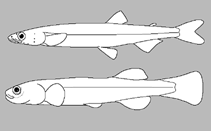
分類 / 名前 共通名の | 類義語 | Catalog of Fishes(部類, 種) | ITIS | CoL | WoRMS | Cloffa
> Galaxiiformes (Southern smelts) > Galaxiidae (Galaxiids) > Galaxiinae
Etymology: Galaxias: Greek, galaxias, ou = a kind of fish (Ref. 45335); arcanus: Name from Latin 'arcanus' meaning cryptic, secret or mysterious, referring to the cryptic habitat occupied by this species, among boulder and cobbles on the stream bed, and its cryptic colouration.
Etymology: Galaxias: Greek, galaxias, ou = a kind of fish (Ref. 45335); arcanus: Name from Latin 'arcanus' meaning cryptic, secret or mysterious, referring to the cryptic habitat occupied by this species, among boulder and cobbles on the stream bed, and its cryptic colouration.
環境:環境 / 気候帯 / 深さの範囲 / 分布範囲 生態学
; 新鮮な水 底生の漂泳性; 移住性ではない; 深さの範囲 0 - 1 m (Ref. 98815). Subtropical
分布 領土 | 国連食糧農業機関の区域 | エコシステム | 事件 | 目的のマップ | 導入 | Faunafri
Oceania: Australia.
サイズ / 重さ / 年齢
成熟: Lm ? range ? - ? cm
Max length : 9.8 cm FL オス/雌雄の選別がない; (Ref. 98815); 最大公表体重: 6.00 g (Ref. 98815)
Max length : 9.8 cm FL オス/雌雄の選別がない; (Ref. 98815); 最大公表体重: 6.00 g (Ref. 98815)
簡単な記述 検索表 | 形態学 | 形態計測学
背鰭 (合計) : 8 - 11; 臀鰭: 8 - 12; 脊つい: 47 - 54. This species is distinguished from all other species in the Galaxias olidus complex by the following set of characters: a shallow body with a straight ventral profile; long and shallow caudal peduncle, its peduncle length is greater than the caudal fin length; caudal peduncle flanges are poorly developed; the distinctive snout extends anteriorly from the thick and fleshy upper jaw as a fleshy protrubence, bulbous in lateral profile; nostrils of moderate length, ofter not visible from ventral view; subterminal mouth and lower jaw 81.5 (72.9-99.4) % of length of upper jaw; most anterior tip of snout level with about lower 0.3 of eye diameter; head wide and shallow; short pre-pelvic fin length, pectoral fin to pelvic fin length and post-orbital head length dimensions; large, ventrally oriented pectoral and pelvic fins (12.1-16.7 and 9.2-13.0 % SL respectively); low mean vertebral count of 51, although range is broad (47-55); pyloric caecae 0-1, when present it is short (1.0 % SL) and wide; gill rakers of moderate length, thin and sharply pointed; anal fin origin usually under 0.4 distance posteriorly along dorsal fin base; distinctive cryptic colouration and no black bars along lateral line (Ref. 98815).
Cross section: oval.
Cross section: oval.
Facultative air-breathing in the genus (Ref. 126274); A freshwater fish not able to undertake diadromous migrations. It was collected at a density ranging from < 0.01-0.80 fish/m2, but as individuals are usually hidden amongst or within the substrate in fast-flowing areas which are difficult to sample, these values are considered a gross underestimate of its relative abundance. Also recorded from cold to relatively cool, clear water in flowing creeks to large rivers (1.0-20.0 m average width), usually in shallow (0.1-0.4 m average depth), fast-flowing and high energy riffles and runs, although juveniles have been recorded moving upstream through slow water along the shallow edges of pools. The substrate in riffles and runs are mainly a complex of abundant cobbles and pebbles, with smaller amounts of bedrock, boulder, gravel and coarse sand. Fish are typically found within the diverse substrate, either amongst or under rocks on the stream bed, or deeper in the interstitial spaces of the substratum. It is usually not associated with aquatic vegetation, but have been found amongst small and large timber debris.
Adults often are solitary; juveniles and younger adults observed in loose shoals of 50+ individuals, moving upstream during the day in shallow, slow-flowing water along the edge of pools, between riffle habitats: fish 3.8-6.6 cm LCF were recorded moving upstream in the Acheron River and individuals < 5.0 cm LCF observed along the edge in the Steavenson River (Goulburn system) in late May 2001; and, individuals 4.9-6.7 cm LCF were collected moving upstream along the edge of a long pool in the Mitta Mitta River (upper Murray system) in late June 2002. This suggests active upstream dispersal by younger age-classes of fish. Individuals from the Steavenson River, downstream from Marysville, were found with cysts, possibly trematode metacercariae, embedded in the skin of the trunk and fins.
This species is often collected with the native species Gadopsis bispinosus (Two-spined Blackfish), Galaxias olidus s.s., Euastacus armatus (Murray Spiny Crayfish), Euastacus crassus (Alpine Spiny Crayfish), a shrimp (Atyidae) and including the alien species Brown Trout and Rainbow Trout (Oncorhynchus mykiss), and less often with the native Galaxias oliros (Obscure Galaxias) and Broadfinned Galaxias (Ref. 98815).
ライフサイクルと交尾行動 成熟 | 繁殖 | 放精 | 卵 | 生産力 | 幼生
主な参考文献
参考文献のアップロード | 参考文献 | コーディネーター : Berra, Tim M. | 協力者
Raadik, T.A., 2014. Fifteen from one: a revision of the Galaxias olidus Günther, 1866 complex (Teleostei, Galaxiidae) in south-eastern Australia recognises three previously described taxa and describes 12 new species. Zootaxa 3898(1):001-198. (Ref. 98815)
CITES
Not Evaluated
人間に対する脅威
Harmless
人間の用途
FAO - Publication: search | FishSource |
より多くの情報
解剖学
カマ
脳
オトリス
カマ
脳
オトリス
生理学
体組成
栄養素
酸素消費
水泳タイプ
泳ぐ速さ
視覚色素
フィッシュ・サウンド
病気と寄生虫
毒性(LC50)
体組成
栄養素
酸素消費
水泳タイプ
泳ぐ速さ
視覚色素
フィッシュ・サウンド
病気と寄生虫
毒性(LC50)
遺伝子の
ゲノム
遺伝子の
ヘテロ接合性
遺伝
遺伝的多様性
ゲノム
遺伝子の
ヘテロ接合性
遺伝
遺伝的多様性
用具
特記事項
XMLをダウンロードして下さい
インターネットの情報源
AFORO (otoliths) | Aquatic Commons | BHL | Cloffa | Websites from users | Check FishWatcher | CISTI | Catalog of Fishes: 部類, 種 | DiscoverLife | ECOTOX | FAO - Publication: search | Faunafri | Fishipedia | Fishtrace | GloBI | Google Books | Google Scholar | Google | IGFA World Record | OneZoom | Open Tree of Life | Otolith Atlas of Taiwan Fishes | PubMed | Reef Life Survey | Socotra Atlas | TreeBase | 生命の木 | Wikipedia: 行く, 検索する | World Records Freshwater Fishing | Zoobank | 動物に関する記録
モデルに基づく推定値
系統多様性指数 (参照 82804): PD50 = 0.5000 [Uniqueness, from 0.5 = low to 2.0 = high].
Bayesian length-weight: a=0.00490 (0.00206 - 0.01165), b=3.12 (2.91 - 3.33), in cm total length, based on LWR estimates for this (Sub)family-body shape (Ref. 93245).
栄養段階 (参照 69278): 3.2 ±0.4 se; based on size and trophs of closest relatives
回復力 (参照 120179): 高い, 15か月以下の倍増期間の最小個体群 (Preliminary K or Fecundity.).