



Otopharynx peridodeka Oliver, 2018
Sube tu fotos y Vídeos
Google image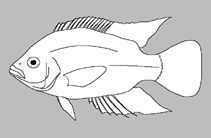 No image available for this species;
drawing shows typical species in Cichlidae.
Google image
drawing shows typical species in Cichlidae.
Clasificación / Nombres Nombres comunes | Sinónimos | Catalog of Fishes(Género, Especie) | ITIS | CoL | WoRMS | Cloffa
> Cichliformes (Cichlids, convict blennies) > Cichlidae (Cichlids) > Pseudocrenilabrinae
Etymology: Otopharynx: Greek, ous = hear + Greek, pharyngx = pharynx (Ref. 45335); peridodeka: From the Greek adverb περι (peri: around, near) and noun δυώδεκα (duódeka: 12), refering to the usually 12 lower-limb gill rakers of this species, a character separating it from the similar-looking Otopharynx panniculus with a higher count; the compound is treated as a noun in apposition (Ref. 119408).
Etymology: Otopharynx: Greek, ous = hear + Greek, pharyngx = pharynx (Ref. 45335); peridodeka: From the Greek adverb περι (peri: around, near) and noun δυώδεκα (duódeka: 12), refering to the usually 12 lower-limb gill rakers of this species, a character separating it from the similar-looking Otopharynx panniculus with a higher count; the compound is treated as a noun in apposition (Ref. 119408).
Entorno: milieu / zona climática / rango de profundidad / gama de distribución Ecología
; agua dulce bentopelágico. Tropical
Distribución Territorios | Áreas FAO | Ecosistemas | Ocurrencias, apariciones | Mapa de puntos | Introducciones | Faunafri
Africa: Lake Malawi off Sungu Point in Malawi (Ref. 119408).
Tamaño / Peso / Edad
Descripción breve Claves de identificación | Morfología | Morfometría
Espinas dorsales (total) : 16 - 17; Radios blandos dorsales (total) : 10 - 13; Espinas anales: 3; Radios blandos anales: 8 - 10. Diagnosis: A small, laterally spotted haplochromine recognizable by the following combination of characters: spots often indistinct, the suprapectoral spot, when discernible, vaguely rectangular, centered on subdorsal bar 3 or connecting bars 3 and 4, and covering four to five consecutive lateral-line scales, extending vertically from just above lateral midline to half a scale above upper lateral line; about seven vertical gray bars below dorsal-fin base; 34-35 scales in lateral line; 11-13 gill rakers on lower limb; 48-73 teeth in outer row of upper jaw; lower pharyngeal bone with a few posteromedian teeth enlarged, submolariform to molariform; lacrimal bone lacking a notch at base of lacrimal process (Ref. 119408). Otopharynx peridodeka is superficially most similar to O. panniculus, which also lacks a lacrimal notch, but O. peridodeka has more scales in the lateral line, 34-35 vs. 31-33, usually fewer lower gill rakers, 11-13 vs. 13-15, posteromedian pharyngeal teeth distinctly enlarged relatively to more lateral teeth vs. median and lateral teeth of nearly uniform size, averages fewer teeth in the posterior row of the lower pharyngeal bone, 37-44 vs. 42-48, and has a deeper lacrimal bone, 19.9-24.7% of head length vs. 18.1-19.9% (Ref. 119408). Compared to O. aletes, O. peridodeka has the hemijaws in ventral view posteriorly convergent, approximated vs. divergent, distant; and lower pharyngeal bone more lightly built, with narrower posterior horns, posteromedian teeth somewhat enlarged but laterally compressed, cuspidate vs. bone heavier, horns thickened, posterior teeth of median rows enlarged, crowns molarized, nearly hemispherical (Ref. 119408). Trematocranus brevirostris is somewhat similar, but in Otopharynx peridodeka the suprapectoral spot is rectangular, covering four to five longitudinal scales, and is located almost entirely below the upper lateral line vs. taller than long, covering three scales and, at least in the lectotype, placed more above than below the upper lateral line; the cephalic lateral-line system is not enlarged vs. pores and canals of the preorbital, nasal, dentary, and lacrimal bones inflated; and there are 48-73 outer upper-jaw teeth vs. about 43 (Ref. 119408).
Body shape (shape guide): short and / or deep.
Body shape (shape guide): short and / or deep.
Ciclo vital y comportamiento de apareamiento Madurez | Reproducción | Puesta | Huevos | Fecundidad | Larva
Referencia principal
Suba sus referencias | Referencias | Coordinador : Kullander, Sven O. | Colaboradores
Oliver, M.K., 2018. Six new species of the Cichlid genus Otopharynx from Lake Malaŵi (Teleostei: Cichlidae). Bulletin of the Peabody Museum of Natural History 59(2):159-197. (Ref. 119408)
CITES
Not Evaluated
Amenaza para el ser humano
Harmless
Usos humanos
FAO - Publication: search | FishSource |
Más información
Ecología Trófica
Alimentos (presas)
Composición de la dieta
consumo de alimento
Raciones de comida
Despredadores
Alimentos (presas)
Composición de la dieta
consumo de alimento
Raciones de comida
Despredadores
Ecología
Ecología
Ecología
Dinámica de la población
Coeficiente del crecimiento para
Edades / tallas máximas
Longitud-peso rel.
Longitud-longitud rel.
Longitud-frecuencias
Conversión de masas
Reclutamiento
Abundancia
Coeficiente del crecimiento para
Edades / tallas máximas
Longitud-peso rel.
Longitud-longitud rel.
Longitud-frecuencias
Conversión de masas
Reclutamiento
Abundancia
Ciclo de vida
Reproducción
Madurez
Madurez/Gills rel.
Fecundidad
Puesta
Agregaciones de desove
Huevos
Desarrollo de los huevos
Larva
Dinámica larvaria
Reproducción
Madurez
Madurez/Gills rel.
Fecundidad
Puesta
Agregaciones de desove
Huevos
Desarrollo de los huevos
Larva
Dinámica larvaria
Distribución
Territorios
Áreas FAO
Ecosistemas
Ocurrencias, apariciones
Introducciones
BRUVS - Vídeos
Territorios
Áreas FAO
Ecosistemas
Ocurrencias, apariciones
Introducciones
BRUVS - Vídeos
Anatomía
Superficie branquial
Cerebro
Otolito
Superficie branquial
Cerebro
Otolito
Fisiología
Composición corporal
Nutrientes
Consumo del oxígeno
Tipo de natación
Velocidad de natación
Pigmentos visuales
Sonido de peces
Enfermedades y parásitos
Toxicidad (CL50)
Composición corporal
Nutrientes
Consumo del oxígeno
Tipo de natación
Velocidad de natación
Pigmentos visuales
Sonido de peces
Enfermedades y parásitos
Toxicidad (CL50)
Genética
Genoma
Genética
Heterocigosidad
heritabilidad
Diversidad genética
Genoma
Genética
Heterocigosidad
heritabilidad
Diversidad genética
Relacionados con el ser humano
Sistemas de acuicultura
Perfiles de acuicultura
Razas
Ciguatera cases
Sellos, monedas, varios
Sistemas de acuicultura
Perfiles de acuicultura
Razas
Ciguatera cases
Sellos, monedas, varios
Herramientas
Libro electrónico | Guía de campo | Asistente para frecuencias de tallas | Herramienta de ciclo de vida | Mapa de puntos |
Catch-MSY |
Informes especiales
Comprobar el mantenimiento del acuario | Buscar fichas sobre especies | Consulte las hojas informativas sobre acuicultura
Descargar XML
Fuentes de Internet
AFORO (otoliths) | Aquatic Commons | BHL | Cloffa | Websites from users | Check FishWatcher | CISTI | Catalog of Fishes: Género, Especie | DiscoverLife | ECOTOX | FAO - Publication: search | Faunafri | Fishipedia | Fishtrace | GloBI | Google Books | Google Scholar | Google | IGFA World Record | OneZoom | Open Tree of Life | Otolith Atlas of Taiwan Fishes | PubMed | Reef Life Survey | Socotra Atlas | TreeBase | Árbol de la vida | Wikipedia: Go, búsqueda | World Records Freshwater Fishing | Zoobank | Expediente Zoológico
Estimaciones basadas en modelos
Índice de diversidad filogenética (Referencia 82804): PD50 = 0.5000 [Uniqueness, from 0.5 = low to 2.0 = high].
Bayesian length-weight: a=0.00389 (0.00180 - 0.00842), b=3.12 (2.94 - 3.30), in cm total length, based on all LWR estimates for this body shape (Ref. 93245).
Nivel trófico (Referencia 69278): 3.4 ±0.4 se; based on size and trophs of closest relatives
Resiliencia (Referencia 120179): Alto, población duplicada en un tiempo mínimo inferior a 15 meses (Preliminary K or Fecundity.).