



Otopharynx panniculus Oliver, 2018
Carica il tuo foto e Video
Google image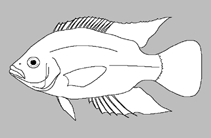 No image available for this species;
drawing shows typical species in Cichlidae.
Google image
drawing shows typical species in Cichlidae.
Classificazione / Nomi Nomi Comuni | Sinonimi | Catalog of Fishes(Genere, Specie) | ITIS | CoL | WoRMS | Cloffa
> Cichliformes (Cichlids, convict blennies) > Cichlidae (Cichlids) > Pseudocrenilabrinae
Etymology: Otopharynx: Greek, ous = hear + Greek, pharyngx = pharynx (Ref. 45335); panniculus: From the Latin noun panniculus, a small cloth patch, with reference to the appearance of the quadrate suprapectoral spot neatly 'stitched' between two vertical bars; a noun in apposition (Ref. 119408).
Etymology: Otopharynx: Greek, ous = hear + Greek, pharyngx = pharynx (Ref. 45335); panniculus: From the Latin noun panniculus, a small cloth patch, with reference to the appearance of the quadrate suprapectoral spot neatly 'stitched' between two vertical bars; a noun in apposition (Ref. 119408).
Ambiente: milieu / zona climatica / distribuzione batimetrica / gamma di distribuzione Ecologia
; acqua dolce benthopelagico. Tropical
Distribuzione Territories | Aree FAO | Ecosistemi | Presenze | Mappa dei ritrovamenti | Introduzioni | Faunafri
Africa: Lake Malawi in Malawi (Ref. 119408).
Dimensione / Peso / Età
Breve descrizione Chiavi di identificazione | Morfologia | Morfometria
Spine dorsali (totale) : 15 - 16; Raggi dorsali molli (totale) : 9 - 11; Spine anali: 3; Raggi anali molli: 8 - 9; Vertebre: 32. Diagnosis: A small, laterally spotted haplochromine which is recognized by the following combination of characters: prominent, quadrate suprapectoral spot spanning subdorsal vertical bars 3-4, this spot below and touching the upper lateral line and usually extending slightly above it; 13-15 lower-limb gill rakers; and deep body, depth 34.4-38.2% of standard length (Ref. 119408). The shape and placement of the suprapectoral spot distinguish Otopharynx panniculus from O. brooksi, O. lithobates, and O. ovatus, in all of which this spot lies entirely below and usually separated from the upper lateral line; its shorter lateral line of 31-33 scales discriminates O. panniculus from O. decorus with 36-38 scales, O. argyrosoma with 34-36 scales, and O. selenurus with 34-35 scales; its higher gill raker count of 13-15 on lower limb distinguishes O. panniculus from O. tetrastigma with 9-11, O. speciosus with 11-12, and O. antron with 10-11; its shorter head, 31.9-33.7% of standard length, and longer caudal peduncle, 18.8-21.7% of standard length, distinguish O. panniculus from O. spelaeotes, with head 34.8-36.6% of standard length and caudal peduncle length 13.2-15.6% of standard length; its 15-16 dorsal-fin spines and lack of dorsal midline spots separate O. panniculus from O. heterodon, which has 17-18 dorsal spines and five or six distinct, small, dark dorsal midline spots just below the dorsal-fin base; the presence of several slightly enlarged teeth in the median columns of the lower pharyngeal bone separates O. panniculus from O. auromarginatus and O. tetraspilus, which have only small, compressed, bicuspid pharyngeal teeth; in O. panniculus the lips are thin and lack median lobes, distinguishing it from O. pachycheilus with lips hypertrophied, with prominent median lobes (Ref. 119408). Compared to O. aletes, O. panniculus has fewer lateral-line scales, 31-33 vs. 34-36; and a lighter lower pharyngeal jaw and dentition, with small, laterally compressed, bicuspid posteromedian pharyngeal teeth vs. these teeth enlarged, molarized; slender posterior horns vs. horns thickened; and anterior blade longer, shallower vs. blade shorter, deeper (Ref. 119408). Compared to O. peridodeka, O. panniculus has fewer lateral-line scales, 31-33 vs. 34-35; usually has more lower-limb gill rakers, 13-15 vs. 11-13; and lower pharyngeal teeth more uniform in size, those of the median columns scarcely larger than the more lateral teeth vs. posterior teeth of median columns distinctly enlarged relative to lateral teeth (Ref. 119408). Otopharynx panniculus superficially resembles Trematocranus "brevirostris deep", but that still-undescribed species is from substantially deeper water, 90-102 m vs. about 42 m; the suprapectoral spot apparently spans subdorsal bars 2-3 vs. bars 3-4 in O. panniculus; and there are 10-13 lower-limb gill rakers vs. 13-15 (Ref. 119408). Trematocranus brevirostris itself is also similar, but in O. panniculus the suprapectoral spot is roughly square, covers four to five longitudinal scales, and is located almost entirely below the upper lateral line vs. taller than long, covers three scales,and at least in the lectotype is placed more above than below the upper lateral line; the cephalic lateral-line system is not enlarged vs. pores and canals of the preorbital, nasal, dentary, and lacrimal bones inflated; there are 52-66 outer upper-jaw teeth vs. about 43; and 3-4 cheek scale rows vs. 2 (Ref. 119408).
Body shape (shape guide): short and / or deep.
Body shape (shape guide): short and / or deep.
Ciclo vitale e comportamento di accoppiamento Maturità | Riproduzione | Deposizione | Uova | Fecondità | Larve
Riferimento principale
Caricare le referenze | Bibliografia | Coordinatore : Kullander, Sven O. | Collaboratori
Oliver, M.K., 2018. Six new species of the Cichlid genus Otopharynx from Lake Malaŵi (Teleostei: Cichlidae). Bulletin of the Peabody Museum of Natural History 59(2):159-197. (Ref. 119408)
CITES
Not Evaluated
Minaccia per l'uomo
Harmless
Usi umani
FAO - Publication: search | FishSource |
Informazioni ulteriori
Ecologia trofica
Articoli alimentari (prede)
Alimentazione
Consumo di cibo
Razioni alimentari
Predatori
Articoli alimentari (prede)
Alimentazione
Consumo di cibo
Razioni alimentari
Predatori
Ecologia
Ecologia
Ecologia
Dinamica della popolazione
Parametri di crescita
Età massima / dimensioni massime
Rapporto lunghezza-peso.
Lunghezza-lunghezza rel.
Lunghezza-frequenze
Conversione di massa
Reclutamento
Abbondanza
Parametri di crescita
Età massima / dimensioni massime
Rapporto lunghezza-peso.
Lunghezza-lunghezza rel.
Lunghezza-frequenze
Conversione di massa
Reclutamento
Abbondanza
Ciclo di vita
Riproduzione
Maturità
Maturità/Gli occhielli sono relativi.
Fecondità
Deposizione
Aggregazioni riproduttive
Uova
Sviluppo delle uova
Larve
Dinamica popolazioni larvali
Riproduzione
Maturità
Maturità/Gli occhielli sono relativi.
Fecondità
Deposizione
Aggregazioni riproduttive
Uova
Sviluppo delle uova
Larve
Dinamica popolazioni larvali
Anatomia
Area branchiale
Cervello
Otolite
Area branchiale
Cervello
Otolite
Fisiologia
Composizione corporea
Nutrienti
Consumo di ossigeno
Tipo di nuoto
Velocità di nuoto
Pigmenti visivi
Suono del pesce
Malattie e parassiti
Tossicità (LC50)
Composizione corporea
Nutrienti
Consumo di ossigeno
Tipo di nuoto
Velocità di nuoto
Pigmenti visivi
Suono del pesce
Malattie e parassiti
Tossicità (LC50)
Genetica
Genome
Genetica
Eterozigosi
Ereditarietà
Diversità genetica
Genome
Genetica
Eterozigosi
Ereditarietà
Diversità genetica
Legato all'uomo
Sistemi di acquacoltura
Profili di acquacoltura
Varietà
Casi di Ciguatera
Francobolli, monete, materiale vario.
Sistemi di acquacoltura
Profili di acquacoltura
Varietà
Casi di Ciguatera
Francobolli, monete, materiale vario.
Strumenti
Libro elettronico | Giuda pratica | Generatore frequenze di lunghezza | Strumento Parametri Biologici | Mappa dei ritrovamenti |
Cattura-MSY |
Rapporti speciali
Controllo della manutenzione dell'acquario | Verificare la presenza di schede informative sulle specie | Verifica delle schede informative sull'acquacoltura
Scarica XML
Fonti Internet
AFORO (otoliths) | Aquatic Commons | BHL | Cloffa | Websites from users | Check FishWatcher | CISTI | Catalog of Fishes: Genere, Specie | DiscoverLife | ECOTOX | FAO - Publication: search | Faunafri | Fishipedia | Fishtrace | GloBI | Google Books | Google Scholar | Google | IGFA World Record | OneZoom | Open Tree of Life | Otolith Atlas of Taiwan Fishes | PubMed | Reef Life Survey | Socotra Atlas | TreeBase | Tree of Life | Wikipedia: Go, ricerca | World Records Freshwater Fishing | Zoobank | Record zoologico
Stime basate su modelli
Indice di diversità filogenetica (Fonte Biblio. 82804): PD50 = 0.5000 [Uniqueness, from 0.5 = low to 2.0 = high].
Bayesian length-weight: a=0.00389 (0.00180 - 0.00842), b=3.12 (2.94 - 3.30), in cm total length, based on all LWR estimates for this body shape (Ref. 93245).
Livello trofico (Fonte Biblio. 69278): 3.3 ±0.4 se; based on size and trophs of closest relatives
Resilienza (Fonte Biblio. 120179): Alto, tempo minimo di raddoppiamento della popolazione meno di 15 mesi (Preliminary K or Fecundity.).