



Otopharynx aletes Oliver, 2018
Загрузить свой Фото и Видео
Изображение на Google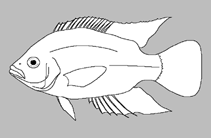 No image available for this species;
drawing shows typical species in Cichlidae.
Изображение на Google
drawing shows typical species in Cichlidae.
Классификация / Имена народные названия | синонимы | Catalog of Fishes(род, виды) | ITIS | CoL | WoRMS | Cloffa
> Cichliformes (Cichlids, convict blennies) > Cichlidae (Cichlids) > Pseudocrenilabrinae
Etymology: Otopharynx: Greek, ous = hear + Greek, pharyngx = pharynx (Ref. 45335); aletes: From the Greek masculine nominative singular noun άλέτης (alétes), a grinder; the name alludes to the well-defined group of conspicuously enlarged molariform teeth on the lower pharyngeal bone; a noun in apposition (Ref. 119408).
Etymology: Otopharynx: Greek, ous = hear + Greek, pharyngx = pharynx (Ref. 45335); aletes: From the Greek masculine nominative singular noun άλέτης (alétes), a grinder; the name alludes to the well-defined group of conspicuously enlarged molariform teeth on the lower pharyngeal bone; a noun in apposition (Ref. 119408).
Окружающая среда: среда / климатическая зона / пределы глубины / диапазон распространения экология
; пресноводный донно-пелагический. Tropical
распространение Территории | регионы FAO | Экосистемы | места находок | карта точек | интродукции | Faunafri
Размер / Вес / Возраст
Краткое описание определительные ключи | морфология | морфометрия
колючие лучи спинного плавника (общее число) : 16; членистые (мягкие) лучи спинного плавника (общее число) : 11 - 12; колючие лучи анального плавника: 3; членистые (мягкие) лучи анального плавника: 8 - 9. Diagnosis: A smallish laterally spotted haplochromine distinguished by the following characters in combination: suprapectoral spot mostly below upper lateral line but extending above it by about one-half to one scale; 10-11 gill rakers on lower outer arch; and lower pharyngeal bone with posteromedian teeth molariform with stout shafts and rounded crowns (Ref. 119408). The placement of the suprapectoral spot overlapping the upper lateral line distinguishes Otopharynx aletes from O. brooksi, O. lithobates, and O. ovatus, al of which have the suprapectoral spot entirely below and usually separated from the upper lateral line; Otopharynx aletes has more scales in the lateral line, 34-36, than 31-33 in O. brooksi, 31-33 in O. spelaeotes, 29-31 in O. antron, 30-32 in O. tetraspilus, and 30-33 in O. tetrastigma, but fewer than O. decorus, which has 36-38 and which also has 13-14 soft dorsal rays vs. 11-12 in O. aletes; with 10-11 gill rakers on the lower outer arch, O. aletes is readily separated from O. auromarginatus with 14-18; its longer caudal peduncle, 1.6-2.0 times as long as deep, and shallowly emarginate caudal fin distinguish O. aletes from O. selenurus, with caudal peduncle 1.0-1.5 times as long as deep, caudal fin crescentically emarginate; the bicuspid outer jaw teeth, molariform pharyngeal teeth, and seven to eight subdorsal bars differentiate O. aletes from O. speciosus, with outer jaw teeth unicuspid, pharyngeal teeth all small, bicuspid; about four subdorsal bars; the presence of seven to eight vertical bars below dorsal-fin base separates O. aletes from O. argyrosoma, which lacks vertical bars; the unthickened, nonlobate lips differentiate O. aletes from O. pachycheilus, which has lips thickened, medially lobate; the 16 dorsal-fin spines, absence of distinct equidistant dorsal midline spots, and offshore habitat on sand or soft bottom distinguish O. aletes from O. heterodon, which has 17-18 dorsal-fin spines, about five distinct dorsal midline spots, and inhabits rocky shores (Ref. 119408). Trematocranus brevirostris somewhat resembles O. aletes, but in O. aletes the suprapectoral spot is largely below the upper lateral line but extends above it by about one-half to one scale vs. placed more above than below the upper lateral line, at least in the lectotype; the cephalic lateral-line system is not enlarged vs. pores and canals inflated; the dorsal fin has 11-12 segmented rays vs. 9; there are 54-67 outer upper-jaw teeth vs. about 43; the posteromedian teeth on the lower pharyngeal bone are molariform with stout shafts and rounded crowns vs. slightly enlarged but cuspidate; and the caudal peduncle length/depth ratio is 1.6-2.0 vs. 1.2-1.4 (Ref. 119408). Compared to Otopharynx panniculus, O. aletes has more scales in the lateral line, 34-36 vs. 31-33; and a heavier lower pharyngeal jaw bone and dentition, including enlarged, molarized teeth posteromedially vs. small, laterally compressed, bicuspid teeth; posterior horns thickened vs. slender; and anterior blade shorter, deeper vs. longer, more shallow (Ref. 119408). Compared to O. peridodeka, O. aletes has the hemijaws in ventral view divergent caudally and distant from each other vs. approximated, convergent; and a heavier lower pharyngeal bone, with horns thicker, posteromedian teeth enlarged, and molarized with nearly hemispherical crowns vs. more lightly built, horns narrower, posteromedian teeth somewhat enlarged but more laterally compressed, cuspidate (Ref. 119408).
Body shape (shape guide): short and / or deep.
Body shape (shape guide): short and / or deep.
Жизненный цикл и брачное поведение половая зрелость | размножение | нерест | икра | Плодовитость | личинки
Основная ссылка
Загрузите свои рекомендации | ссылки | координатор : Kullander, Sven O. | соавторы
Oliver, M.K., 2018. Six new species of the Cichlid genus Otopharynx from Lake Malaŵi (Teleostei: Cichlidae). Bulletin of the Peabody Museum of Natural History 59(2):159-197. (Ref. 119408)
CITES
Not Evaluated
Угроза для людей
Harmless
Использование человеком
FAO - Publication: search | FishSource |
дополнительная информация
Трофическая экология
Пищевые предметы (добыча)
состав пищи
потребление пищи
Продовольственные пайки
хищники
Пищевые предметы (добыча)
состав пищи
потребление пищи
Продовольственные пайки
хищники
экология
экология
экология
Динамика численности населения
Параметры роста
Макс. возраст / размер
Отношение длины к весу.
Отношение длины к длине.
Размерный состав
Преобразование массы
пополнение
численность
Параметры роста
Макс. возраст / размер
Отношение длины к весу.
Отношение длины к длине.
Размерный состав
Преобразование массы
пополнение
численность
Жизненный цикл
размножение
половая зрелость
Зрелость/Жиры относительно.
Плодовитость
нерест
Нерестовые скопления
икра
Развитие икры
личинки
динамика численности личинок
размножение
половая зрелость
Зрелость/Жиры относительно.
Плодовитость
нерест
Нерестовые скопления
икра
Развитие икры
личинки
динамика численности личинок
Анатомия
жаберная область
Мозг
Отолит
жаберная область
Мозг
Отолит
Физиология
Состав тела
Питательные вещества
Потребление кислорода
Тип плавания
Скорость плавания
Зрительные пигменты
Звук рыбы
Болезни и паразиты
Токсичность (LC50s)
Состав тела
Питательные вещества
Потребление кислорода
Тип плавания
Скорость плавания
Зрительные пигменты
Звук рыбы
Болезни и паразиты
Токсичность (LC50s)
генетика
Геном
генетика
Гетерозиготность
наследуемость
Генетическое разнообразие
Геном
генетика
Гетерозиготность
наследуемость
Генетическое разнообразие
Связанные с человеком
Системы аквакультуры
особенности рыбоводства
степень растяжения
Случаи заболевания сигуатерой
Марки, монеты и прочее.
Системы аквакультуры
особенности рыбоводства
степень растяжения
Случаи заболевания сигуатерой
Марки, монеты и прочее.
инструменты
Специальные отчеты
Проверить содержание в аквариумах | Проверить опубликованные видовые данные | Проверить опубликованные данные по аквакультуре
Скачать в формате XML
ресурсы в Интернет
AFORO (otoliths) | Aquatic Commons | BHL | Cloffa | Websites from users | Проверить FishWatcher | CISTI | Catalog of Fishes: род, виды | DiscoverLife | ECOTOX | FAO - Publication: search | Faunafri | Fishipedia | Fishtrace | GloBI | Google Books | Google Scholar | Google | IGFA World Record | OneZoom | Open Tree of Life | Otolith Atlas of Taiwan Fishes | PubMed | Reef Life Survey | Socotra Atlas | TreeBase | Tree of Life | Wikipedia: Вперёд, поиск | World Records Freshwater Fishing | Zoobank | Зоологическая летопись
Оценки, основанные на моделях
Индекс филогенетического разнообразия (ссылка 82804): PD50 = 0.5000 [Uniqueness, from 0.5 = low to 2.0 = high].
Bayesian length-weight: a=0.00389 (0.00180 - 0.00842), b=3.12 (2.94 - 3.30), in cm total length, based on all LWR estimates for this body shape (Ref. 93245).
Трофический уровень (ссылка 69278): 3.4 ±0.4 se; based on size and trophs of closest relatives
устойчивость к внешним воздействиям (ссылка 120179): высокий, минимальное время удвоения популяции до 15 месяцев (Preliminary K or Fecundity.).