



Trachelochismus aestuarium Conway, Stewart & King, 2017
Estuary clingfish
Hochladen Photos und videos
Google Bild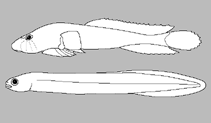 No image available for this species;
drawing shows typical species in Gobiesocidae.
Google Bild
drawing shows typical species in Gobiesocidae.
Klassifizierung / Names Namen | Synonyme | Catalog of Fishes(Gattung, Arten) | ITIS | CoL | WoRMS | Cloffa
> Gobiesociformes (Clingfishes) > Gobiesocidae (Clingfishes and singleslits) > Trachelochisminae
Etymology: Trachelochismus: Greek, trachelos = neck + Greek, schismos, -ou = cut (Ref. 45335); aestuarium: Name from Latin 'aestuarium" for 'a tidal inlet of the sea', referring to the presence of this species in estuaries; noun in apposition.
Etymology: Trachelochismus: Greek, trachelos = neck + Greek, schismos, -ou = cut (Ref. 45335); aestuarium: Name from Latin 'aestuarium" for 'a tidal inlet of the sea', referring to the presence of this species in estuaries; noun in apposition.
Umwelt: Milieu / Klimazone / Tiefenbereich / Verbreitungsgebiet Ökologie
; brackwasser demersal; tiefenbereich 0 - 29 m (Ref. 116173). Tropical; 33°S - 47°S, 166°E - 179°E (Ref. 116173)
Verbreitung Territorien | FAO Gebiete | Ökosysteme | Vorkommen | Punkt Karte | Einführungen | Faunafri
Southwest Pacific: New Zealand.
Größe / Gewicht / Alter
Kurzbeschreibung Bestimmungsschlüssel | Morphologie | Morphometrie
Rückenflossenweichstrahlen (insgesamt) : 8; Afterflossenweichstrahlen: 7; Wirbelzahl: 32. This species is distinguished from its congeners by the following set of characters: adhesive disc region A without flattened papillae at the centre; apapillate area of adhesive disc region A is equal in width or wider than region C; the flap along posterior margin of anterior nostril is a short, thin blade; lachrymal canal pores 2 and 3 flush with surface of skin or weakly elevated above the skin; suborbital, mandibular and postorbital rows of superficial neuromasts are located in shallow grooves with smooth borders; suborbital row is continuous, extending along ventral margin of orbit; postorbital row with 3 superficial neuromasts; a single gill raker present along the anterior edge of ceratobranchial 1; D 8; A 7; pectoral-fin rays 25; vertebrae 14 + 18 = 32. Colouration: in life, a single dark brown or black irregular streak found on the lateral surface of head posterior to eye (Ref. 116173).
Cross section: oval.
Cross section: oval.
Known only from shallow bay (0-29 m) and estuarine areas along the coast of New Zealand. Usually it is asscoiated with mixed shell-bryozoan rubble benthic communities. Some speciments have also been collected in association with Zostra and mangroves. At the type locality, it is found predominantly in association with spent shells of bivalves over a substrate of fine sand and silt at depths below the low tide mark (0-3 m) (Ref. 116173).
Lebenszyklus und Paarungsverhalten Geschlechtsreife | Fortpflanzung | Ablaichen | Eier | Fruchtbarkeit | Larven
Hauptreferenz
Laden Sie Ihre Referenzen hoch | Referenzen | Koordinator : Williams, Jeffrey T. | Partner
Conway, K.W., A.L. Stewart and C. King, 2017. A new species of the clingfish genus Trachelochismus from bay and estuarine areas of New Zealand (Teleostei: Gobiesocidae). Zootaxa 4319(3). (Ref. 116173)
IUCN Rote Liste Status (Ref. 130435: Version 2025-2 (Global))
nicht bedroht (LC) ; Date assessed: 19 March 2024
CITES
Not Evaluated
Bedrohung für Menschen
Harmless
Nutzung durch Menschen
FAO - Publication: search | FishSource |
Mehr Information
Trophische Ökologie
Lebensmittel (Beutetiere)
Nahrungszusammensetzung
Nahrungsaufnahme
Lebensmittelrationen
Räuber
Lebensmittel (Beutetiere)
Nahrungszusammensetzung
Nahrungsaufnahme
Lebensmittelrationen
Räuber
Ökologie
Ökologie
Ökologie
Populationsdynamik
Wachstumsparameter
Max. Alter/Größen
Länge-Gewicht-Rel.
Länge-Länge-Verhältnis.
Längenhäufigkeiten
Massenkonvertierung
Rekrutierung
Dichte
Wachstumsparameter
Max. Alter/Größen
Länge-Gewicht-Rel.
Länge-Länge-Verhältnis.
Längenhäufigkeiten
Massenkonvertierung
Rekrutierung
Dichte
Lebenszyklus
Fortpflanzung
Geschlechtsreife
Reifung/Kiemen rel.
Fruchtbarkeit
Ablaichen
Laichaggregationen
Eier
Eientwicklung
Larven
Larven Pop.Dyn.
Fortpflanzung
Geschlechtsreife
Reifung/Kiemen rel.
Fruchtbarkeit
Ablaichen
Laichaggregationen
Eier
Eientwicklung
Larven
Larven Pop.Dyn.
Anatomie
Kiemenoberfläche
Gehirn
Otolith
Kiemenoberfläche
Gehirn
Otolith
Physiologie
Körperliche Zusammensetzung
Nährstoffe
Sauerstoffverbrauch
Schwimmart
Schwimmgeschwindigkeit
Visuelle Pigmente
Fischgeräusche
Krankheiten und Parasiten
Toxizität (LC50s)
Körperliche Zusammensetzung
Nährstoffe
Sauerstoffverbrauch
Schwimmart
Schwimmgeschwindigkeit
Visuelle Pigmente
Fischgeräusche
Krankheiten und Parasiten
Toxizität (LC50s)
Genetik
Genom
Genetik
Heterozygotie
Vererbbarkeit
Genetische Vielfalt
Genom
Genetik
Heterozygotie
Vererbbarkeit
Genetische Vielfalt
Menschenbezogen
Aquakultur-Systeme
Aquakultur Profile
Zuchtlinien
Ciguatera-Fälle
Briefmarken, Münzen, Verschiedenes.
Aquakultur-Systeme
Aquakultur Profile
Zuchtlinien
Ciguatera-Fälle
Briefmarken, Münzen, Verschiedenes.
Tools
Zusatzinformationen
Download XML
Zusammenfassung | Punktdaten | Namen | Photos
Internet Quellen
AFORO (otoliths) | Aquatic Commons | BHL | Cloffa | Websites from users | FishWatcher Einträge suchen | CISTI | Catalog of Fishes: Gattung, Arten | DiscoverLife | ECOTOX | FAO - Publication: search | Faunafri | Fishipedia | Fishtrace | GloBI | Google Books | Google Scholar | Google | IGFA World Record | OneZoom | Open Tree of Life | Otolith Atlas of Taiwan Fishes | PubMed | Reef Life Survey | Socotra Atlas | TreeBase | Tree of Life | Wikipedia: Gehe zu, Suchen | World Records Freshwater Fishing | Zoobank | Zoologischer Rekord
Schätzungen auf der Grundlage von Modellen
Phylogenetischer Diversitätsindex (Ref. 82804): PD50 = 0.6250 [Uniqueness, from 0.5 = low to 2.0 = high].
Bayesian length-weight: a=0.00457 (0.00177 - 0.01179), b=3.12 (2.89 - 3.35), in cm total length, based on LWR estimates for this (Sub)family-body shape (Ref. 93245).
Trophische Ebene (Ref. 69278): 3.1 ±0.3 se; based on size and trophs of closest relatives
Widerstandsfähigkeit (Ref. 120179): hoch, Verdopplung der Population dauert weniger als 15 Monate. (Preliminary K or Fecundity.).