This website uses cookies to enhance your browsing experience and ensure the functionality of our site. For more detailed information about the types of cookies we use and how we protect your privacy, please visit our Privacy Information page.
×
Cookie Settings
This website uses different types of cookies to enhance your experience. Please select your preferences below:
> Mulliformes (Goatfishes) > Mullidae (Goatfishes)
Etymology: Upeneus:Greek, ypene, -es = upper lip (Ref. 45335); heterospinus:The name refers to the variable number of 7 or 8 dorsal-fin spines.
Taxonomic Remarks FishBase common name changed from Varied-spine goatfish to Variedspine goatfish (Uiblein et al., 2024: Ref. 130857).
Milieu: milieu / Klimaatzone / Diepte / verspreidingsgebied Ecologie
marien demersaal; diepte 6 - 24 m (Ref. 121834). Tropical
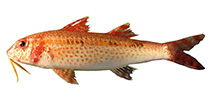
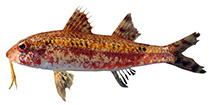
Dorsale stekels (totaal) : 7 - 8; Dorsale zachte stralen (totaal) : 9. This species is distinguished by the following characters: D VII or VIII + 9, with the first spine minute in 8-spined fish; pectoral fins 13-15; gill rakers 4-6 + 15-18 = 21-24; lateral-line scales 28-30. All measurements in % SL, adults: body depth at first dorsal-fin origin 22-26; body depth at anus 18-22; caudal-peduncle depth 9.2-11; caudal-peduncle width 3.5-5.0; maximum head depth 19-23; head depth through eye 15-18; suborbital depth 8.3-11; interorbital length 7.2-9.2; head length 27-31; snout length 9.7-13; postorbital length 10-13; orbit length 5.9-8.3; upper-jaw length 9.4-13; barbel length 16-20; interdorsal distance 13-17; caudal-peduncle length 22-26; caudal-fin length 27-32; anal-fin height 15-19; pelvic-fin length 19-23; pectoral-fin length 19-22; pectoral-fin width 3.4-4.7; first dorsal-fin height 18-23; second dorsal-fin height 16-20. All measurements in % SL, subadults: body depth at first dorsal-fin origin 22-24; body depth
at anus 18-21; caudal-peduncle depth 9.1-10; caudal-peduncle width 3.6-3.8; maximum head depth 19-21; head depth through eye 15-18; suborbital depth 9.0-10; interorbital length 7.6-8.1; head length 29-30; snout length 11-12; postorbital length 11-13; orbit length 7.8-7.9; upper-jaw length 9.9-12; barbel length 18-19; interdorsal distance 12-14; caudal-peduncle length 22-25; caudal-fin length 29-31; anal-fin height 16-19; pelvic-fin length 21-22; pectoral-fin length 21; pectoral-fin width 3.8-4.2; first dorsal-fin height 21-22; second dorsal-fin height 17-20. Colouration: head and body are red dorsally, brown or dark-grey mottled, ventrally white, often with pale beige or grey dots or red blotches (inactive, live fish with large red patches and broad vertical or oblique red bands on body); the upper lobe of caudal fin with 4-6 red or brown bars (3 or 4 bars in subadults), while the lower caudal-fin lobe with 5-7 (3-5) red, brown or dark-brown bars, usually crossed, entirely or ony dorsally, by a yellow, beige, pale red or pale brown stripe; bars on both lobes of pupil width or less in adults, interrupted by pale, partly hyaline interspaces of similar width or slightly narrower; the lower caudal-lobe tip sometimes black; barbels are entirely yellow; with a single yellow, beige, or pale brown mid-lateral body stripe of pupil width from snout tip through eye to caudal-fin base; the stripe sometimes covered by 1-4 sections with 1-4 dark dots, the posteriormost group of dots behind second dorsal-fin base, often connecting to a dark saddle behind second dorsal fin; the first dorsal fin with 3-4 often fused, pale-red, pale-brown or beige stripes, the fin-tip area not darker pigmented while the second dorsal fin has 3-4 red or brown well-separated stripes with hyaline interspaces; pectoral fins hyaline, pelvic and anal fins weakly pigmented and partly hyaline; preserved fish is pale brown, often with remains of dark pigmentation deriving from caudal-fin bars, mid-lateral dots, saddle and/or second dorsal-fin distal stripe (Ref. 121834). Cross section: compressed.
Uiblein, F., D.C. Gledhill, D.A. Pavlov, T.A. Hoang and S. Shaheen, 2019. Three new goatfishes of the genus Upeneus (Mullidae) from the Indo-Pacific, with a redescription of colour patterns in U. margarethae. Zootaxa 4683(2):151-196. (Ref. 121834)
Status op de Rode Lijst van het IUCN (Ref. 130435: Version 2025-2 (Global))
Fylogenetische diversiteitsindex (Ref. 82804): PD50 = 0.5000 [Uniqueness, from 0.5 = low to 2.0 = high].
Bayesian length-weight: a=0.00933 (0.00439 - 0.01983), b=3.09 (2.92 - 3.26), in cm total length, based on LWR estimates for this Genus-body shape (Ref. 93245).
Trofisch niveau (Ref. 69278): 3.5 ±0.4 se; based on size and trophs of closest relatives
Weerstandsvermogen (Ref. 120179): Hoog, minimale populatieverdubbelingstijd minder dan 15 maanden (Preliminary K or Fecundity.).
Kwetsbaarheid van de visserij (Ref. 59153): Low vulnerability (10 of 100). 🛈