



Pomacentrus bellipictus Allen, Erdmann & Hidayat, 2018
Bluemouth demoiselle
Hochladen Photos und videos
Google Bild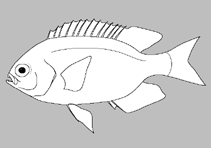 No image available for this species;
drawing shows typical species in Pomacentridae.
Google Bild
drawing shows typical species in Pomacentridae.
Klassifizierung / Names Namen | Synonyme | Catalog of Fishes(Gattung, Arten) | ITIS | CoL | WoRMS | Cloffa
> Ovalentaria/misc (Various families in series Ovalentaria) > Pomacentridae (Damselfishes) > Pomacentrinae
Etymology: Pomacentrus: Greek, poma, -atos = cover, operculum + Greek, kentron = sting (Ref. 45335); bellipictus: Name from Latin 'bellipictus' or 'war-painted'; referring to its facial coloration and belligerent behaviour towards divers; masculine compound adjective.
Etymology: Pomacentrus: Greek, poma, -atos = cover, operculum + Greek, kentron = sting (Ref. 45335); bellipictus: Name from Latin 'bellipictus' or 'war-painted'; referring to its facial coloration and belligerent behaviour towards divers; masculine compound adjective.
Umwelt: Milieu / Klimazone / Tiefenbereich / Verbreitungsgebiet Ökologie
seewasser riff-verbunden; tiefenbereich 1 - 2 m (Ref. 118654). Tropical
Verbreitung Territorien | FAO Gebiete | Ökosysteme | Vorkommen | Punkt Karte | Einführungen | Faunafri
Western Pacific: Indoneia (West Papua).
Größe / Gewicht / Alter
Kurzbeschreibung Bestimmungsschlüssel | Morphologie | Morphometrie
Rückenflossenstacheln (insgesamt) : 13 - 14; Rückenflossenweichstrahlen (insgesamt) : 12 - 14; Afterflossenstacheln: 2; Afterflossenweichstrahlen: 12 - 15; Wirbelzahl: 26. This species is distinguished by the following characters: D XIV (rarely XIII),12-14 (usually XIV,14); A II,12-15 (usually 14-15); pectoral-fin rays 17-19 (rarely 19); tubed lateral-line scales 17-19 (usually 18); total gill rakers on first arch 18-20 (rarely 20); body depth 1.8-2.0 (mean 1.9) in SL; scales absent on preorbital and suborbital; lower margin of suborbital series with 4-12 serrae; color in life mainly dark brown, nearly black, with contrasting blue areas around mouth (including isthmus), below eye, and along margin of preopercle; iris of adult mostly dark gray with a narrow bronze ring around pupil (Ref. 118654).
Cross section: compressed.
Cross section: compressed.
Relatively common at the type locality, darting among wave-washed rocks and boulders next to shore in about 1-2 meters and although the shoreline was exposed to significant wave action, the surrounding waters have characteristics more typical of estuarine habitats, i.e. with lowered salinity, high turbidity and sedimentation, and frequently elevated temperatures up to about 31°C. This area of unusual combination of coastal and offshore conditions may account for the development of the microendemic species limited to this area. Adults and subadults exhibited aggressive behavior when approached at close range, charging to within a few centimeters when confronted with either a camera or small collecting spear (Ref. 118654).
Lebenszyklus und Paarungsverhalten Geschlechtsreife | Fortpflanzung | Ablaichen | Eier | Fruchtbarkeit | Larven
Hauptreferenz
Laden Sie Ihre Referenzen hoch | Referenzen | Koordinator : Allen, Gerald R. | Partner
Allen, G.R., M.V. Erdmann and N.I. Hidayat, 2018. Pomacentrus bellipictus, a new microendemic species of damselfish (Pisces: Pomacentridae) from the Fakfak Peninsula, West Papua, Indonesia. J. Ocean Sci. Found. 30:1-10. (Ref. 118654)
CITES
Not Evaluated
Bedrohung für Menschen
Harmless
Nutzung durch Menschen
FAO - Publication: search | FishSource |
Mehr Information
Trophische Ökologie
Lebensmittel (Beutetiere)
Nahrungszusammensetzung
Nahrungsaufnahme
Lebensmittelrationen
Räuber
Lebensmittel (Beutetiere)
Nahrungszusammensetzung
Nahrungsaufnahme
Lebensmittelrationen
Räuber
Ökologie
Ökologie
Ökologie
Populationsdynamik
Wachstumsparameter
Max. Alter/Größen
Länge-Gewicht-Rel.
Länge-Länge-Verhältnis.
Längenhäufigkeiten
Massenkonvertierung
Rekrutierung
Dichte
Wachstumsparameter
Max. Alter/Größen
Länge-Gewicht-Rel.
Länge-Länge-Verhältnis.
Längenhäufigkeiten
Massenkonvertierung
Rekrutierung
Dichte
Lebenszyklus
Fortpflanzung
Geschlechtsreife
Reifung/Kiemen rel.
Fruchtbarkeit
Ablaichen
Laichaggregationen
Eier
Eientwicklung
Larven
Larven Pop.Dyn.
Fortpflanzung
Geschlechtsreife
Reifung/Kiemen rel.
Fruchtbarkeit
Ablaichen
Laichaggregationen
Eier
Eientwicklung
Larven
Larven Pop.Dyn.
Anatomie
Kiemenoberfläche
Gehirn
Otolith
Kiemenoberfläche
Gehirn
Otolith
Physiologie
Körperliche Zusammensetzung
Nährstoffe
Sauerstoffverbrauch
Schwimmart
Schwimmgeschwindigkeit
Visuelle Pigmente
Fischgeräusche
Krankheiten und Parasiten
Toxizität (LC50s)
Körperliche Zusammensetzung
Nährstoffe
Sauerstoffverbrauch
Schwimmart
Schwimmgeschwindigkeit
Visuelle Pigmente
Fischgeräusche
Krankheiten und Parasiten
Toxizität (LC50s)
Genetik
Genom
Genetik
Heterozygotie
Vererbbarkeit
Genetische Vielfalt
Genom
Genetik
Heterozygotie
Vererbbarkeit
Genetische Vielfalt
Menschenbezogen
Aquakultur-Systeme
Aquakultur Profile
Zuchtlinien
Ciguatera-Fälle
Briefmarken, Münzen, Verschiedenes.
Aquakultur-Systeme
Aquakultur Profile
Zuchtlinien
Ciguatera-Fälle
Briefmarken, Münzen, Verschiedenes.
Tools
Zusatzinformationen
Download XML
Zusammenfassung | Punktdaten | Namen | Photos
Internet Quellen
AFORO (otoliths) | Aquatic Commons | BHL | Cloffa | Websites from users | FishWatcher Einträge suchen | CISTI | Catalog of Fishes: Gattung, Arten | DiscoverLife | ECOTOX | FAO - Publication: search | Faunafri | Fishipedia | Fishtrace | GloBI | Google Books | Google Scholar | Google | IGFA World Record | OneZoom | Open Tree of Life | Otolith Atlas of Taiwan Fishes | PubMed | Reef Life Survey | Socotra Atlas | TreeBase | Tree of Life | Wikipedia: Gehe zu, Suchen | World Records Freshwater Fishing | Zoobank | Zoologischer Rekord
Schätzungen auf der Grundlage von Modellen
Phylogenetischer Diversitätsindex (Ref. 82804): PD50 = 0.5000 [Uniqueness, from 0.5 = low to 2.0 = high].
Bayesian length-weight: a=0.02399 (0.01134 - 0.05074), b=2.98 (2.81 - 3.15), in cm total length, based on LWR estimates for this Genus-body shape (Ref. 93245).
Trophische Ebene (Ref. 69278): 2.7 ±0.3 se; based on size and trophs of closest relatives
Widerstandsfähigkeit (Ref. 120179): hoch, Verdopplung der Population dauert weniger als 15 Monate. (Preliminary K or Fecundity.).