



Scorpaena wellingtoni Victor, 2013
muatnaik fotos/gambar dan video
imej Google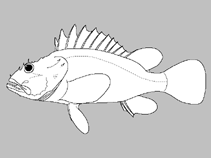 No image available for this species;
drawing shows typical species in Scorpaenidae.
imej Google
drawing shows typical species in Scorpaenidae.
klasifikasi / Nama Nama-nama umum | Sinonim (persamaan) | Catalog of Fishes(Marga, Jenis) | ITIS | CoL | WoRMS | Cloffa
> Perciformes/Scorpaenoidei (Scorpionfishes) > Scorpaenidae (Scorpionfishes or rockfishes) > Scorpaeninae
Etymology: Scorpaena: Latin, scorpaena = a kind of fish, 1706 (Ref. 45335); wellingtoni: Named for Gerard M. Wellington, a pioneer in research on the marine biology and conservation in the Galápagos Archipelago.
Eponymy: Gerard M Wellington (d: 2014) was Professor of Biology at the University of Houston. [...] (Ref. 128868), visit book page.
Etymology: Scorpaena: Latin, scorpaena = a kind of fish, 1706 (Ref. 45335); wellingtoni: Named for Gerard M. Wellington, a pioneer in research on the marine biology and conservation in the Galápagos Archipelago.
Eponymy: Gerard M Wellington (d: 2014) was Professor of Biology at the University of Houston. [...] (Ref. 128868), visit book page.
Lingkungan: lingkungan / zona iklim / kisaran kedalaman / jangkauan distribusi Ekologi
laut berasosiasi dengan karang. Tropical
Penyebaran Wilayah | Daerah-daerah FAO | Ekosistem | Kemunculan | peta titik | Introduksi | Faunafri
Southeast Pacific: Galápagos Islands.
Ukuran / Berat / umur
deskripsi pendek Kunci identifiaksi (pengenalan) | Morfologi | Morfometrik
Duri punggung (Keseluruhan (total)) : 12; Duri dubur: 3; vertebrata, bertulang belakang: 24. This species is distinguished by the following characters: D XII,8½ (38 split to base); A III,5½; pectoral-fin rays 21, the second through fifth ray branched; penultimate dorsal-fin spine more than half length of ultimate spine; gill rakeres, upper-limb 4, lower 6-7; relatively deep body, depth 36.2-37.0 SL, upper body below spinous dorsal fin arched; eye large, snout short; occipital pit moderate to shallow, no significant suborbital pit; interorbital space narrow and shallow, its width 3.2-5.2% SL, width between supraocular spines 4.3-6.3% SL, interorbital ridges are not developed; suborbital ridge with 2 small spines, one at midpoint, one at end; simple lacrimal spines 2, posterior spine oriented straight down; preopercular spines 5, the first spine reaching halfway across operculum with no supplemental preopercular spine, second spine much shorter than third; upper posttemporal spine directed obliquely upward; with cleithral spine; lower rim of upper corneal layer (= “corneal drape”) of eye with rounded tabs associated with tentacles; lateral line scales 23, some with tentacles; anterior mandibular pores paired. Colouration: a dark bar on cheek below rear half of eye, dark blotches on operculum above and below the first preopercular spine, indistinct dark blotch on anterior mid-body, a series of dark spots and saddles along base of spinous and soft dorsal fins, dusky caudal peduncle, two dark bands on both the soft dorsal and anal fins, clear caudal fin, dark base and tip of pectoral fin, and dark pelvic fins (Ref. 94246).
Cross section: compressed.
Cross section: compressed.
Siklus hidup dan perilaku kawin Kematangan | Reproduksi, perkembang biakan | Pemijahan | telur-telur | Fekunditas | Larva
rujukan utama
Unggah referensi Anda | Acuan | Koordinator | mitra
Victor, B.C., 2013. Scorpaena wellingtoni n. sp., a new scorpionfish from the Galápagos Islands (Scorpaeniformes: Scorpaenidae). J. Ocean Sci. Found. 8:30-43. (Ref. 94246)
Status IUCN Red List (Ref. 130435: Version 2025-2 (Global))
kekurangan data (DD) ; Date assessed: 16 September 2022
CITES
Not Evaluated
ancaman kepada manusia
Harmless
penggunaan manusia
FAO - Publication: search | FishSource |
informasi lanjut
Ekologi trofik
Item makanan (mangsa)
Komposisi makanan
Konsumsi makanan
Ransum makanan
Pemangsa
Item makanan (mangsa)
Komposisi makanan
Konsumsi makanan
Ransum makanan
Pemangsa
Ekologi
Ekologi
Ekologi
Dinamika populasi
Parameter pertumbuhan
Maks. usia / ukuran
Panjang-berat rel.
Panjang-panjang rel.
ukuran frekuensi
Konversi massa
pemulihan
Kelimpahan
Parameter pertumbuhan
Maks. usia / ukuran
Panjang-berat rel.
Panjang-panjang rel.
ukuran frekuensi
Konversi massa
pemulihan
Kelimpahan
Siklus hidup
Reproduksi, perkembang biakan
Kematangan
Kedewasaan / insang rel.
Fekunditas
Pemijahan
Agregasi pemijahan
telur-telur
pekembangan telor
Larva
Dinamika larva
Reproduksi, perkembang biakan
Kematangan
Kedewasaan / insang rel.
Fekunditas
Pemijahan
Agregasi pemijahan
telur-telur
pekembangan telor
Larva
Dinamika larva
Anatomi
Area insang
Otak
Otolith
Area insang
Otak
Otolith
Fisiologi
Komposisi tubuh
Nutrisi
Konsumsi oksigen
Jenis renang
Kecepatan berenang
Pigmen visual
Suara ikan
Penyakit & Parasit
Toksisitas (LC50)
Komposisi tubuh
Nutrisi
Konsumsi oksigen
Jenis renang
Kecepatan berenang
Pigmen visual
Suara ikan
Penyakit & Parasit
Toksisitas (LC50)
Genetika
genom
Genetika
Heterozigositas
Diturunkan
Keanekaragaman Genetik
genom
Genetika
Heterozigositas
Diturunkan
Keanekaragaman Genetik
Yang berhubungan dengan manusia
Sistem akuakultur
profil budidaya air
Strain
Kasus Ciguatera
Perangko, koin, dll.
Sistem akuakultur
profil budidaya air
Strain
Kasus Ciguatera
Perangko, koin, dll.
Alat, peralatan
E-book | Penuntun lapangan | tanda freqkuenci panjang | peringkat sejarah hidup | peta titik |
Tangkap-MSY |
laporan khas
muat turun XML
Sumber internet
AFORO (otoliths) | Aquatic Commons | BHL | Cloffa | Websites from users | semak peneliti ikan | CISTI | Catalog of Fishes: Marga, Jenis | DiscoverLife | ECOTOX | FAO - Publication: search | Faunafri | Fishipedia | Fishtrace | GloBI | Google Books | Google Scholar | Google | IGFA World Record | OneZoom | Open Tree of Life | Otolith Atlas of Taiwan Fishes | PubMed | Reef Life Survey | Socotra Atlas | TreeBase | Tree of Life | Wikipedia: pergi, Cari | World Records Freshwater Fishing | Zoobank | Catatan Zoologi
Estimasi berdasarkan model
Indeks keanekaragaman filogenetik (Acuan 82804): PD50 = 0.5000 [Uniqueness, from 0.5 = low to 2.0 = high].
Bayesian length-weight: a=0.01349 (0.00638 - 0.02853), b=3.01 (2.84 - 3.18), in cm total length, based on LWR estimates for this Genus-body shape (Ref. 93245).
Tingkat Trofik (Acuan 69278): 3.4 ±0.2 se; based on size and trophs of closest relatives
Daya lenting (Acuan 120179): Tinggi, Waktu penggandaan populasi minimum kurang dari 15 bulan (Preliminary K or Fecundity.).