This website uses cookies to enhance your browsing experience and ensure the functionality of our site. For more detailed information about the types of cookies we use and how we protect your privacy, please visit our Privacy Information page.
×
Cookie Settings
This website uses different types of cookies to enhance your experience. Please select your preferences below:
> Gobiiformes (Gobies) > Gobiidae (Gobies) > Gobiinae
Etymology: vandersteene:Name from the combined surnames of Rob Vanderloos and Roger Steene, two highly esteemed underwater photographers who have contributed greatly to the knowledge of the reef fishes of Milne Bay; noun in apposition. Eponymy: Professor Cornelius Jan van der Horst (1889–1951) was a Dutch zoologist who moved to South Africa (1928) and became Head of the Zoology Department, Witwatersrand University, Johannesburg. [...] (Ref. 128868), visit book page.
Ambiente: milieu / zona climatica / distribuzione batimetrica / gamma di distribuzione Ecologia
marino associati a barriera corallina; distribuzione batimetrica 35 - 60 m (Ref. 122681). Tropical
Maturità: Lm? range ? - ? cm Max length : 3.2 cm SL maschio/sesso non determinato; (Ref. 122681); 2.8 cm SL (female)
Breve descrizione Chiavi di identificazione | Morfologia | Morfometria
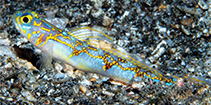
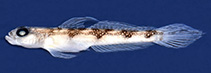
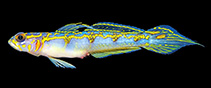
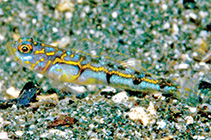
Spine dorsali (totale) : 7; Raggi dorsali molli (totale) : 10 - 12; Spine anali: 1; Raggi anali molli: 11. This species is distinguished by the following characters: D VI-I,10-12, with fourth dorsal-fin spine filamentous, reaching base of about fifth to seventh segmented dorsal-fin ray when adpressed; A I,11; pectoral-fin rays 16-18; lateral scales 35-37; transverse scales 10; body scales mostly ctenoid, except with cycloid scales anterior to level of about second dorsal-fin origin, on pectoral-fin base, prepelvic region, and lower side between pectoral and pelvic fins; no scales on head, including medially and anteriorly on predorsal region; caudal fin lanceolate with an elongate median filament. Colour in life is light neon blue with wavy yellow-orange stripe from upper operculum to upper caudal-fin base; with prominent yellow-orange bars, bands, and spots on head and upper sides; a pair of yellow stripes on the second dorsal fin; yellow streaks and bands on caudal fin (Ref. 122681). Cross section: oval.
Inhabits relatively steep outer reef slope with fish occupying burrows on black volcanic sand/
rubble substrates. About 20 individuals were observed in an area that occupied about 600 sq.m. Solitary individuals encountered were invariably associated with an unidentified snapping shrimp of the genus Alpheus that share the burrows, a symbiotic relationship found in all Vanderhorstia species (Ref. 122681).
Ciclo vitale e comportamento di accoppiamento Maturità | Riproduzione | Deposizione | Uova | Fecondità | Larve
Allen, G.R., M.V. Erdmann and W.M. Brooks, 2020. Vanderhorstia vandersteene, a new species of shrimpgoby (Pisces: Gobiidae) from Papua New Guinea. J. Ocean Sci. Found. 35:65-75. (Ref. 122681)
Stato della Lista Rossa IUCN (Ref. 130435: Version 2025-2 (Global))
Dinamica della popolazione Parametri di crescita Età massima / dimensioni massime Rapporto lunghezza-peso. Lunghezza-lunghezza rel. Lunghezza-frequenze Conversione di massa Reclutamento Abbondanza
Ciclo di vita Riproduzione Maturità Maturità/Gli occhielli sono relativi. Fecondità Deposizione Aggregazioni riproduttive Uova Sviluppo delle uova Larve Dinamica popolazioni larvali
Fisiologia Composizione corporea Nutrienti Consumo di ossigeno Tipo di nuoto Velocità di nuoto Pigmenti visivi Suono del pesce Malattie e parassiti Tossicità (LC50)
Indice di diversità filogenetica (Fonte Biblio. 82804): PD50 = 0.5000 [Uniqueness, from 0.5 = low to 2.0 = high].
Bayesian length-weight: a=0.00741 (0.00347 - 0.01582), b=3.09 (2.91 - 3.27), in cm total length, based on LWR estimates for this (Sub)family-body shape (Ref. 93245).
Livello trofico (Fonte Biblio. 69278): 3.1 ±0.3 se; based on size and trophs of closest relatives
Resilienza (Fonte Biblio. 120179): Alto, tempo minimo di raddoppiamento della popolazione meno di 15 mesi (Preliminary K or Fecundity.).
Vulnerabilità della pesca (Ref. 59153): Low vulnerability (10 of 100). 🛈