This website uses cookies to enhance your browsing experience and ensure the functionality of our site. For more detailed information about the types of cookies we use and how we protect your privacy, please visit our Privacy Information page.
×
Cookie Settings
This website uses different types of cookies to enhance your experience. Please select your preferences below:
> Pleuronectiformes (Flatfishes) > Pleuronectidae (Righteye flounders) > Pleuronectinae
Etymology: Platichthys:Greek, platys = flat + Greek, ichthys = fish (Ref. 45335); solemdali:Named for Per Solemdal (1941-2016), the first researcher to study the Baltic Sea flounder’s eggs and sperm in connection to salinity; he discovered that 'the specific gravity of the eggs is a fixed population characteristic which is almost unchangeable' (Solemdal, 1973), thus laying the foundations on which many subsequent studies on local adaptation and speciation of Baltic Sea marine fishes were built. Eponymy: Per Solemdal (1941–2016) was a marine scientist who spent his entire career at the Insitute of Marine Research, Bergen, Norway (1967–2011). [...] (Ref. 128868), visit book page.
Taxonomic Remarks This species would be the result of the first colonization of the Baltic Sea at its opening, the ancestral population having colonized a seconfd time while Platichthys solemdali was already differentiated (Momigliano et al. 2018: Ref. 119386). Further genetic evidence is need to confirm this species, but life-traits evidence suggests that this population should be considered as separated stocks.
Ambiente: milieu / zona climatica / distribuzione batimetrica / gamma di distribuzione Ecologia
Maturità: Lm? range ? - ? cm Max length : 26.7 cm SL maschio/sesso non determinato; (Ref. 119386); 21.4 cm SL (female)
Breve descrizione Chiavi di identificazione | Morfologia | Morfometria
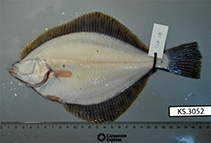
Raggi dorsali molli (totale) : 46 - 59; Raggi anali molli: 35 - 41; Vertebre: 33 - 35. This species is distinguished from all its congeners by the following: differs from P. stellatus by the absence of stripes on the dorsal and anal fin rays (vs. presence); differs from P. flesus with more than 99.999% certainty using genotypes of at least three of the outlier loci which were genotyped in this study (Loci 886, 3599, and 1822), with dorsal-fin rays 46-59 (vs. 51-66) and anal-fin rays 35-41 (vs. 35-45). Reproductive traits (viz. egg morphology and buoyancy, as well as sperm physiology) are distinct diagnostic characters with eggs of P. solemdali become neutrally buoyant at salinities between 16 and 21.5 psu and are 0.99 ± 0.05 mm in diameter, whereas the eggs of P. flesus in the Baltic Sea are larger, 1.3-1.5 mm, and reach neutral buoyancy between 11 and 18 psu). Spermatozoa of P. solemdalis activate at minimum salinities between 2 and 4 psu (vs. required salinity above 10 psu for P. flesus) (Ref. 119386). Cross section: flattened.
This demersal species has been reported to have adults reside in the archipelago and coastal areas throughout their lives undertaking only limited migrations between deeper wintering grounds and shallower spawning and feeding areas. It lives in brackish water of varying salinities at 0.5 to 50 m depth on soft and hard bottoms. It is a benthivore, feeding on various mussels and other benthic invertebrates from its postsettled juvenile stage. Spawning occurs in April to June in nearshore areas 5-20 m depth, preferred water temperature of around 8°C. Mature females are reported lay up to 2 million relatively small eggs after fertilization develop on the bottom, above stony, sandy, or vegetated substrates. Little is known about its larval phase, while early development and juvenile habitat use generally resembles the common features of flatfishes. There are no studies specifically done on age and length at maturity for demersal Baltic flounder. However, around Gotland in the central Baltic Sea (SD 28) where both P. flesus and P. solemdali species co-occur, female flounders recruit to the adult population and attain maturity around the age of 3 years (range: 2-5) at a length of 20-25 cm, while males often maturing earlier (2-3 years) than females (3-4 years) (Ref. 119386).
Ciclo vitale e comportamento di accoppiamento Maturità | Riproduzione | Deposizione | Uova | Fecondità | Larve
Momigliano, O., G.P.J. Denys, H. Jokinen and J. Merilä, 2018. Platichthys solemdali sp. nov. (Actinopterygii, Pleuronectiformes): a new flounder species from the Baltic Sea.. Front. Mar. Sci. 5:Art. 225:1-21. (Ref. 119386)
Stato della Lista Rossa IUCN (Ref. 130435: Version 2025-2 (Global))
Dinamica della popolazione Parametri di crescita Età massima / dimensioni massime Rapporto lunghezza-peso. Lunghezza-lunghezza rel. Lunghezza-frequenze Conversione di massa Reclutamento Abbondanza
Ciclo di vita Riproduzione Maturità Maturità/Gli occhielli sono relativi. Fecondità Deposizione Aggregazioni riproduttive Uova Sviluppo delle uova Larve Dinamica popolazioni larvali
Fisiologia Composizione corporea Nutrienti Consumo di ossigeno Tipo di nuoto Velocità di nuoto Pigmenti visivi Suono del pesce Malattie e parassiti Tossicità (LC50)
Indice di diversità filogenetica (Fonte Biblio. 82804): PD50 = 0.5625 [Uniqueness, from 0.5 = low to 2.0 = high].
Bayesian length-weight: a=0.01000 (0.00244 - 0.04107), b=3.04 (2.81 - 3.27), in cm total length, based on all LWR estimates for this body shape (Ref. 93245).
Livello trofico (Fonte Biblio. 69278): 3.9 ±0.13 se; based on food items.
Resilienza (Fonte Biblio. 120179): Medio, tempo minimo di raddoppiamento della popolazione 1.4 - 4.4 anni (Preliminary K or Fecundity.).
Vulnerabilità della pesca (Ref. 59153): Low vulnerability (23 of 100). 🛈