



Orthochromis indermauri Schedel, Vreven, Katemo Manda, Abwe, Chocha Manda & Schliewen, 2018
muatnaik fotos/gambar dan video
imej Google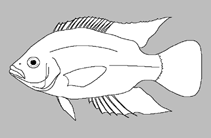 No image available for this species;
drawing shows typical species in Cichlidae.
imej Google
drawing shows typical species in Cichlidae.
klasifikasi / Nama Nama-nama umum | Sinonim (persamaan) | Catalog of Fishes(Marga, Jenis) | ITIS | CoL | WoRMS | Cloffa
> Cichliformes (Cichlids, convict blennies) > Cichlidae (Cichlids) > Pseudocrenilabrinae
Etymology: Orthochromis: Greek, ortho = straight + Greek, chromis = a fish, perhaps a perch (Ref. 45335); indermauri: The species name indermauri honours the Swiss ichthyologist Dr. Adrian Indermaur, who was the first to document this new species with underwater photographs, videos, and with aquarium observations, thereby contributing to a large extent to our knowledge of behaviour and ecology of this species (Ref. 122085).
Eponymy: Dr Adrian Indermaur (d: 1984) is a Swiss ichthyologist who is (2014) Head of the animal facility at the Waler Salzburger Laboratory. [...] (Ref. 128868), visit book page.
Etymology: Orthochromis: Greek, ortho = straight + Greek, chromis = a fish, perhaps a perch (Ref. 45335); indermauri: The species name indermauri honours the Swiss ichthyologist Dr. Adrian Indermaur, who was the first to document this new species with underwater photographs, videos, and with aquarium observations, thereby contributing to a large extent to our knowledge of behaviour and ecology of this species (Ref. 122085).
Eponymy: Dr Adrian Indermaur (d: 1984) is a Swiss ichthyologist who is (2014) Head of the animal facility at the Waler Salzburger Laboratory. [...] (Ref. 128868), visit book page.
Lingkungan: lingkungan / zona iklim / kisaran kedalaman / jangkauan distribusi Ekologi
; air tawar bentopelagis; pH range: 8.0 - 8.6. Tropical; 23°C - 28°C (Ref. 122085)
Penyebaran Wilayah | Daerah-daerah FAO | Ekosistem | Kemunculan | peta titik | Introduksi | Faunafri
Africa: lower reaches of Lufubu River, tributary of Lake Tanganyika, in Zambia (Ref. 122085).
Ukuran / Berat / umur
deskripsi pendek Kunci identifiaksi (pengenalan) | Morfologi | Morfometrik
Duri punggung (Keseluruhan (total)) : 17 - 18; duri punggung lunak (Keseluruhan (total)) : 8 - 10; Duri dubur: 3; Sirip dubur lunak: 7 - 9; vertebrata, bertulang belakang: 28 - 29. Diagnosis: Orthochromis indermauri is distinguished from all species currently placed in Orthochromis, except O. torrenticola, by having hypurals 1 and 2 clearly separated or separated by distinct seam vs. always fused (Ref. 122085). It is further distinguished from Malagarasi-Orthochromis species, except O. mazimeroensis, O. malagaraziensis, and O. rubrolabialis, by having fewer caudal vertebrae, 14-15 vs. 16-18, and total vertebrae, 28-29 vs. 30-32; it is also distinguished from O. luichensis, O. malagaraziensis, O. mazimeroensis, O. mosoensis by having more inner series of teeth in upper jaw, 3-5 vs. 1-2; moreover, it differs from O. kasuluensis by having fewer anal-fin rays, 7-9 vs. 10; from O. malagaraziensis by having more scales between upper lateral line and dorsal-fin origin, 5-7 vs. 3-4, and by having more ceratobranchial gill rakers, 8-11 vs. 6-7; from O. mazimeroensis by having more abdominal vertebrae, 14-15 vs. 12-13; from O. mosoensis and O. rubrolabialis by having more ceratobranchial gill rakers, 8-11 vs. 5-7, and total gill rakers, 11-15 vs. 8-10; from O. uvinzae by having fewer horizontal line scales, 25-29 vs. 30-32, fewer dorsal-fin spines, 17-18 vs. 19-20, and by position of pterygiophore supporting last dorsal-fin spine, vertebral count 16-17 vs. 18-19 (Ref. 122085). It is distinguished from O. kalungwishiensis, O. luongoensis, and O. torrenticola by having fewer horizontal line scales, 28-29 vs. 30-32, and by having fewer caudal vertebrae, 14-15 vs. 17-18; further, it differs from O. luongoensis and O. machadoi by having fewer series of scales on cheek, 0-1 vs. 2-5; from O. kalungwishiensis by having fewer total vertebrae, 28-29 vs. 31-33 (Ref. 122085). It is distinguished from Schwetzochromis neodon by having fewer horizontal line scales, 28-29 vs. 30-31, more circumpeduncular scales, 16 vs. 12, fewer caudal vertebrae, 14-15 vs. 16-17, fewer total vertebrae, 28-29 vs. 30-32, fewer dorsal-fin rays, 8-10 vs. 11-12, and by having hypurals 1 and 2 clearly separated or separated by distinct seam vs. fused; it differs from Haplochromis snoeksi by having fewer scales on cheek, 0-1 vs. 2-3, fewer horizontal line scales, 25-29 vs. 30-31, more abdominal vertebrae, 14-15 vs. 13, fewer caudal vertebrae, 14-15 vs. 17, fewer total vertebrae, 28-29 vs. 30, more anal-fin rays, 7-9 vs. 5-6, more dorsal-fin spines, 17-18 vs. 16, more ceratobranchial gill rakers, 8-11 vs. 6, and total gill rakers, 11-15 vs. 9; from Haplochromis bakongo by having more inner series of teeth, 3-5 vs. 1-2, more dorsal-fin spines, 17-18 vs. 14-15, and in position of pterygiophore supporting last dorsal-fin spine, vertebral count 16-18 vs. 13-14; from Haplochromis moeruensis by having hypurals 1 and 2 clearly separated or separated by distinct seam vs. always fused; meristic values of O. indermauri overlap with those of Haplochromis vanheusdeni but is distinguished in head mask, nostril stripe present vs. absent, caudal corner of cheek with blackish element vs. no such element present, and by size and colouration of eggspot-like maculae on anal fin, deep red centre vs. orange centre in Haplochromis vanheusdeni (Ref. 122085). It is distinguished from O. mporokoso and O. katumbii by having fewer caudal vertebrae, 14-15 vs. 16-17, fewer total vertebrae, 28-29 vs. 30-31, and by having hypurals 1 and 2 and hypurals 3 and 4 clearly separated or separated by distinct seam vs. always fused; further from O. mporokoso by having fewer series of scales on cheek, 0-1 vs. 2-4; from O. katumbii by having fewer horizontal line scales, 25-29 vs. 30-31; it is distinguished from O. kimpala by having fewer series of scales on cheek, 0-1 vs. 3-4, and by having more dorsal-fin spines, 17-18 vs. 15-16; meristic values of O. indermauri overlap with those of O. gecki but is distinguished by having a wider interorbital width, 13.5-18.2% of head length vs. 9.6-12.9% (Ref. 122085).
Body shape (shape guide): fusiform / normal.
Body shape (shape guide): fusiform / normal.
Found in part of river which is rocky with some patches of sand and gravel, about 20 meters wide and on average 50 cm deep (Ref. 122085). This species is benthic-rheophilic and prefers stretches of fast flowing water where it is found between and among large rocks or patches of gravel (Ref. 122085). It is a maternal mouthbrooder (Ref. 122085).
Siklus hidup dan perilaku kawin Kematangan | Reproduksi, perkembang biakan | Pemijahan | telur-telur | Fekunditas | Larva
rujukan utama
Unggah referensi Anda | Acuan | Koordinator : Kullander, Sven O. | mitra
Schedel, F.D.B., E.J.W.M.N. Vreven, B. Katemo Manda, E. Abwe, A. Chocha Manda and U.K. Schliewen, 2018. Description of five new rheophilic Orthochromis species (Teleostei: Cichlidae) from the Upper Congo drainage in Zambia and the Democratic Republic of the Congo. Zootaxa 4461(3):301-349. (Ref. 122085)
CITES
Not Evaluated
ancaman kepada manusia
Harmless
penggunaan manusia
FAO - Publication: search | FishSource |
informasi lanjut
Ekologi trofik
Item makanan (mangsa)
Komposisi makanan
Konsumsi makanan
Ransum makanan
Pemangsa
Item makanan (mangsa)
Komposisi makanan
Konsumsi makanan
Ransum makanan
Pemangsa
Dinamika populasi
Parameter pertumbuhan
Maks. usia / ukuran
Panjang-berat rel.
Panjang-panjang rel.
ukuran frekuensi
Konversi massa
pemulihan
Kelimpahan
Parameter pertumbuhan
Maks. usia / ukuran
Panjang-berat rel.
Panjang-panjang rel.
ukuran frekuensi
Konversi massa
pemulihan
Kelimpahan
Siklus hidup
Reproduksi, perkembang biakan
Kematangan
Kedewasaan / insang rel.
Fekunditas
Pemijahan
Agregasi pemijahan
telur-telur
pekembangan telor
Larva
Dinamika larva
Reproduksi, perkembang biakan
Kematangan
Kedewasaan / insang rel.
Fekunditas
Pemijahan
Agregasi pemijahan
telur-telur
pekembangan telor
Larva
Dinamika larva
Anatomi
Area insang
Otak
Otolith
Area insang
Otak
Otolith
Fisiologi
Komposisi tubuh
Nutrisi
Konsumsi oksigen
Jenis renang
Kecepatan berenang
Pigmen visual
Suara ikan
Penyakit & Parasit
Toksisitas (LC50)
Komposisi tubuh
Nutrisi
Konsumsi oksigen
Jenis renang
Kecepatan berenang
Pigmen visual
Suara ikan
Penyakit & Parasit
Toksisitas (LC50)
Genetika
genom
Genetika
Heterozigositas
Diturunkan
Keanekaragaman Genetik
genom
Genetika
Heterozigositas
Diturunkan
Keanekaragaman Genetik
Yang berhubungan dengan manusia
Sistem akuakultur
profil budidaya air
Strain
Kasus Ciguatera
Perangko, koin, dll.
Sistem akuakultur
profil budidaya air
Strain
Kasus Ciguatera
Perangko, koin, dll.
Alat, peralatan
E-book | Penuntun lapangan | tanda freqkuenci panjang | peringkat sejarah hidup | peta titik |
Tangkap-MSY |
laporan khas
muat turun XML
Sumber internet
AFORO (otoliths) | Aquatic Commons | BHL | Cloffa | Websites from users | semak peneliti ikan | CISTI | Catalog of Fishes: Marga, Jenis | DiscoverLife | ECOTOX | FAO - Publication: search | Faunafri | Fishipedia | Fishtrace | GloBI | Google Books | Google Scholar | Google | IGFA World Record | OneZoom | Open Tree of Life | Otolith Atlas of Taiwan Fishes | PubMed | Reef Life Survey | Socotra Atlas | TreeBase | Tree of Life | Wikipedia: pergi, Cari | World Records Freshwater Fishing | Zoobank | Catatan Zoologi
Estimasi berdasarkan model
Indeks keanekaragaman filogenetik (Acuan 82804): PD50 = 0.5000 [Uniqueness, from 0.5 = low to 2.0 = high].
Bayesian length-weight: a=0.00389 (0.00180 - 0.00842), b=3.12 (2.94 - 3.30), in cm total length, based on all LWR estimates for this body shape (Ref. 93245).
Daya lenting (Acuan 120179): Tinggi, Waktu penggandaan populasi minimum kurang dari 15 bulan (Preliminary K or Fecundity.).