



Orthochromis mporokoso Schedel, Vreven, Katemo Manda, Abwe, Chocha Manda & Schliewen, 2018
Carica il tuo foto e Video
Google image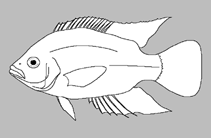 No image available for this species;
drawing shows typical species in Cichlidae.
Google image
drawing shows typical species in Cichlidae.
Classificazione / Nomi Nomi Comuni | Sinonimi | Catalog of Fishes(Genere, Specie) | ITIS | CoL | WoRMS | Cloffa
> Cichliformes (Cichlids, convict blennies) > Cichlidae (Cichlids) > Pseudocrenilabrinae
Etymology: Orthochromis: Greek, ortho = straight + Greek, chromis = a fish, perhaps a perch (Ref. 45335); mporokoso: The species name mporokoso is derived from Mporokoso, a town in the Northern Province of Zambia, near the type locality of the species; a noun in apposition (Ref. 122085).
Etymology: Orthochromis: Greek, ortho = straight + Greek, chromis = a fish, perhaps a perch (Ref. 45335); mporokoso: The species name mporokoso is derived from Mporokoso, a town in the Northern Province of Zambia, near the type locality of the species; a noun in apposition (Ref. 122085).
Ambiente: milieu / zona climatica / distribuzione batimetrica / gamma di distribuzione Ecologia
; acqua dolce benthopelagico; pH range: 6.7 - 7.3. Tropical; 19°C - 20°C (Ref. 122085)
Distribuzione Territories | Aree FAO | Ecosistemi | Presenze | Mappa dei ritrovamenti | Introduzioni | Faunafri
Africa: Kasinsha stream, Lake Mweru drainage, in Zambia (Ref. 122085).
Dimensione / Peso / Età
Breve descrizione Chiavi di identificazione | Morfologia | Morfometria
Spine dorsali (totale) : 16 - 17; Raggi dorsali molli (totale) : 9 - 10; Spine anali: 3; Raggi anali molli: 7 - 9; Vertebre: 30. Diagnosis: Orthochromis mporokoso can be readily distinguished from all species currently placed in Orthochromis and O. sp. "Igamba" from the Malagarasi drainage system by having more scale rows on cheek, 2-4 vs. 0-1 (Ref. 122085). Furthermore, O. mporokoso can be distinguished from O. kasuluensis, O. mosoensis, and O. rugufuensis by having more scales on operculum, 3-4 vs. 0-2; from O. kasuluensis by having fewer total vertebrae, 30 vs. 31-32; from O. rugufuensis by fewer dorsal-fin spines, 6-17 vs. 19; from O. mazimeroensis by more horizontal line scales, 29-30 vs. 26-28, more abdominal vertebrae, 14 vs. 12-13, and more total vertebrae, 30 vs. 28-29; from O. rubrolabialis and O. uvinzae by fewer dorsal-fin spines, 16-17 vs. 18-20; it has more total gill rakers than O. rubrolabialis, 10-12 vs. 8-9, and differs in position of pterygiophore supporting last dorsal-fin spine, vertebral count 16 vs. 17-18 (Ref. 122085). It differs from O. uvinzae additionally by having fewer scales between upper lateral line and dorsal-fin origin, 4-5 vs. 6-8, fewer abdominal vertebrae, 14 vs. 15-16, fewer total vertebrae, 30 vs. 31-33, position of pterygiophore supporting last dorsal-fin spine, vertebral count 16 vs. 18-19, position of pterygiophore supporting last anal-fin spine, vertebral count 14-15 vs. 16-17; from O. luongoensis and O. torrenticola by having fewer caudal vertebrae, 16 vs. 17-18, and total vertebrae, 30 vs. 31-33; from O. kalungwishiensis by having fewer total vertebrae, 30 vs. 31-33, and fewer horizontal line scales, 29-30 vs. 31-32; from O. torrenticola additionally by having fewer anal-fin spines, 3 vs. 4, and position of pterygiophore supporting last anal-fin spine, vertebral count 14-15 vs. 16-17 (Ref. 122085). It can be distinguished from O. stormsi and O. polyacanthus by having fewer scales between upper lateral line and dorsal-fin origin, 4-5 vs. 6-9; in addition, it is distinguished from O. stormsi by having more horizontal line scales, 29-30 vs. 26-28, more total vertebrae, 30 vs. 28-29, and fewer total gill rakers, 10-12 vs. 13-15; from O. polyacanthus by having more series of scales on cheek, 2-4 vs. 0, fewer dorsal-fin spines, 16-17 vs. 18-20, and in position of pterygiophore supporting last dorsal-fin spine, vertebral count 16 vs. 17-18, as in position of pterygiophore supporting last anal-fin spine, vertebral count 14-15 vs. 16-17 (Ref. 122085). Meristic values of O. mporokoso overlap with those of O. machadoi, but it can be readily distinguished by having more vertical bars on flanks, 13-15 vs. 9-10, which moreover extend mainly ventrally; those of O. machadoi extend mainly dorsally; in addition, it is distinguished in head mask pattern, i.e. V-shape nostril stripe in O. mporokoso vs. straight nostril stripe in O. machadoi; cheek stripe present vs. absent in O. machadoi (Ref. 122085). It differs from Schwetzochromis neodon by ahving more circumpeduncular scales, 16 vs. 12, fewer inner series of teeth, 1-3 vs. 4-6, and fewer dorsal-fin rays, 9-10 vs. 11-12; it differs from Haplochromis bakongo and Haplochromis moeruensis by having more horizontal line scales, 29-30 vs. 26-28, more caudal vertebrae, 16 vs. 12-15, and more total vertebrae, 30 vs. 26-29; additionally, it is distinguished from H. moeruensis by having more upper lateral line scales, 21-23 vs. 19-20; from H. bakongo by having more dorsal-fin spines, 16-17 vs. 14-15, and in position of pterygiophore supporting last dorsal-fin spine, vertebral count 16 vs. 13-14; and from H. snoeksi it is distinguished by having more abdominal vertebrae, 14 vs. 13, fewer caudal vertebrae, 16 vs. 17, more anal-fin rays, 7-9 vs. 5-6, more total gill rakers, 10-12 vs. 9, and in position of pterygiophore supporting last dorsal-fin spine, vertebral count 16 vs. 15, and position pterygiophore supporting last anal-fin spine, vertebral count 14-15 vs. 13 (Ref. 122085). Meristic values of O. mporokoso overlap with those of Haplochromis vanheusdeni, but it lacks eggspots, has a nostril stripe vs. absent in H. vanheusdeni, exhibits a cheek stripe vs. absent in H. vanheusdeni, and has a higher number of vertical bars on flank, 13-15 vs. 6-7 (Ref. 122085). It differs from O. kimpala by having fewer scales between upper lateral line and dorsal-fin origin, 4-5 vs. 6-7; from O. indermauri by having more series of scales on the cheek, 2-4 vs. 0-1, more caudal vertebrae, 16 vs. 14-15, and more total vertebrae, 30 vs. 28-29 (Ref. 122085). Meristic values of O. mporokoso overlap with those of O. katumbii but former differs by having more vertical bars on flank, 13-15 vs. 7-9, and by head mask pattern, cheek stripe present vs. absent in O. katumbii; meristic values of O. mporokoso overlap with those of O. gecki but former is distinguished by having much wide interorbital, 1.3-19.5% of head length vs. 9.6-12.9%, and by lacking eggspots on anal fin vs. present in O. gecki (Ref. 122085).
Body shape (shape guide): fusiform / normal.
Body shape (shape guide): fusiform / normal.
A benthic-rheophilic species (Ref. 122085).
Ciclo vitale e comportamento di accoppiamento Maturità | Riproduzione | Deposizione | Uova | Fecondità | Larve
Riferimento principale
Caricare le referenze | Bibliografia | Coordinatore : Kullander, Sven O. | Collaboratori
Schedel, F.D.B., E.J.W.M.N. Vreven, B. Katemo Manda, E. Abwe, A. Chocha Manda and U.K. Schliewen, 2018. Description of five new rheophilic Orthochromis species (Teleostei: Cichlidae) from the Upper Congo drainage in Zambia and the Democratic Republic of the Congo. Zootaxa 4461(3):301-349. (Ref. 122085)
CITES
Not Evaluated
Minaccia per l'uomo
Harmless
Usi umani
FAO - Publication: search | FishSource |
Informazioni ulteriori
Ecologia trofica
Articoli alimentari (prede)
Alimentazione
Consumo di cibo
Razioni alimentari
Predatori
Articoli alimentari (prede)
Alimentazione
Consumo di cibo
Razioni alimentari
Predatori
Dinamica della popolazione
Parametri di crescita
Età massima / dimensioni massime
Rapporto lunghezza-peso.
Lunghezza-lunghezza rel.
Lunghezza-frequenze
Conversione di massa
Reclutamento
Abbondanza
Parametri di crescita
Età massima / dimensioni massime
Rapporto lunghezza-peso.
Lunghezza-lunghezza rel.
Lunghezza-frequenze
Conversione di massa
Reclutamento
Abbondanza
Ciclo di vita
Riproduzione
Maturità
Maturità/Gli occhielli sono relativi.
Fecondità
Deposizione
Aggregazioni riproduttive
Uova
Sviluppo delle uova
Larve
Dinamica popolazioni larvali
Riproduzione
Maturità
Maturità/Gli occhielli sono relativi.
Fecondità
Deposizione
Aggregazioni riproduttive
Uova
Sviluppo delle uova
Larve
Dinamica popolazioni larvali
Anatomia
Area branchiale
Cervello
Otolite
Area branchiale
Cervello
Otolite
Fisiologia
Composizione corporea
Nutrienti
Consumo di ossigeno
Tipo di nuoto
Velocità di nuoto
Pigmenti visivi
Suono del pesce
Malattie e parassiti
Tossicità (LC50)
Composizione corporea
Nutrienti
Consumo di ossigeno
Tipo di nuoto
Velocità di nuoto
Pigmenti visivi
Suono del pesce
Malattie e parassiti
Tossicità (LC50)
Genetica
Genome
Genetica
Eterozigosi
Ereditarietà
Diversità genetica
Genome
Genetica
Eterozigosi
Ereditarietà
Diversità genetica
Legato all'uomo
Sistemi di acquacoltura
Profili di acquacoltura
Varietà
Casi di Ciguatera
Francobolli, monete, materiale vario.
Sistemi di acquacoltura
Profili di acquacoltura
Varietà
Casi di Ciguatera
Francobolli, monete, materiale vario.
Strumenti
Libro elettronico | Giuda pratica | Generatore frequenze di lunghezza | Strumento Parametri Biologici | Mappa dei ritrovamenti |
Cattura-MSY |
Rapporti speciali
Controllo della manutenzione dell'acquario | Verificare la presenza di schede informative sulle specie | Verifica delle schede informative sull'acquacoltura
Scarica XML
Fonti Internet
AFORO (otoliths) | Aquatic Commons | BHL | Cloffa | Websites from users | Check FishWatcher | CISTI | Catalog of Fishes: Genere, Specie | DiscoverLife | ECOTOX | FAO - Publication: search | Faunafri | Fishipedia | Fishtrace | GloBI | Google Books | Google Scholar | Google | IGFA World Record | OneZoom | Open Tree of Life | Otolith Atlas of Taiwan Fishes | PubMed | Reef Life Survey | Socotra Atlas | TreeBase | Tree of Life | Wikipedia: Go, ricerca | World Records Freshwater Fishing | Zoobank | Record zoologico
Stime basate su modelli
Indice di diversità filogenetica (Fonte Biblio. 82804): PD50 = 0.5000 [Uniqueness, from 0.5 = low to 2.0 = high].
Bayesian length-weight: a=0.00389 (0.00180 - 0.00842), b=3.12 (2.94 - 3.30), in cm total length, based on all LWR estimates for this body shape (Ref. 93245).
Resilienza (Fonte Biblio. 120179): Alto, tempo minimo di raddoppiamento della popolazione meno di 15 mesi (Preliminary K or Fecundity.).