



分类 / 名称 俗名 | 同种异名 | Catalog of Fishes(属, 种) | ITIS | CoL | WoRMS | Cloffa
Teleostei > Cypriniformes (Carps) > Cyprinidae (Minnows or carps) > Labeoninae
Etymology: Garra: Name based on a vernacular Indian name (Hamilton, 1822:343, Ref. 1813); a fish living in mud (Ref. 128817); napata: Named after "Napata", the capital of the ancient Kush kingdom, which is very close to the type locality of this species; a noun in apposition (Ref. 122047).
Etymology: Garra: Name based on a vernacular Indian name (Hamilton, 1822:343, Ref. 1813); a fish living in mud (Ref. 128817); napata: Named after "Napata", the capital of the ancient Kush kingdom, which is very close to the type locality of this species; a noun in apposition (Ref. 122047).
环境:氛围 / 气候带 / 深度上下限 / 分布范围 生态学
; 淡水 底中水层性.
分布 领土 | FAO区域 | 生态系 | 标本纪录 | 分布图 | 简介 | Faunafri
Africa: Main Nile River in Sudan and Egypt (Ref. 122047).
大小 / 重量 / 年龄
简单描述 检索表 | 型态特徵 | 形态测量图
背棘 (总数) : 0; 背的软条 (总数) : 9 - 10; 臀棘: 0; 臀鳍软条: 7 - 8; 脊椎骨: 34 - 36. Diagnosis: Garra napata differs from all other African Garra species, except G. jamila and G. ethelwynnae, in a scaleless area on the dorsal body area clearly exceeding beyond dorsal fin origin and thus in an incomplete count of only 1 to 2.5 scale rows between the origin of the dorsal fin and lateral line series vs. 3 or more (Ref. 122047). It is distinguished from G. ethelwynnae from the Damas River basin in Eritrea by: its intermediate, type B, developed disc and only minute free posterior flap vs. prominent disc of type C with well-developed posterior flap; and an asquamate postpelvic area vs. squamate (Ref. 122047). It is distinguished from G. jamila of the Atbara by: its intermediate type B developed disc with a very small free posterior flap vs. prominent disc type C with well-developed posterior flap; a smoother upper lip vs. crenate; and, in live specimens, an uncoloured anal fin vs. red anal fin; dark humeral spot large and nearly twice as big as red postopercular spot vs. equally sized small humeral and postopercular spots; fixed specimens usually display a pronounced lateral band and pale back vs. dark back strongly and contrasting light belly (Ref. 122047). It is distinguished from Garra vinciguerrae and G. sannarensis by: its narrow disc, width much smaller than mouth vs. as large as mouth width; virtually absent lateroposterior flap of the disc vs. clearly developed; and a relatively broad head, i.e. cheeks visible when viewed from dorsal vs. cheeks not visible; from G. vinciguerrae by its prominent dark colour markings in the centre of the dorsal-fin membrane near its base vs. no such pattern; from G. sp. "White Nile" by its visible cheeks when viewed from dorsal vs. not visible from above, and by its short barbels barely reaching margin of lower-lip pad vs. almost reaching each other (Ref. 122047).
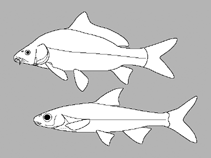
Body shape (shape guide): elongated.
Body shape (shape guide): elongated.
Rheophilic and collected from swift water in strong current, likely prefers habitats with high velocity; occurs syntopically with other rheophilic species like Garra vinciguerrae, Chiloglanis niloticus, Andersonia leptura and Labeo forskalii (Ref. 122047).
生命周期和交配行为 成熟度 | 繁殖 | 产卵场 | 卵 | 孕卵数 | 仔鱼
主要参考文献
上传您的参考资料 | 参考文献 | 合作者 | 合作者
Moritz, T., N. Straube and D. Neumann, 2019. The Garra species (Cyprinidae) of the Main Nile basin with description of three new species. Cybium 43(4):311-329. (Ref. 122047)
CITES
Not Evaluated
对人类的威胁
人类利用
渔业: 没有兴趣
FAO - Publication: search | FishSource |
更多信息
解剖学
鳃区
大脑
耳石
鳃区
大脑
耳石
生理学
身体成分
营养素
耗氧量
游泳类型
游泳速度
视觉色素
鱼声
疾病与寄生虫
毒性(半数致死浓度)
身体成分
营养素
耗氧量
游泳类型
游泳速度
视觉色素
鱼声
疾病与寄生虫
毒性(半数致死浓度)
遗传学
基因组
遗传学
异质性
遗传率
基因多样性
基因组
遗传学
异质性
遗传率
基因多样性
工具
特别资料
下载 XML
网络资源
AFORO (otoliths) | Aquatic Commons | BHL | Cloffa | Websites from users | 核实 FishWatcher | CISTI | Catalog of Fishes: 属, 种 | DiscoverLife | ECOTOX | FAO - Publication: search | Faunafri | Fishipedia | Fishtrace | GloBI | Google Books | Google Scholar | Google | IGFA World Record | OneZoom | Open Tree of Life | Otolith Atlas of Taiwan Fishes | PubMed | Reef Life Survey | Socotra Atlas | TreeBase | 树状分类阶层 | Wikipedia: 转至, 搜寻 | World Records Freshwater Fishing | Zoobank | 动物学的记录
基于模型的估算
系统发育多样性指数 (参考文献 82804): PD50 = 0.5000 [Uniqueness, from 0.5 = low to 2.0 = high].
Bayesian length-weight: a=0.00794 (0.00359 - 0.01758), b=3.04 (2.87 - 3.21), in cm total length, based on LWR estimates for this Genus-body shape (Ref. 93245).
回复力 (参考文献 120179): 高度, 族群倍增时间少于 15个月 (Preliminary K or Fecundity.).