



Electrophorus varii de Santana, Wosiacki, Crampton, Sabaj, Dillman, Mendes-Júnior & Castro e Castro, 2019
Hochladen Photos und videos
Google Bild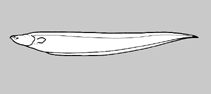 No image available for this species;
drawing shows typical species in Gymnotidae.
Google Bild
drawing shows typical species in Gymnotidae.
Klassifizierung / Names Namen | Synonyme | Catalog of Fishes(Gattung, Arten) | ITIS | CoL | WoRMS | Cloffa
> Gymnotiformes (Knifefishes) > Gymnotidae (Naked-back knifefishes) > Electrophorinae
Etymology: Electrophorus: Greek, elektron = amber + Greek,pherein = to carry (Ref. 45335).
Eponymy: Dr Richard Peter Vari (1949–2016) was a curator of fish at the Smithsonian. [...] (Ref. 128868), visit book page.
Etymology: Electrophorus: Greek, elektron = amber + Greek,pherein = to carry (Ref. 45335).
Eponymy: Dr Richard Peter Vari (1949–2016) was a curator of fish at the Smithsonian. [...] (Ref. 128868), visit book page.
Umwelt: Milieu / Klimazone / Tiefenbereich / Verbreitungsgebiet Ökologie
; süßwasser benthopelagisch. Tropical
Verbreitung Territorien | FAO Gebiete | Ökosysteme | Vorkommen | Punkt Karte | Einführungen | Faunafri
South America: lowland floodplain and terra-firme systems of the intercratonic Amazon Basin; including some streams in the Guiana Shield.
Größe / Gewicht / Alter
Kurzbeschreibung Bestimmungsschlüssel | Morphologie | Morphometrie
This species is distinguished by the following characters: pectoral-fin rays 20-28; lateral-line pores 124-186 ((vs. 32-38 and 88-101, respectively, in E. electricus); narrow head (vs. wide in E. voltai); the distance between medial margins of contralateral dentaries at transverse through last two ventral pores is 2-3 times shorter than E. voltai; deep skull, cleithrum lies between vertebrae 1 and 2 (vs. depressed with cleithrum lying between vertebrae 5 and 6, in E. electricus and E. voltai). Low-voltage electric organ discharges or EOD duration 1.24-1.78 ms, high-voltage EOD 151 V (20.0 cm TL) to 572 V (60.9 cm TL) (Ref. 120918).
Body shape (shape guide): elongated; Cross section: oval.
Body shape (shape guide): elongated; Cross section: oval.
Obligate air-breathing (Ref. 126274)
Lebenszyklus und Paarungsverhalten Geschlechtsreife | Fortpflanzung | Ablaichen | Eier | Fruchtbarkeit | Larven
Hauptreferenz
Laden Sie Ihre Referenzen hoch | Referenzen | Koordinator : Campos-da-Paz, Ricardo | Partner
de Santana, C.D., W.G.R. Crampton, C.B. Dillman, R.G. Frederico, M.H. Sabaj, R. Covain, J. Ready, J. Zuanon, R.R. de Oliveira, R.N. Mendes-Júnior, D.A. Bastos, T.F. Teixeira, J. Mol, W. Ohara, N.C. de Castro, L.A. Peixoto et al., 2019. Unexpected species diversity in electric eels with a description of the strongest living bioelectricity generator. Nature Communications (2019)10:4000. [+authors; Nagamachi, C.; Sousa, L.; Montag, L.F.A.; Ribeiro, F.; Waddell, J.C.; Piorsky, N.M.; Vari, R.P.; Wosiacki, W.B.] (Ref. 120918)
CITES
Not Evaluated
Bedrohung für Menschen
Harmless
Nutzung durch Menschen
FAO - Publication: search | FishSource |
Mehr Information
Trophische Ökologie
Lebensmittel (Beutetiere)
Nahrungszusammensetzung
Nahrungsaufnahme
Lebensmittelrationen
Räuber
Lebensmittel (Beutetiere)
Nahrungszusammensetzung
Nahrungsaufnahme
Lebensmittelrationen
Räuber
Ökologie
Ökologie
Ökologie
Populationsdynamik
Wachstumsparameter
Max. Alter/Größen
Länge-Gewicht-Rel.
Länge-Länge-Verhältnis.
Längenhäufigkeiten
Massenkonvertierung
Rekrutierung
Dichte
Wachstumsparameter
Max. Alter/Größen
Länge-Gewicht-Rel.
Länge-Länge-Verhältnis.
Längenhäufigkeiten
Massenkonvertierung
Rekrutierung
Dichte
Lebenszyklus
Fortpflanzung
Geschlechtsreife
Reifung/Kiemen rel.
Fruchtbarkeit
Ablaichen
Laichaggregationen
Eier
Eientwicklung
Larven
Larven Pop.Dyn.
Fortpflanzung
Geschlechtsreife
Reifung/Kiemen rel.
Fruchtbarkeit
Ablaichen
Laichaggregationen
Eier
Eientwicklung
Larven
Larven Pop.Dyn.
Anatomie
Kiemenoberfläche
Gehirn
Otolith
Kiemenoberfläche
Gehirn
Otolith
Physiologie
Körperliche Zusammensetzung
Nährstoffe
Sauerstoffverbrauch
Schwimmart
Schwimmgeschwindigkeit
Visuelle Pigmente
Fischgeräusche
Krankheiten und Parasiten
Toxizität (LC50s)
Körperliche Zusammensetzung
Nährstoffe
Sauerstoffverbrauch
Schwimmart
Schwimmgeschwindigkeit
Visuelle Pigmente
Fischgeräusche
Krankheiten und Parasiten
Toxizität (LC50s)
Genetik
Genom
Genetik
Heterozygotie
Vererbbarkeit
Genetische Vielfalt
Genom
Genetik
Heterozygotie
Vererbbarkeit
Genetische Vielfalt
Menschenbezogen
Aquakultur-Systeme
Aquakultur Profile
Zuchtlinien
Ciguatera-Fälle
Briefmarken, Münzen, Verschiedenes.
Aquakultur-Systeme
Aquakultur Profile
Zuchtlinien
Ciguatera-Fälle
Briefmarken, Münzen, Verschiedenes.
Tools
Zusatzinformationen
Download XML
Zusammenfassung | Punktdaten | Namen | Photos
Internet Quellen
AFORO (otoliths) | Aquatic Commons | BHL | Cloffa | Websites from users | FishWatcher Einträge suchen | CISTI | Catalog of Fishes: Gattung, Arten | DiscoverLife | ECOTOX | FAO - Publication: search | Faunafri | Fishipedia | Fishtrace | GloBI | Google Books | Google Scholar | Google | IGFA World Record | OneZoom | Open Tree of Life | Otolith Atlas of Taiwan Fishes | PubMed | Reef Life Survey | Socotra Atlas | TreeBase | Tree of Life | Wikipedia: Gehe zu, Suchen | World Records Freshwater Fishing | Zoobank | Zoologischer Rekord
Schätzungen auf der Grundlage von Modellen
Phylogenetischer Diversitätsindex (Ref. 82804): PD50 = 0.6250 [Uniqueness, from 0.5 = low to 2.0 = high].
Bayesian length-weight: a=0.00389 (0.00180 - 0.00842), b=3.12 (2.94 - 3.30), in cm total length, based on all LWR estimates for this body shape (Ref. 93245).
Trophische Ebene (Ref. 69278): 3.5 ±0.5 se; based on size and trophs of closest relatives
Widerstandsfähigkeit (Ref. 120179): sehr niedrig, Verdopplung der Population dauert mehr als 14 Jahre. (Preliminary K or Fecundity.).