



Syncomistes carcharus Shelley, Delaval & Le Feuvre, 2017
Sharp-toothed grunter
Envoyez vos Photos et vidéos
Images Google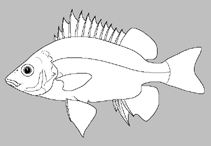 No image available for this species;
drawing shows typical species in Terapontidae.
Images Google
drawing shows typical species in Terapontidae.
Classification / Noms Noms communs | Synonymes | Catalog of Fishes(Genre, Espèce) | ITIS | CoL | WoRMS | Cloffa
> Centrarchiformes (Basses) > Terapontidae (Grunters or tigerperches)
Etymology: Syncomistes: Greek, syn, symphysis = grown together + Greek, komistes, -ou = leader, driver (Ref. 45335); carcharus: The specific epithet carcharus is Latin for sharp teeth, in reference to the robust, pointed teeth of the species, relative to other Syncomistes.
Etymology: Syncomistes: Greek, syn, symphysis = grown together + Greek, komistes, -ou = leader, driver (Ref. 45335); carcharus: The specific epithet carcharus is Latin for sharp teeth, in reference to the robust, pointed teeth of the species, relative to other Syncomistes.
Environnement : milieu / zone climatique / profondeur / gamme de distribution Écologie
; eau douce benthopélagique. Tropical
Distribution Territoires | Zones FAO | Écosystèmes | Occurrences | Carte par point | Introductions | Faunafri
Oceania: Prince Regent River in the Kimberley region, Australia.
Taille / Poids / Âge
Description synthétique Clés d'identification | Morphologie | Morphométrie
Épines dorsales (Total) : 12; Rayons mous dorsaux (Total) : 12 - 13; Épines anales: 3; Rayons mous anaux: 8 - 9; Vertèbres: 25. Syncomistes carcharus is distinguished from other congeners within the Syncomistes complex by a combination of the following characters: jaw rounded with a tapered point when viewed from below in adults (jaw shape of juveniles unknown); mouth terminal; mouth slightly oblique; teeth conical; longest dorsal ray > 16.7 % SL; longest dorsal spine > 13.4 % SL; pectoral fins > 22.8 % SL; upper caudal lobe > 29.9 % SL (Ref. 119336).
Body shape (shape guide): fusiform / normal.
Body shape (shape guide): fusiform / normal.
Inhabits streams, preferring deep back waters and slow-flowing portions. Forms shoals in the middle of the water column with Hephaestus jenkinsi Whitley, 1945. Occurs in clear waters over rocky substrates, usually where algae are in abundance. Found in highest abundance during snorkelling in Pitta Creek, 1km upstream from the confluence with the Prince Regent River (Ref. 119336).
Cycle de vie et comportement reproducteur Maturité | Reproduction | Frai | Œufs | Fécondité | Larves
Référence principale
Téléchargez vos références | Références | Coordinateur | Collaborateurs
Shelley, J.J, A. Delaval and M.C. Le Feuvre, 2017. A revision of the grunter genus Syncomistes (Teleostei, Terapontidae, Syncomistes) with descriptions of seven new species from the Kimberley region, northwestern Australia. Zootaxa 4367(1):1-103. (Ref. 119336)
Statut dans la liste rouge de l'IUCN (Ref. 130435: Version 2025-2 (Global))
Quasi-menacé (NT) (B1a); Date assessed: 02 February 2019
CITES
Not Evaluated
Menace pour l'homme
Harmless
Utilisations par l'homme
FAO - Publication: search | FishSource |
Plus d'informations
Écologie trophique
Aliments (proies)
Composition du régime alimentaire
Consommation alimentaire
Rations alimentaires
Prédateurs
Aliments (proies)
Composition du régime alimentaire
Consommation alimentaire
Rations alimentaires
Prédateurs
Dynamique des populations
Paramètres de croissance
Âges / tailles maximales
Longueur-poids rel.
Rel. longueur-longueur.
Fréquences de longueurs
Conversion de masse
Recrutement
Abondance
Paramètres de croissance
Âges / tailles maximales
Longueur-poids rel.
Rel. longueur-longueur.
Fréquences de longueurs
Conversion de masse
Recrutement
Abondance
Cycle de vie
Reproduction
Maturité
Maturité/épines rel.
Fécondité
Frai
Agrégats de frai
Œufs
Développement de l'œuf
Larves
Dynamique des populations larvaires
Reproduction
Maturité
Maturité/épines rel.
Fécondité
Frai
Agrégats de frai
Œufs
Développement de l'œuf
Larves
Dynamique des populations larvaires
Anatomie
Surface branchiale
Cerveau
Otolithe
Surface branchiale
Cerveau
Otolithe
Physiologie
Composition corporelle
Nutriments
Consommation d'oxygène
Type de natation
Vitesse de nage
Pigments visuels
Son de poisson
Maladies et parasites
Toxicité (CL50)
Composition corporelle
Nutriments
Consommation d'oxygène
Type de natation
Vitesse de nage
Pigments visuels
Son de poisson
Maladies et parasites
Toxicité (CL50)
Génétique
génôme
Génétique
Hétérozygotie
Héritabilité
Diversité génétique
génôme
Génétique
Hétérozygotie
Héritabilité
Diversité génétique
Liées à l'homme
Systèmes d'aquaculture
Profils d'aquaculture
Souches
Cas de ciguatera
Timbres, pièces de monnaie, divers
Systèmes d'aquaculture
Profils d'aquaculture
Souches
Cas de ciguatera
Timbres, pièces de monnaie, divers
Outils
E-book | Guide de terrain | Générateur de fréquences de longueur | Outil de dynamique de population | Carte par point |
Capture-MSY |
Articles particuliers
Télécharger en XML
Sources Internet
AFORO (otoliths) | Aquatic Commons | BHL | Cloffa | Websites from users | FishWatcher | CISTI | Catalog of Fishes: Genre, Espèce | DiscoverLife | ECOTOX | FAO - Publication: search | Faunafri | Fishipedia | Fishtrace | GloBI | Google Books | Google Scholar | Google | IGFA World Record | OneZoom | Open Tree of Life | Otolith Atlas of Taiwan Fishes | PubMed | Reef Life Survey | Socotra Atlas | TreeBase | Arbre de Vie | Wikipedia: aller à, chercher | World Records Freshwater Fishing | Zoobank | Zoological Record
Estimations basées sur des modèles
Indice de diversité phylogénétique (Réf. 82804): PD50 = 0.5005 [Uniqueness, from 0.5 = low to 2.0 = high].
Bayesian length-weight: a=0.01230 (0.00548 - 0.02760), b=3.04 (2.85 - 3.23), in cm total length, based on LWR estimates for this (Sub)family-body shape (Ref. 93245).
Résilience (Réf. 120179): Haut, temps minimum de doublement de population inférieur à 15 mois (Preliminary K or Fecundity.).