



Astatoreochromis straeleni (Poll, 1944)
Bluelip haplo
Hochladen Photos und videos
Bilder | Google Bild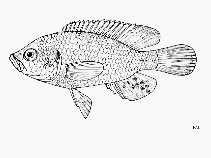 Astatoreochromis straeleni
Photo von FAO
Bilder | Google Bild
Photo von FAO
Klassifizierung / Names Namen | Synonyme | Catalog of Fishes(Gattung, Arten) | ITIS | CoL | WoRMS | Cloffa
> Cichliformes (Cichlids, convict blennies) > Cichlidae (Cichlids) > Pseudocrenilabrinae
Etymology: Astatoreochromis: Greek, astato = unstable + Greek, rheos = stream + Greek, chromis = a marine fish without identification, dealing with perch; cited by Plinius (Ref. 45335); straeleni: Named in honour of Prof. V. Van Straelen, Director of the Musée du Congo Belge, Tervuren, Belgium from 1926 to 1954 (Ref. 126033).
Eponymy: Professor Victor Émile van Straelen (1889–1964) was a Belgian geologist, palaeontologist, carcinologist and naturalist. [...] (Ref. 128868), visit book page.
More on author: Poll.
Etymology: Astatoreochromis: Greek, astato = unstable + Greek, rheos = stream + Greek, chromis = a marine fish without identification, dealing with perch; cited by Plinius (Ref. 45335); straeleni: Named in honour of Prof. V. Van Straelen, Director of the Musée du Congo Belge, Tervuren, Belgium from 1926 to 1954 (Ref. 126033).
Eponymy: Professor Victor Émile van Straelen (1889–1964) was a Belgian geologist, palaeontologist, carcinologist and naturalist. [...] (Ref. 128868), visit book page.
More on author: Poll.
Umwelt: Milieu / Klimazone / Tiefenbereich / Verbreitungsgebiet Ökologie
; süßwasser benthopelagisch. Tropical; 24°C - 28°C (Ref. 2059); 3°S - 8°S
Verbreitung Territorien | FAO Gebiete | Ökosysteme | Vorkommen | Punkt Karte | Einführungen | Faunafri
Africa: Rusizi, Lukuga and Malagarazi basins and Luiche River, a small affluent of Lake Tanganyika (Ref. 5602, 126033); apparently also enters Lake Tanganyika (Ref. 126033).
Größe / Gewicht / Alter
Kurzbeschreibung Bestimmungsschlüssel | Morphologie | Morphometrie
Rückenflossenstacheln (insgesamt) : 16 - 19; Rückenflossenweichstrahlen (insgesamt) : 8 - 10; Afterflossenstacheln: 3 - 4; Afterflossenweichstrahlen: 8 - 10. Diagnosis: Astatoreochromis straeleni can be distinguished from A. alluaudi by the possession of 3-4 anal spines vs. 4-7; 16-18, exceptionally 19, dorsal spines vs. 17-19 dorsal spines, rarely 16 or 20 (Ref. 126033).
Body shape (shape guide): fusiform / normal; Cross section: oval.
Body shape (shape guide): fusiform / normal; Cross section: oval.
Aastatoreochromis straeleni is primarily a riverine species, prefering clear water and caught in swampy flooded areas and marginal vegetation with a high water transparency (Ref. 126033). In Lake Tanganyika, it is found only at the mouths of rivers and in their associated swamps (Ref. 6770). Omnivorous, swamp-dweller (Ref. 6770), reported to feed mainly on snails, ostracods and insects (Ref. 126033). This species is a mouth-brooder (Ref. 126033).
Lebenszyklus und Paarungsverhalten Geschlechtsreife | Fortpflanzung | Ablaichen | Eier | Fruchtbarkeit | Larven
This species is a mouth-brooder (Ref. 126033). Nothing has been reported about its breeding period, but most probably it reproduces at the start of the short dry season from December to January (Ref. 126033).
Hauptreferenz
Laden Sie Ihre Referenzen hoch | Referenzen | Koordinator : Kullander, Sven O. | Partner
van Oijen, M.J.P. and J. Snoeks, 1991. Astatoreochromis. p. 9-10. In J. Daget, J.-P. Gosse, G.G. Teugels and D.F.E. Thys van den Audenaerde (eds.) Checklist of the freshwater fishes of Africa (CLOFFA). ISNB, Brussels; MRAC, Tervuren; and ORSTOM, Paris. Vol. 4. (Ref. 5602)
IUCN Rote Liste Status (Ref. 130435: Version 2025-2 (Global))
nicht bedroht (LC) ; Date assessed: 11 March 2025
CITES
Not Evaluated
Bedrohung für Menschen
Harmless
Nutzung durch Menschen
Fischereien: nicht kommerziell; Aquarium: Kommerziell
FAO - Publication: search | FishSource |
Mehr Information
Trophische Ökologie
Lebensmittel (Beutetiere)
Nahrungszusammensetzung
Nahrungsaufnahme
Lebensmittelrationen
Räuber
Lebensmittel (Beutetiere)
Nahrungszusammensetzung
Nahrungsaufnahme
Lebensmittelrationen
Räuber
Populationsdynamik
Wachstumsparameter
Max. Alter/Größen
Länge-Gewicht-Rel.
Länge-Länge-Verhältnis.
Längenhäufigkeiten
Massenkonvertierung
Rekrutierung
Dichte
Wachstumsparameter
Max. Alter/Größen
Länge-Gewicht-Rel.
Länge-Länge-Verhältnis.
Längenhäufigkeiten
Massenkonvertierung
Rekrutierung
Dichte
Lebenszyklus
Fortpflanzung
Geschlechtsreife
Reifung/Kiemen rel.
Fruchtbarkeit
Ablaichen
Laichaggregationen
Eier
Eientwicklung
Larven
Larven Pop.Dyn.
Fortpflanzung
Geschlechtsreife
Reifung/Kiemen rel.
Fruchtbarkeit
Ablaichen
Laichaggregationen
Eier
Eientwicklung
Larven
Larven Pop.Dyn.
Anatomie
Kiemenoberfläche
Gehirn
Otolith
Kiemenoberfläche
Gehirn
Otolith
Physiologie
Körperliche Zusammensetzung
Nährstoffe
Sauerstoffverbrauch
Schwimmart
Schwimmgeschwindigkeit
Visuelle Pigmente
Fischgeräusche
Krankheiten und Parasiten
Toxizität (LC50s)
Körperliche Zusammensetzung
Nährstoffe
Sauerstoffverbrauch
Schwimmart
Schwimmgeschwindigkeit
Visuelle Pigmente
Fischgeräusche
Krankheiten und Parasiten
Toxizität (LC50s)
Genetik
Genom
Genetik
Heterozygotie
Vererbbarkeit
Genetische Vielfalt
Genom
Genetik
Heterozygotie
Vererbbarkeit
Genetische Vielfalt
Menschenbezogen
Aquakultur-Systeme
Aquakultur Profile
Zuchtlinien
Ciguatera-Fälle
Briefmarken, Münzen, Verschiedenes.
Aquakultur-Systeme
Aquakultur Profile
Zuchtlinien
Ciguatera-Fälle
Briefmarken, Münzen, Verschiedenes.
Tools
Zusatzinformationen
Download XML
Zusammenfassung | Punktdaten | Namen | Photos
Internet Quellen
AFORO (otoliths) | Aquatic Commons | BHL | Cloffa | Websites from users | FishWatcher Einträge suchen | CISTI | Catalog of Fishes: Gattung, Arten | DiscoverLife | ECOTOX | FAO - Publication: search | Faunafri | Fishipedia | Fishtrace | GloBI | Google Books | Google Scholar | Google | IGFA World Record | OneZoom | Open Tree of Life | Otolith Atlas of Taiwan Fishes | PubMed | Reef Life Survey | Socotra Atlas | TreeBase | Tree of Life | Wikipedia: Gehe zu, Suchen | World Records Freshwater Fishing | Zoologischer Rekord
Schätzungen auf der Grundlage von Modellen
Phylogenetischer Diversitätsindex (Ref. 82804): PD50 = 0.7500 [Uniqueness, from 0.5 = low to 2.0 = high].
Bayesian length-weight: a=0.01445 (0.00671 - 0.03113), b=2.99 (2.82 - 3.16), in cm total length, based on LWR estimates for this (Sub)family-body shape (Ref. 93245).
Trophische Ebene (Ref. 69278): 3.4 ±0.4 se; based on size and trophs of closest relatives
Widerstandsfähigkeit (Ref. 120179): mittel, Verdopplung der Population dauert 1,4 - 4,4 Jahre. (Assuming Fec<1000).