



Cynolebias elegans Costa, 2017
Envoyez vos Photos et vidéos
Images Google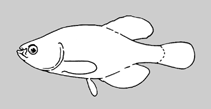 No image available for this species;
drawing shows typical species in Rivulidae.
Images Google
drawing shows typical species in Rivulidae.
Classification / Noms Noms communs | Synonymes | Catalog of Fishes(Genre, Espèce) | ITIS | CoL | WoRMS | Cloffa
> Cyprinodontiformes (Rivulines, killifishes and live bearers) > Rivulidae (Rivulines) > Cynolebiinae
Etymology: Cynolebias: Greek, kyon = dog + Greek, odous = teeth + Greek, lebias = a kind of small fish (Ref. 45335).
Etymology: Cynolebias: Greek, kyon = dog + Greek, odous = teeth + Greek, lebias = a kind of small fish (Ref. 45335).
Environnement : milieu / zone climatique / profondeur / gamme de distribution Écologie
; eau douce benthopélagique. Tropical
Distribution Territoires | Zones FAO | Écosystèmes | Occurrences | Carte par point | Introductions | Faunafri
South America: Verde Grande River drainage, Bahia, Brazil.
Taille / Poids / Âge
Maturité: Lm ? range ? - ? cm
Max length : 3.8 cm SL mâle / non sexé; (Ref. 118117); 3.7 cm SL (female)
Max length : 3.8 cm SL mâle / non sexé; (Ref. 118117); 3.7 cm SL (female)
Description synthétique Clés d'identification | Morphologie | Morphométrie
Cynolebias elegans is similar to other members of the C. gilbertoi group (C. gilbertoi and C. ochraceus) and distinguished from all other species of the subgenus Cynolebias, by having 19-16 vomerine teeth (vs. 1-4, when teeth are present), 7-8 gill-rakers on the ventral part of the first branchial arch (vs. 9-12), highest body depth at vertical just anterior to base of pelvic fin (vs. through base of pecto¬ral fin), and flank with light dots arranged in vertical groups (vs. light dots when present not arranged in vertical groups). It can be diagnosed from C. gil¬bertoi and C. ochraceus by possessing long dorsal and anal fins in males, their extremities excluding filaments posteri¬orly reaching base of caudal fin (vs. reaching caudal pedun¬cle), greater pre-pelvic length in males (52.2-53.9 % SL, vs. 48.5-49.9 % SL in C. gilbertoi and 48.9-50.5 % SL in C. ochraceus), and first proximal radial of the anal fin between neural spines of 9th and 10th vertebrae in males, and between neural spines of 11th and 12th vertebrae in females (vs. between neural spines of 11th and 13th verte¬brae in males, and between neural spines of 12th and 14th vertebrae in females). It can be further differentiated from C. gilbertoi by having the following characters: larger head (31.3-34.2 % SL in males, 32.1-33.4 % in females, vs. 27.9-30.3 % SL in males, 29.0-31.1 % in females) and smaller eye (25.5-29.1 % of head length in males, 27.3-29.9 % in fe¬males, vs. 30.0-31.0 % of head length in males, 31.5-34.2 % in females). It can be also distinguished from C. ochraceus by having 31-32 ver¬tebrae (vs. 33-34), narrower body depth (32.5-34.5 % SL vs. 35.0-37.8 % SL), and flank light pur¬plish brown in males (vs. light yellow ochre) (Ref. 118117).
Body shape (shape guide): fusiform / normal.
Body shape (shape guide): fusiform / normal.
Cycle de vie et comportement reproducteur Maturité | Reproduction | Frai | Œufs | Fécondité | Larves
Référence principale
Téléchargez vos références | Références | Coordinateur : Costa, Wilson J.E.M. | Collaborateurs
Costa, W.J.E.M., 2017. Description of two endangered new seasonal killifish species of the genus Cynolebias from the São Francisco River basin, Brazilian Caatinga (Cyprinodontiformes, Aplocheilidae). Zoosyst. Evol. 93(2):333-341. (Ref. 118117)
Statut dans la liste rouge de l'IUCN (Ref. 130435: Version 2025-2 (Global))
Niveau de menace critique (CR) (A2ac; B1ab(iii)+2ab(iii); D); Date assessed: 29 December 2020
CITES
Not Evaluated
Menace pour l'homme
Harmless
Utilisations par l'homme
FAO - Publication: search | FishSource |
Plus d'informations
Écologie trophique
Aliments (proies)
Composition du régime alimentaire
Consommation alimentaire
Rations alimentaires
Prédateurs
Aliments (proies)
Composition du régime alimentaire
Consommation alimentaire
Rations alimentaires
Prédateurs
Écologie
Écologie
Écologie
Dynamique des populations
Paramètres de croissance
Âges / tailles maximales
Longueur-poids rel.
Rel. longueur-longueur.
Fréquences de longueurs
Conversion de masse
Recrutement
Abondance
Paramètres de croissance
Âges / tailles maximales
Longueur-poids rel.
Rel. longueur-longueur.
Fréquences de longueurs
Conversion de masse
Recrutement
Abondance
Cycle de vie
Reproduction
Maturité
Maturité/épines rel.
Fécondité
Frai
Agrégats de frai
Œufs
Développement de l'œuf
Larves
Dynamique des populations larvaires
Reproduction
Maturité
Maturité/épines rel.
Fécondité
Frai
Agrégats de frai
Œufs
Développement de l'œuf
Larves
Dynamique des populations larvaires
Anatomie
Surface branchiale
Cerveau
Otolithe
Surface branchiale
Cerveau
Otolithe
Physiologie
Composition corporelle
Nutriments
Consommation d'oxygène
Type de natation
Vitesse de nage
Pigments visuels
Son de poisson
Maladies et parasites
Toxicité (CL50)
Composition corporelle
Nutriments
Consommation d'oxygène
Type de natation
Vitesse de nage
Pigments visuels
Son de poisson
Maladies et parasites
Toxicité (CL50)
Génétique
génôme
Génétique
Hétérozygotie
Héritabilité
Diversité génétique
génôme
Génétique
Hétérozygotie
Héritabilité
Diversité génétique
Liées à l'homme
Systèmes d'aquaculture
Profils d'aquaculture
Souches
Cas de ciguatera
Timbres, pièces de monnaie, divers
Systèmes d'aquaculture
Profils d'aquaculture
Souches
Cas de ciguatera
Timbres, pièces de monnaie, divers
Outils
E-book | Guide de terrain | Générateur de fréquences de longueur | Outil de dynamique de population | Carte par point |
Capture-MSY |
Articles particuliers
Télécharger en XML
Sources Internet
AFORO (otoliths) | Aquatic Commons | BHL | Cloffa | Websites from users | FishWatcher | CISTI | Catalog of Fishes: Genre, Espèce | DiscoverLife | ECOTOX | FAO - Publication: search | Faunafri | Fishipedia | Fishtrace | GloBI | Google Books | Google Scholar | Google | IGFA World Record | OneZoom | Open Tree of Life | Otolith Atlas of Taiwan Fishes | PubMed | Reef Life Survey | Socotra Atlas | TreeBase | Arbre de Vie | Wikipedia: aller à, chercher | World Records Freshwater Fishing | Zoobank | Zoological Record
Estimations basées sur des modèles
Indice de diversité phylogénétique (Réf. 82804): PD50 = 0.5000 [Uniqueness, from 0.5 = low to 2.0 = high].
Bayesian length-weight: a=0.01122 (0.00514 - 0.02450), b=3.04 (2.87 - 3.21), in cm total length, based on all LWR estimates for this body shape (Ref. 93245).
Niveau trophique (Réf. 69278): 3.2 ±0.4 se; based on size and trophs of closest relatives
Résilience (Réf. 120179): Haut, temps minimum de doublement de population inférieur à 15 mois (Preliminary K or Fecundity.).