This website uses cookies to enhance your browsing experience and ensure the functionality of our site. For more detailed information about the types of cookies we use and how we protect your privacy, please visit our Privacy Information page.
×
Cookie Settings
This website uses different types of cookies to enhance your experience. Please select your preferences below:
> Gobiiformes (Gobies) > Gobiidae (Gobies) > Gobiinae
Etymology: Trimma:Greek, trimma, -atos = something crushed (Ref. 45335); multiclitellum:Name from the Latin: ‘multi’ meaning many and ‘clitella’ for saddle; referring to the distinctive markings of this fish.
Milieu: milieu / Klimaatzone / Diepte / verspreidingsgebied Ecologie
marien rifbewoner; diepte 17 - 18 m (Ref. 100512). Tropical
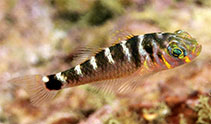
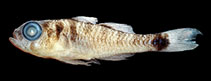
Dorsale stekels (totaal) : 7; Dorsale zachte stralen (totaal) : 8; Anale stekels: 1; Anale zachte stralen: 8. This species is distinguished by the following characters: D VI + I, 8, there are no elongate or filamentous spines; A I,8; pectoral rays 17; emarginate caudal fin with pointed upper lobe and rounded lower lobe; the fifth pelvic ray is branched, 74% length of fourth pelvic ray; the basal membrane is relatively well-developed, 41% length of fourth pelvic ray; the bony interorbital about equal to pupil diameter; the midline of predorsal mainly scaleless, but with patch of about 4 scales on middle portion; no scales on cheek; few scales dorsally on opercle; highly distinctive colour pattern with 7 alternating brown and white bars on upper side, a nearly eye-sized black spot at base of caudal fin, and pair of yellow bars on head, 1 below eye and another on opercle (Ref. 100512). Body shape (shape guide): elongated; Cross section: oval.
A single individual was found together with Trimma chledophilum at the base of a sloping mud bottom, among pieces of metal wreckage. This species was invariably seen sheltering in a small enclosed 'grotto', either resting on the bottom or hovering a short distance above it. This holotype was the only individual encountered in the area despite 38 hours of diving in the immediate vicinity of this site and possibly the main population inhabits deeper waters farther from shore (Ref. 100512).
Fylogenetische diversiteitsindex (Ref. 82804): PD50 = 0.5000 [Uniqueness, from 0.5 = low to 2.0 = high].
Bayesian length-weight: a=0.00741 (0.00347 - 0.01582), b=3.09 (2.91 - 3.27), in cm total length, based on LWR estimates for this (Sub)family-body shape (Ref. 93245).
Weerstandsvermogen (Ref. 120179): Hoog, minimale populatieverdubbelingstijd minder dan 15 maanden (Preliminary K or Fecundity.).
Kwetsbaarheid van de visserij (Ref. 59153): Low vulnerability (10 of 100). 🛈