



Ferrarissoaresia ferrarisi (Birindelli, Sarmento-Soares & Lima, 2015)
Hochladen Photos und videos
Google Bild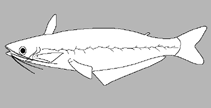 No image available for this species;
drawing shows typical species in Auchenipteridae.
Google Bild
drawing shows typical species in Auchenipteridae.
Klassifizierung / Names Namen | Synonyme | Catalog of Fishes(Gattung, Arten) | ITIS | CoL | WoRMS | Cloffa
> Siluriformes (Catfishes) > Auchenipteridae (Driftwood catfishes) > Centromochlinae
Etymology: Ferrarissoaresia: Named after C. Ferrarris and Soares; ferrarisi: Named for C. J. Ferraris Jr., for his numerous contributions to the systematics of Siluriformes, especially Auchenipteridae, including the first hypothesis recognizing Centromochlinae as sister to all other Auchenipteridae.
Eponymy: Dr Luisa Maria Sarmento-Soares Porto is an ichthyologist at the Museu de Bologia. [...] Dr Carl James Ferraris Jr (d: 1950) is an American ichthyologist and fish taxonomist who is a recognised authority on catfish. [...] (Ref. 128868), visit book page.
Etymology: Ferrarissoaresia: Named after C. Ferrarris and Soares; ferrarisi: Named for C. J. Ferraris Jr., for his numerous contributions to the systematics of Siluriformes, especially Auchenipteridae, including the first hypothesis recognizing Centromochlinae as sister to all other Auchenipteridae.
Eponymy: Dr Luisa Maria Sarmento-Soares Porto is an ichthyologist at the Museu de Bologia. [...] Dr Carl James Ferraris Jr (d: 1950) is an American ichthyologist and fish taxonomist who is a recognised authority on catfish. [...] (Ref. 128868), visit book page.
Umwelt: Milieu / Klimazone / Tiefenbereich / Verbreitungsgebiet Ökologie
; süßwasser demersal; tiefenbereich 0 - 1 m (Ref. 104786). Tropical
Verbreitung Territorien | FAO Gebiete | Ökosysteme | Vorkommen | Punkt Karte | Einführungen | Faunafri
South America: Rio das Balsas, Rio Tocantins basin in Brazil.
Größe / Gewicht / Alter
Kurzbeschreibung Bestimmungsschlüssel | Morphologie | Morphometrie
Rückenflossenstacheln (insgesamt) : 2; Rückenflossenweichstrahlen (insgesamt) : 5; Afterflossenweichstrahlen: 10; Wirbelzahl: 35. Centromochlus ferrarisi can be diagnosed from all species of Centromochlinae, with the exception of C. meridionalis by having dorsal and lateral surfaces of head and body darkly mottled with many small rounded blotches, blotches closely spaced, often coalescent and rather poorly delimited on a pale background (v. dorsolateral surfaces either uniformly dusky or dark, with pale blotches on a darker background, or with a few large dark
blotches or spots well spaced and well defined on a pale background). It can be distinguished from C. meridionalis by having the dorsal-fin spine with serrations anteriorly and smooth posteriorly (v. dorsal-fin spine smooth anteriorly and with serrations
posteriorly), seven branched anal-fin rays of mature males (v. six) and posterior nuchal
plate short, not extended anteroventrally (v. posterior nuchal plate with anteroventral
extension). It further differs from C. altae, C. existimatus, C. heckelii, C. meridionalis, C. perugiae, C. reticulatus and C. romani by possessing seven branched anal-fin rays (v. five or six); from C. macracanthus and C. schultzi by having short pectoral-fin spine, c. 15% of SL (v. long pectoral-fin spine, 25% of SL); from C. concolor and C. punctatus by its short posterior cleithral process, c. 5% of SL (v. c. 20% of SL); from C. altae, C. existimatus, C. heckelii and C. perugiae by the absence of the anterior nuchal plate (v. presence); from C. romani by having anterior margin of dorsal-fin spine with serrations (v. smooth); from C. simplex by having adipose fin well developed (v. minute) (Ref. 104786).
Body shape (shape guide): fusiform / normal.
Body shape (shape guide): fusiform / normal.
The type locality is a small headwater stream with width of 1-1.5 m, depth of 0.3-1.0 m, moderate current and bottom composed of sand-silt and pebbles in some stretches. Collected near submerged logs, and caught by overturning a log with the hand-net positioned immediately below. Occurs syntopically with Knodus cf. savannensis (Characidae), two species of Phenacorhamdia (Heptapteridae), and Melanorivulus cf. zygonectes (Rivulidae) (Ref. 114786).
Lebenszyklus und Paarungsverhalten Geschlechtsreife | Fortpflanzung | Ablaichen | Eier | Fruchtbarkeit | Larven
Hauptreferenz
Laden Sie Ihre Referenzen hoch | Referenzen | Koordinator : Ferraris, Jr., Carl J. | Partner
Birindelli, J.L.O., L.M. Sarmento-Soares and F.C.T. Lima, 2015. A new species of Centromochlus (Siluriformes, Auchenipteridae, Centromochlinae) from the middle Rio Tocantins basin, Brazil. J. Fish Biol. 87(4):860-875. (Ref. 104786)
IUCN Rote Liste Status (Ref. 130435: Version 2025-2 (Global))
nicht bedroht (LC) ; Date assessed: 14 October 2020
CITES
Not Evaluated
Bedrohung für Menschen
Harmless
Nutzung durch Menschen
Fischereien: nicht kommerziell
FAO - Publication: search | FishSource |
Mehr Information
Trophische Ökologie
Lebensmittel (Beutetiere)
Nahrungszusammensetzung
Nahrungsaufnahme
Lebensmittelrationen
Räuber
Lebensmittel (Beutetiere)
Nahrungszusammensetzung
Nahrungsaufnahme
Lebensmittelrationen
Räuber
Populationsdynamik
Wachstumsparameter
Max. Alter/Größen
Länge-Gewicht-Rel.
Länge-Länge-Verhältnis.
Längenhäufigkeiten
Massenkonvertierung
Rekrutierung
Dichte
Wachstumsparameter
Max. Alter/Größen
Länge-Gewicht-Rel.
Länge-Länge-Verhältnis.
Längenhäufigkeiten
Massenkonvertierung
Rekrutierung
Dichte
Lebenszyklus
Fortpflanzung
Geschlechtsreife
Reifung/Kiemen rel.
Fruchtbarkeit
Ablaichen
Laichaggregationen
Eier
Eientwicklung
Larven
Larven Pop.Dyn.
Fortpflanzung
Geschlechtsreife
Reifung/Kiemen rel.
Fruchtbarkeit
Ablaichen
Laichaggregationen
Eier
Eientwicklung
Larven
Larven Pop.Dyn.
Anatomie
Kiemenoberfläche
Gehirn
Otolith
Kiemenoberfläche
Gehirn
Otolith
Physiologie
Körperliche Zusammensetzung
Nährstoffe
Sauerstoffverbrauch
Schwimmart
Schwimmgeschwindigkeit
Visuelle Pigmente
Fischgeräusche
Krankheiten und Parasiten
Toxizität (LC50s)
Körperliche Zusammensetzung
Nährstoffe
Sauerstoffverbrauch
Schwimmart
Schwimmgeschwindigkeit
Visuelle Pigmente
Fischgeräusche
Krankheiten und Parasiten
Toxizität (LC50s)
Genetik
Genom
Genetik
Heterozygotie
Vererbbarkeit
Genetische Vielfalt
Genom
Genetik
Heterozygotie
Vererbbarkeit
Genetische Vielfalt
Menschenbezogen
Aquakultur-Systeme
Aquakultur Profile
Zuchtlinien
Ciguatera-Fälle
Briefmarken, Münzen, Verschiedenes.
Aquakultur-Systeme
Aquakultur Profile
Zuchtlinien
Ciguatera-Fälle
Briefmarken, Münzen, Verschiedenes.
Tools
Zusatzinformationen
Download XML
Zusammenfassung | Punktdaten | Namen | Photos
Internet Quellen
AFORO (otoliths) | Aquatic Commons | BHL | Cloffa | Websites from users | FishWatcher Einträge suchen | CISTI | Catalog of Fishes: Gattung, Arten | DiscoverLife | ECOTOX | FAO - Publication: search | Faunafri | Fishipedia | Fishtrace | GloBI | Google Books | Google Scholar | Google | IGFA World Record | OneZoom | Open Tree of Life | Otolith Atlas of Taiwan Fishes | PubMed | Reef Life Survey | Socotra Atlas | TreeBase | Tree of Life | Wikipedia: Gehe zu, Suchen | World Records Freshwater Fishing | Zoologischer Rekord
Schätzungen auf der Grundlage von Modellen
Phylogenetischer Diversitätsindex (Ref. 82804): PD50 = 0.7500 [Uniqueness, from 0.5 = low to 2.0 = high].
Bayesian length-weight: a=0.01122 (0.00514 - 0.02450), b=3.04 (2.87 - 3.21), in cm total length, based on all LWR estimates for this body shape (Ref. 93245).
Trophische Ebene (Ref. 69278): 3.3 ±0.4 se; based on size and trophs of closest relatives
Widerstandsfähigkeit (Ref. 120179): hoch, Verdopplung der Population dauert weniger als 15 Monate. (Preliminary K or Fecundity.).