



Choerodon aurulentus Gomon, 2017
Gilded tuskfish
Hochladen Photos und videos
Google Bild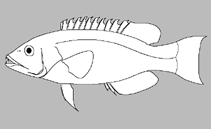 No image available for this species;
drawing shows typical species in Labridae.
Google Bild
drawing shows typical species in Labridae.
Klassifizierung / Names Namen | Synonyme | Catalog of Fishes(Gattung, Arten) | ITIS | CoL | WoRMS | Cloffa
> Eupercaria/misc (Various families in series Eupercaria) > Labridae (Wrasses) > Hypsigenyinae
Etymology: Choerodon: Greek, choiros = a pig + odous = teeth (Ref. 45335); referrring to the prominent anterior canines of the species in this genus (Ref. 116605); aurulentus: Name from Latin 'aurulentus' for 'ornamented with gold', referring to the prominent golden markings characterising this species.
Etymology: Choerodon: Greek, choiros = a pig + odous = teeth (Ref. 45335); referrring to the prominent anterior canines of the species in this genus (Ref. 116605); aurulentus: Name from Latin 'aurulentus' for 'ornamented with gold', referring to the prominent golden markings characterising this species.
Umwelt: Milieu / Klimazone / Tiefenbereich / Verbreitungsgebiet Ökologie
seewasser demersal; tiefenbereich 80 - 90 m (Ref. 116605). Subtropical
Verbreitung Territorien | FAO Gebiete | Ökosysteme | Vorkommen | Punkt Karte | Einführungen | Faunafri
South Pacific: Norfolk Ridge, ne Tasman Sea, between New Caledonia and New Zealand.
Größe / Gewicht / Alter
Kurzbeschreibung Bestimmungsschlüssel | Morphologie | Morphometrie
Rückenflossenstacheln (insgesamt) : 12; Rückenflossenweichstrahlen (insgesamt) : 8; Afterflossenstacheln: 3; Afterflossenweichstrahlen: 10; Wirbelzahl: 27. This species is distinguished by the following characters: D XII,8; A III,10; pectoral fin rays ii,13the , dorsalmost ray very short 7.0-9.1% pectoral fin length, ventralmost ray is distinctly longer than those immediately above, posterior edge of fin falcate, dorsoposterior corner bluntly pointed, posteroventral corner sharply pointed; shallow body, 10.6-11.4% SL, head depth 24.6-25.0% SL, caudal peduncle depth 10.6-11.4% SL; blunt head with dorsal profile of snout steeply rounded, snout length 12.0-12.2% SL; approximately 7 predorsal scales, reaching forward on dorsal midline just in advance of posterior edge of preopercle; the cheek with small partially embedded scales in about four diagonal rows, posteriormost with about 7 scales to upper extent of free preopercular edge, scales not reaching forward quite to below centre of eye, lower third or more of cheek above ventral edge of preopercle naked; 1-2 rows of about 7 or 8 small scales on subopercle adjacent preopercular edge extending forward to just more than half way to anterior extent of free ventral preopercular edge; each lateral line scale has an unbranched laterosensory canal tube; cephalic sensory canal pores are moderately numerous, confined to lines or short branches associated with major canals between and behind eye, less numerous in front of and below eye; scales above lateral line about 2½; the second pair of canines in lower jaw is directed laterally, recurved posteriorly; dorsal and anal fins without basal sheath, additional small scale at top of some oblique rows; posterior lobe of dorsal and anal fins just reaching hypural crease; caudal fin truncate, posterior margin mostly straight, upper and lower corners slightly pointed; pelvic fin to anus or anal fin origin, length 24.6-25.8% SL; colouration, green above, white below with pearly blue midlateral stripe angled from underside of eye to base of caudal fin, additional blue stripes curving from front of eye to upper jaw and across lower part of head from underside of lower jaw to preopercular margin; colour of terminal phase golden midlaterally, scales with vertical pearly bar and second pearly blue stripe from back of eye along lateral line to top of caudal peduncle; scales posteroventrally with vertical pearly blue line; lines on head with gold margins (Ref. 116605).
Body shape (shape guide): fusiform / normal; Cross section: compressed.
Body shape (shape guide): fusiform / normal; Cross section: compressed.
Lebenszyklus und Paarungsverhalten Geschlechtsreife | Fortpflanzung | Ablaichen | Eier | Fruchtbarkeit | Larven
Hauptreferenz
Laden Sie Ihre Referenzen hoch | Referenzen | Koordinator : Westneat, Mark | Partner
Gomon, M.F., 2017. A review of the tuskfishes, genus Choerodon (Labridae, Perciformes), with descriptions of three new species. Memoirs of Museum Victoria 76:1-111. (Ref. 116605)
CITES
Not Evaluated
Bedrohung für Menschen
Harmless
Nutzung durch Menschen
FAO - Publication: search | FishSource |
Mehr Information
Trophische Ökologie
Lebensmittel (Beutetiere)
Nahrungszusammensetzung
Nahrungsaufnahme
Lebensmittelrationen
Räuber
Lebensmittel (Beutetiere)
Nahrungszusammensetzung
Nahrungsaufnahme
Lebensmittelrationen
Räuber
Ökologie
Ökologie
Ökologie
Populationsdynamik
Wachstumsparameter
Max. Alter/Größen
Länge-Gewicht-Rel.
Länge-Länge-Verhältnis.
Längenhäufigkeiten
Massenkonvertierung
Rekrutierung
Dichte
Wachstumsparameter
Max. Alter/Größen
Länge-Gewicht-Rel.
Länge-Länge-Verhältnis.
Längenhäufigkeiten
Massenkonvertierung
Rekrutierung
Dichte
Lebenszyklus
Fortpflanzung
Geschlechtsreife
Reifung/Kiemen rel.
Fruchtbarkeit
Ablaichen
Laichaggregationen
Eier
Eientwicklung
Larven
Larven Pop.Dyn.
Fortpflanzung
Geschlechtsreife
Reifung/Kiemen rel.
Fruchtbarkeit
Ablaichen
Laichaggregationen
Eier
Eientwicklung
Larven
Larven Pop.Dyn.
Anatomie
Kiemenoberfläche
Gehirn
Otolith
Kiemenoberfläche
Gehirn
Otolith
Physiologie
Körperliche Zusammensetzung
Nährstoffe
Sauerstoffverbrauch
Schwimmart
Schwimmgeschwindigkeit
Visuelle Pigmente
Fischgeräusche
Krankheiten und Parasiten
Toxizität (LC50s)
Körperliche Zusammensetzung
Nährstoffe
Sauerstoffverbrauch
Schwimmart
Schwimmgeschwindigkeit
Visuelle Pigmente
Fischgeräusche
Krankheiten und Parasiten
Toxizität (LC50s)
Genetik
Genom
Genetik
Heterozygotie
Vererbbarkeit
Genetische Vielfalt
Genom
Genetik
Heterozygotie
Vererbbarkeit
Genetische Vielfalt
Menschenbezogen
Aquakultur-Systeme
Aquakultur Profile
Zuchtlinien
Ciguatera-Fälle
Briefmarken, Münzen, Verschiedenes.
Aquakultur-Systeme
Aquakultur Profile
Zuchtlinien
Ciguatera-Fälle
Briefmarken, Münzen, Verschiedenes.
Tools
Zusatzinformationen
Download XML
Zusammenfassung | Punktdaten | Namen | Photos
Internet Quellen
AFORO (otoliths) | Aquatic Commons | BHL | Cloffa | Websites from users | FishWatcher Einträge suchen | CISTI | Catalog of Fishes: Gattung, Arten | DiscoverLife | ECOTOX | FAO - Publication: search | Faunafri | Fishipedia | Fishtrace | GloBI | Google Books | Google Scholar | Google | IGFA World Record | OneZoom | Open Tree of Life | Otolith Atlas of Taiwan Fishes | PubMed | Reef Life Survey | Socotra Atlas | TreeBase | Tree of Life | Wikipedia: Gehe zu, Suchen | World Records Freshwater Fishing | Zoobank | Zoologischer Rekord
Schätzungen auf der Grundlage von Modellen
Phylogenetischer Diversitätsindex (Ref. 82804): PD50 = 0.5000 [Uniqueness, from 0.5 = low to 2.0 = high].
Bayesian length-weight: a=0.00955 (0.00426 - 0.02142), b=3.10 (2.91 - 3.29), in cm total length, based on LWR estimates for this (Sub)family-body shape (Ref. 93245).
Trophische Ebene (Ref. 69278): 3.7 ±0.5 se; based on size and trophs of closest relatives
Widerstandsfähigkeit (Ref. 120179): sehr niedrig, Verdopplung der Population dauert mehr als 14 Jahre. (Preliminary K or Fecundity.).