



Pethia sanjaymoluri Katwate, Jadhav, Kumkar, Raghavan & Dahanukar, 2016
Hochladen Photos und videos
Google Bild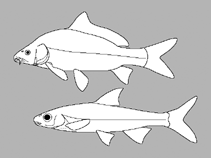 No image available for this species;
drawing shows typical species in Cyprinidae.
Google Bild
drawing shows typical species in Cyprinidae.
Klassifizierung / Names Namen | Synonyme | Catalog of Fishes(Gattung, Arten) | ITIS | CoL | WoRMS | Cloffa
> Cypriniformes (Carps) > Cyprinidae (Minnows or carps) > Smiliogastrinae
Etymology: Pethia: Pethia is the generic vernacular name for small cyprinids in Sinhala; sanjaymoluri: Named for Sanjay Molur from the Zoo Outreach Organization, for his contribution to the conservation of threatened taxa in the South Asian region.
Eponymy: Sanjay Molur is Director of the Zoo Outreach Organisation, India. He was honoured for his contribution to the conservation of endangered fauna in South Asia. (Ref. 128868), visit book page.
Etymology: Pethia: Pethia is the generic vernacular name for small cyprinids in Sinhala; sanjaymoluri: Named for Sanjay Molur from the Zoo Outreach Organization, for his contribution to the conservation of threatened taxa in the South Asian region.
Eponymy: Sanjay Molur is Director of the Zoo Outreach Organisation, India. He was honoured for his contribution to the conservation of endangered fauna in South Asia. (Ref. 128868), visit book page.
Umwelt: Milieu / Klimazone / Tiefenbereich / Verbreitungsgebiet Ökologie
; süßwasser benthopelagisch. Tropical
Verbreitung Territorien | FAO Gebiete | Ökosysteme | Vorkommen | Punkt Karte | Einführungen | Faunafri
Asia: Bhima River, Krishna River system, Maharashtra, India.
Größe / Gewicht / Alter
Geschlechtsreife: Lm ? range ? - ? cm
Max length : 6.4 cm TL Männchen/unbestimmt; (Ref. 124472); max. veröff. Gewicht: 3.97 g (Ref. 124472)
Max length : 6.4 cm TL Männchen/unbestimmt; (Ref. 124472); max. veröff. Gewicht: 3.97 g (Ref. 124472)
Kurzbeschreibung Bestimmungsschlüssel | Morphologie | Morphometrie
Rückenflossenweichstrahlen (insgesamt) : 11; Afterflossenweichstrahlen: 8; Wirbelzahl: 30. Pethia sanjaymoluri is diagnosed from all its congeners by a combination of the following characteristics: lateral line incomplete; barbels absent; fleshy upper lip; lateral-line pored scales ceasing after the seventh to 12th lateral-line scale; 23-25 scales in lateral series; 10 predorsal scales; 11-14 prepelvic scales; 17-20 pre-anal scales; 4 1?2 scales between dorsal-fin origin and lateral-line row; four scales between lateral-line row and pelvic-fin origin; last simple dorsal-fin ray strong, serrated, with 8-15 serrae on its distal half, one serra on its apical half; dorsal fin originating
behind pelvic-fin origin; caudal fin with 8+8 procurrent rays and 9+8 branched caudal-fin rays; four supraneurals; six predorsal neural spines; third infraorbital deep, overlapping preoperculum; gill rakers simple, four on lateral and 11-12 on medial margin of first ceratobranchial and four on medial side of first epibranchial; 4+5 predorsal vertebrae; 4+26 total vertebrae, with 4+13 abdominal and 13 caudal vertebrae. Body color pattern consists of a black humeral spot below the lateral line, covering third and fourth lateral-line scales and extending to one scale below the lateral-line row; a caudal spot, covering 17 th-19th scales in lateral series; apical half of dorsal-fin membrane between anterior-most five branched rays studded with melanophores, making the tip of the dorsal fin appear dark black; and anal, pelvic and pectoral fins colorless in adults (Ref. 107652).
Body shape (shape guide): fusiform / normal.
Body shape (shape guide): fusiform / normal.
At Rawet, this species occupied the main river channel beneath riparian vegetation and submerged boulders and silt as substratum. It was found among aquatic vegetation. It co-occurred with the following fishes: Salmostoma boopis (Day 1874), Devario aequipinnatus (McClelland 1839), Rasbora daniconius (Hamilton 1822), Aplocheilus lineatus (Valenciennes 1846), Notopterus notopterus (Pallas 1769), Mastacembelus armatus (Lacépède 1800), Puntius sophore (Hamilton 1822), and Rohtee ogilbii Sykes 1839. At Bhor, it was encountered in ponds and ditches formed by boulders in the main river channel, with no riparian vegetation and with substratum composed of basalt bedrock and silt. It was observed to co-occur with the following fishes: Nemacheilus denisoni (Day 1867), R. daniconius, Garra mullya (Sykes 1839), S. boopis, Lepidocephalichthys thermalis (Valenciennes 1846) and D. aequipinnatus (Ref. 107652).
Lebenszyklus und Paarungsverhalten Geschlechtsreife | Fortpflanzung | Ablaichen | Eier | Fruchtbarkeit | Larven
Hauptreferenz
Laden Sie Ihre Referenzen hoch | Referenzen | Koordinator | Partner
Katwate, U., S. Jadhav, P. Kumkar, R. Raghavan and N. Dahanukar, 2016. Pethia sanjaymoluri, a new species of barb (Teleostei: Cyprinidae) from the northern Western Ghats, India. J. Fish Biol. 88(5):2027-2050. (Ref. 107652)
IUCN Rote Liste Status (Ref. 130435: Version 2025-2 (Global))
stark gefährdet (EN) (B1ab(iii)); Date assessed: 28 March 2021
CITES
Not Evaluated
Bedrohung für Menschen
Harmless
Nutzung durch Menschen
FAO - Publication: search | FishSource |
Mehr Information
Trophische Ökologie
Lebensmittel (Beutetiere)
Nahrungszusammensetzung
Nahrungsaufnahme
Lebensmittelrationen
Räuber
Lebensmittel (Beutetiere)
Nahrungszusammensetzung
Nahrungsaufnahme
Lebensmittelrationen
Räuber
Populationsdynamik
Wachstumsparameter
Max. Alter/Größen
Länge-Gewicht-Rel.
Länge-Länge-Verhältnis.
Längenhäufigkeiten
Massenkonvertierung
Rekrutierung
Dichte
Wachstumsparameter
Max. Alter/Größen
Länge-Gewicht-Rel.
Länge-Länge-Verhältnis.
Längenhäufigkeiten
Massenkonvertierung
Rekrutierung
Dichte
Lebenszyklus
Fortpflanzung
Geschlechtsreife
Reifung/Kiemen rel.
Fruchtbarkeit
Ablaichen
Laichaggregationen
Eier
Eientwicklung
Larven
Larven Pop.Dyn.
Fortpflanzung
Geschlechtsreife
Reifung/Kiemen rel.
Fruchtbarkeit
Ablaichen
Laichaggregationen
Eier
Eientwicklung
Larven
Larven Pop.Dyn.
Anatomie
Kiemenoberfläche
Gehirn
Otolith
Kiemenoberfläche
Gehirn
Otolith
Physiologie
Körperliche Zusammensetzung
Nährstoffe
Sauerstoffverbrauch
Schwimmart
Schwimmgeschwindigkeit
Visuelle Pigmente
Fischgeräusche
Krankheiten und Parasiten
Toxizität (LC50s)
Körperliche Zusammensetzung
Nährstoffe
Sauerstoffverbrauch
Schwimmart
Schwimmgeschwindigkeit
Visuelle Pigmente
Fischgeräusche
Krankheiten und Parasiten
Toxizität (LC50s)
Genetik
Genom
Genetik
Heterozygotie
Vererbbarkeit
Genetische Vielfalt
Genom
Genetik
Heterozygotie
Vererbbarkeit
Genetische Vielfalt
Menschenbezogen
Aquakultur-Systeme
Aquakultur Profile
Zuchtlinien
Ciguatera-Fälle
Briefmarken, Münzen, Verschiedenes.
Aquakultur-Systeme
Aquakultur Profile
Zuchtlinien
Ciguatera-Fälle
Briefmarken, Münzen, Verschiedenes.
Tools
Zusatzinformationen
Download XML
Zusammenfassung | Punktdaten | Namen | Photos
Internet Quellen
AFORO (otoliths) | Aquatic Commons | BHL | Cloffa | Websites from users | FishWatcher Einträge suchen | CISTI | Catalog of Fishes: Gattung, Arten | DiscoverLife | ECOTOX | FAO - Publication: search | Faunafri | Fishipedia | Fishtrace | GloBI | Google Books | Google Scholar | Google | IGFA World Record | OneZoom | Open Tree of Life | Otolith Atlas of Taiwan Fishes | PubMed | Reef Life Survey | Socotra Atlas | TreeBase | Tree of Life | Wikipedia: Gehe zu, Suchen | World Records Freshwater Fishing | Zoobank | Zoologischer Rekord
Schätzungen auf der Grundlage von Modellen
Phylogenetischer Diversitätsindex (Ref. 82804): PD50 = 0.5000 [Uniqueness, from 0.5 = low to 2.0 = high].
Bayesian length-weight: a=0.01175 (0.00633 - 0.02180), b=3.06 (2.91 - 3.21), in cm total length, based on LWR estimates for this species & Genus-body shape (Ref. 93245).
Trophische Ebene (Ref. 69278): 2.6 ±0.1 se; based on size and trophs of closest relatives
Widerstandsfähigkeit (Ref. 120179): hoch, Verdopplung der Population dauert weniger als 15 Monate. (Preliminary K or Fecundity.).