This website uses cookies to enhance your browsing experience and ensure the functionality of our site. For more detailed information about the types of cookies we use and how we protect your privacy, please visit our Privacy Information page.
×
Cookie Settings
This website uses different types of cookies to enhance your experience. Please select your preferences below:
> Acropomatiformes (Oceanic basses) > Pempheridae (Sweepers)
Etymology: Pempheris:Greek, pempheris = the name of a fish (Ref. 45335); darvelli:Named for Brian W. Darvell, for his fieldwork in Oman resulting in the specimens and photographs of this new species. Eponymy: Dr Brian William Darvell (d: 1948) is a chemist, academic and marine conservationist who is honorary professor at the School of Dentistry at Birmingham University, UK. [...] (Ref. 128868), visit book page.
Entorno: milieu / zona climática / rango de profundidad / gama de distribución Ecología
marino asociado a arrecife; rango de profundidad 6 - 7 m (Ref. 97766). Tropical
Madurez: Lm? range ? - ? cm Max length : 9.7 cm SL macho / no sexado; (Ref. 97766); 11.7 cm SL (female)
Descripción breve Claves de identificación | Morfología | Morfometría
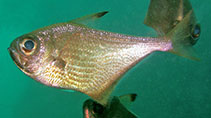
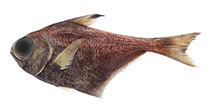
Espinas dorsales (total) : 6; Radios blandos dorsales (total) : 9; Espinas anales: 3; Radios blandos anales: 41 - 43; Vértebra: 25. This species is distinguished by the following characters: D VI,9; A III,41-43; pectoral rays 18-19; lateral-line scales 56-58; scales on anteroventral ctenoid and covering 90% of chest; gill rakers 30-32; body depth 2.1 in SL; head length 3.0-3.05 in SL; orbit diameter 7.45-7.7 in SL; caudal-fin length 3.45-3.55 in SL, moderately emarginate, caudal concavity 3.55-3.7 in head length; pectoral-fin length 3.15-3.2 in SL; colour in alcohol dark maroon brown, with the outer edge of scales broadly translucent gray; dorsal fin is pale yellowish, the distal half of first six soft rays and adjacent membranes black (dark pigment covering outer half of longest rays and adjacent membranes); anal fin and adjacent base of body darker brown than body, becoming progressively more translucent yellow distally, with a small brown spot on each scale; anal ray tips are translucent white; anterior five rays and membranes dark brown, the dark pigment also distally on the next five rays; caudal fin is dusky yellowish, darker brown basally and broadly darker all around margin; pectoral fins are yellowish gray with a large dark maroon brown spot covering entire base of fin; axil also dark maroon brown; pelvic fins are pale dusky yellowish (Ref. 97766). Body shape (shape guide): short and / or deep; Cross section: compressed.
Ciclo vital y comportamiento de apareamiento Madurez | Reproducción | Puesta | Huevos | Fecundidad | Larva
Randall, J.E. and B.C. Victor, 2014. Four new fishes of the genus Pempheris (Perciformes: Pempheridae) from the western Indian Ocean. J. Ocean Sci. Found. 12:61-83. (Ref. 97766)
Situación en la Lista Roja de la UICN (Ref. 130435: Version 2025-2 (Global))
Ecología Trófica Alimentos (presas) Composición de la dieta consumo de alimento Raciones de comida Despredadores
Ecología Ecología
Dinámica de la población Coeficiente del crecimiento para Edades / tallas máximas Longitud-peso rel. Longitud-longitud rel. Longitud-frecuencias Conversión de masas Reclutamiento Abundancia
Ciclo de vida Reproducción Madurez Madurez/Gills rel. Fecundidad Puesta Agregaciones de desove Huevos Desarrollo de los huevos Larva Dinámica larvaria
Fisiología Composición corporal Nutrientes Consumo del oxígeno Tipo de natación Velocidad de natación Pigmentos visuales Sonido de peces Enfermedades y parásitos Toxicidad (CL50)
Índice de diversidad filogenética (Referencia 82804): PD50 = 0.5000 [Uniqueness, from 0.5 = low to 2.0 = high].
Bayesian length-weight: a=0.01380 (0.00586 - 0.03254), b=3.01 (2.82 - 3.20), in cm total length, based on LWR estimates for this Genus-body shape (Ref. 93245).
Nivel trófico (Referencia 69278): 3.4 ±0.5 se; based on size and trophs of closest relatives
Resiliencia (Referencia 120179): Alto, población duplicada en un tiempo mínimo inferior a 15 meses (Preliminary K or Fecundity.).
Vulnerabilidad pesquera (Ref. 59153): Low vulnerability (10 of 100). 🛈