



Tometes siderocarajensis Andrade, Machado, Jégu, Farias & Giarrizzo, 2017
Carregue seu(sua) Fotos e vídeos
Imagem do Google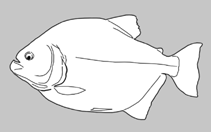 No image available for this species;
drawing shows typical species in Serrasalmidae.
Imagem do Google
drawing shows typical species in Serrasalmidae.
Classificação / Nomes Nomes comuns | Sinônimos | Catalog of Fishes(Gênero, Espécies) | ITIS | CoL | WoRMS | Cloffa
> Characiformes (Characins) > Serrasalmidae (Piranhas and pacus) > Myleinae
Etymology: siderocarajensis: The specific name is in allusion to the locality `Serra and Carajás', the largest high-grade iron deposit in the world. Derived from the Greek‒Latin sidero means `iron', and carajensis in reference to the type locality. A toponymic adjective.
Etymology: siderocarajensis: The specific name is in allusion to the locality `Serra and Carajás', the largest high-grade iron deposit in the world. Derived from the Greek‒Latin sidero means `iron', and carajensis in reference to the type locality. A toponymic adjective.
Meio ambiente: milieu / Zona climática / intervalo de profundidade / faixa de distribuição Ecologia
; Água doce bentopelágico. Tropical
Distribuição Territórios | Áreas da FAO | Ecossistemas | Ocorrências | Mapa de pontos | Introduções | Faunafri
South America: ItacaiuÂnas River and Catete River, Tocantins-Araguaia River Basin, State of Para, Brazil.
Tamanho / Peso / Idade
Descrição suscinta Chaves de identificação | Morfologia | Morfometria
Vértebras: 42. Tometes siderocarajensis can be diagnosed from all its congeners by dense pigmentation on the distalmost portion of the pelvic-fin rays or the entirety of the fin (vs. pelvic fin hyaline or pale, or with few scattered dark chromatophores along distal portion of rays). In addition, it differs from all congeners, except from T. camunani and T. kranponhah, by having more circumpeduncular scale rows 39?41 (vs. 38 or less), and from T. kranponhah and T. trilobatus by having 1st and 2nd labial premaxillary teeth laterally spaced (vs. 1st and 2nd labial premaxillary teeth with lateral contact). It is further distinguished from T. trilobatus by having more perforated lateral line scales 74±84 (vs. 58±72); from T. makue by having more spines on ventral keel 11±17 prepelvic spines and 26±33 total spines (vs. 0±9 and 10±23, respectively); and from T. lebaili by having a terminal to gently upturned mouth and invariably 5 dentary teeth (vs. a markedly upturned mouth and 6±7 dentary teeth) (Ref. 116762).
Body shape (shape guide): short and / or deep.
Body shape (shape guide): short and / or deep.
Inhabits rapids associated with rocky outcropping covered in aquatic macrophytes of the families Podostemaceae and Fabaceae, which serve as a food source for this fish. The stomach contents of one large specimen measuring 34.0 cm SL consisted mainly of large pieces of Podostemaceae (leaves and flowers), but also comprised of three small Fabaceae fruits and a cricket (Orthoptera). Occurs syntopically with three other serrasalmid, rapids-adapted species, namely, Mylesinus paucisquamatus, Myleus setiger, and Tometes ancylorhynchus. Commonly captured by local, professional and amateur fishermen in the Itacaiúnas River. One of the most in demand species for game fishing in the region based on fishermen report (Ref. 116762).
Ciclo de vida ou comportamento de acasalamento Maturidade | Reprodução | Desova | Ovos | Fecundidade | Larvas
Referência principal
Carregar suas referências | Referências | Coordenador | Colaboradores
Andrade, M.C., V.N. Machado, M. Jégu, I.P. Farias and T. Giarrizzo, 2017. A new species of Tometes Valenciennes 1850 (Characiformes: Serrasalmidae) from Tocantins-Araguaia River Basin based on integrative analysis of molecular and morphological data. Plos ONE 12(4):e0170053. (Ref. 116762)
CITES
Not Evaluated
Ameaça para os humanos
Harmless
Uso pelos humanos
Peixe esportivo: sim
FAO - Publication: search | FishSource |
Mais informação
Ecologia Trófica
Itens alimentares (presas)
Composição da dieta
Consumo alimentar
Rações alimentares
Predadores
Itens alimentares (presas)
Composição da dieta
Consumo alimentar
Rações alimentares
Predadores
Dinâmica populacional
Parâmetros de crescimento
Idade máxima / tamanhos
Relação comprimento-peso.
Relação comprimento-comprimento.
Frequências de comprimento
Conversão de massa
Recrutamento
Abundância
Parâmetros de crescimento
Idade máxima / tamanhos
Relação comprimento-peso.
Relação comprimento-comprimento.
Frequências de comprimento
Conversão de massa
Recrutamento
Abundância
Ciclo de vida
Reprodução
Maturidade
Maturidade/Rel. das guelras
Fecundidade
Desova
Agregações de desova
Ovos
Desenvolvimento dos ovos
Larvas
Dinâmica larval
Reprodução
Maturidade
Maturidade/Rel. das guelras
Fecundidade
Desova
Agregações de desova
Ovos
Desenvolvimento dos ovos
Larvas
Dinâmica larval
Anatomia
Área branquial
Cérebro
Otólito
Área branquial
Cérebro
Otólito
Fisiologia
Composição corporal
Nutrientes
Consumo de oxigênio
Tipo de natação
Velocidade de natação
Pigmentos visuais
Som de peixe
Doenças e Parasitas
Toxicidade (LC50s)
Composição corporal
Nutrientes
Consumo de oxigênio
Tipo de natação
Velocidade de natação
Pigmentos visuais
Som de peixe
Doenças e Parasitas
Toxicidade (LC50s)
Genética
genoma
Genética
Heterozigosidade
Hereditariedade
Diversidade genética
genoma
Genética
Heterozigosidade
Hereditariedade
Diversidade genética
Relacionado a humanos
Sistemas de aquicultura
Perfis para aquacultura
Estirpes
Casos de Ciguatera
Selos, moedas, diversos.
Sistemas de aquicultura
Perfis para aquacultura
Estirpes
Casos de Ciguatera
Selos, moedas, diversos.
Ferramentas
Livro eletrônico | Guia de campo | Ferramenta auxiliar de frequências de comprimento | Ferramenta sobre a história de vida | Mapa de pontos |
Catch-MSY |
Relatórios especiais
Checar Manutenção em Aquário | Checar Planilhas de Fatos sobre as Espécies | Checar Planilhas de Fatos sobre Aquicultura
Baixar XML
Fontes da internet
AFORO (otoliths) | Aquatic Commons | BHL | Cloffa | Websites from users | Checar Observador de Peixes (FishWatcher) | CISTI | Catalog of Fishes: Gênero, Espécies | DiscoverLife | ECOTOX | FAO - Publication: search | Faunafri | Fishipedia | Fishtrace | GloBI | Google Books | Google Scholar | Google | IGFA World Record | OneZoom | Open Tree of Life | Otolith Atlas of Taiwan Fishes | PubMed | Reef Life Survey | Socotra Atlas | TreeBase | Árvore da vida | Wikipedia: Ir para, procura | World Records Freshwater Fishing | Zoobank | Registro zoológico
Estimativas baseadas em modelos
Índice de diversidade filogenética (Ref. 82804): PD50 = 0.5078 [Uniqueness, from 0.5 = low to 2.0 = high].
Bayesian length-weight: a=0.02399 (0.01109 - 0.05190), b=2.99 (2.80 - 3.18), in cm total length, based on LWR estimates for this (Sub)family-body shape (Ref. 93245).
Resiliência (Ref. 120179): Elevada, tempo mínimo de duplicação da população menor que 15 meses (Preliminary K or Fecundity.).