



Hochladen Photos und videos
Google Bild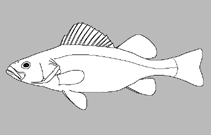 No image available for this species;
drawing shows typical species in Percidae.
Google Bild
drawing shows typical species in Percidae.
Klassifizierung / Names Namen | Synonyme | Catalog of Fishes(Gattung, Arten) | ITIS | CoL | WoRMS | Cloffa
> Perciformes/Percoidei (Perchs) > Percidae (Perches) > Etheostomatinae
Etymology: Percina: Latin, diminutive of perch = perch (Ref. 45335).
Etymology: Percina: Latin, diminutive of perch = perch (Ref. 45335).
Umwelt: Milieu / Klimazone / Tiefenbereich / Verbreitungsgebiet Ökologie
; süßwasser benthopelagisch. Temperate
Verbreitung Territorien | FAO Gebiete | Ökosysteme | Vorkommen | Punkt Karte | Einführungen | Faunafri
North America: Duck River system and Whiteoak Creek, Western Highland Rim in Tennessee, USA.
Größe / Gewicht / Alter
Geschlechtsreife: Lm ? range ? - ? cm
Max length : 13.7 cm SL Männchen/unbestimmt; (Ref. 116752); 13.4 cm SL (female)
Max length : 13.7 cm SL Männchen/unbestimmt; (Ref. 116752); 13.4 cm SL (female)
Kurzbeschreibung Bestimmungsschlüssel | Morphologie | Morphometrie
Rückenflossenstacheln (insgesamt) : 14 - 18; Rückenflossenweichstrahlen (insgesamt) : 14 - 17; Afterflossenweichstrahlen: 11 - 13. Percina apina can be distinguished by having the following characters: dorsum with about 11 dark saddles that are interspersed with vermiculated patches of pigment that extend to the side of the body; 7 to 9 dark, large round or oval shaped lateral blotches along the side of the body that are typically wider than high; anterior-most blotches are just posterior of the operculum and are smaller in size, as is the most posterior blotch, which is often confluent with a distinct caudal spot; a moderate to diffuse suborbital bar of pigment; males in nuptial condition with a gold-green background color with an overall duskiness and a blue-green iridescence on the cheeks and side of the body; first dorsal fin with an intense orange submarginal band distal to a narrow yellow band of coloration with a wide and basal band comprising uniform streaks of brown-orange pigment; distal margin of the second dorsal fin lightly pigmented with a proximate band of dusky orange coloration and a tessellated basal margin; caudal fin with light bands of pigment and the distal margin slightly pigmented in nuptial males; nuptial males with anal fin yellowgold distally with a basal peppering of dark pigment; males in nuptial condition with membranes of the pelvic fin filled with jet-black pigment, and the pectoral fin membranes slightly peppered with dark pigment (Ref. 116752).
Body shape (shape guide): elongated.
Body shape (shape guide): elongated.
Habitats of this species differ between reproductive and non-reproductive periods. Both sexes in in reproductive condition were most often found in swift runs of depths about one meter or less with predominant gravel and cobble substrates. On many occasions, adult males were collected in shallow, swift riffles with gravel bottoms during late April to early June. In summer months, adult males and females occurred in swift runs and in pool areas with substrates free of silt. Subadults were only encountered in pool habitats and were usually accompanied by adult females (Ref. 116752).
Lebenszyklus und Paarungsverhalten Geschlechtsreife | Fortpflanzung | Ablaichen | Eier | Fruchtbarkeit | Larven
Hauptreferenz
Laden Sie Ihre Referenzen hoch | Referenzen | Koordinator | Partner
Near, T.J., J.W. Simmons, J.M. Mollish, M.A. Correa, E. Benavides, R.C. Harrington and B.P. Keck, 2017. A new species of longperch endemic to Tennessee (Percidae: Etheostomatinae: Percina). Bulletin of the Peabody Museum of Natural History 58(2):287-309. (Ref. 116752)
CITES
Not Evaluated
Bedrohung für Menschen
Harmless
Nutzung durch Menschen
FAO - Publication: search | FishSource |
Mehr Information
Trophische Ökologie
Lebensmittel (Beutetiere)
Nahrungszusammensetzung
Nahrungsaufnahme
Lebensmittelrationen
Räuber
Lebensmittel (Beutetiere)
Nahrungszusammensetzung
Nahrungsaufnahme
Lebensmittelrationen
Räuber
Populationsdynamik
Wachstumsparameter
Max. Alter/Größen
Länge-Gewicht-Rel.
Länge-Länge-Verhältnis.
Längenhäufigkeiten
Massenkonvertierung
Rekrutierung
Dichte
Wachstumsparameter
Max. Alter/Größen
Länge-Gewicht-Rel.
Länge-Länge-Verhältnis.
Längenhäufigkeiten
Massenkonvertierung
Rekrutierung
Dichte
Lebenszyklus
Fortpflanzung
Geschlechtsreife
Reifung/Kiemen rel.
Fruchtbarkeit
Ablaichen
Laichaggregationen
Eier
Eientwicklung
Larven
Larven Pop.Dyn.
Fortpflanzung
Geschlechtsreife
Reifung/Kiemen rel.
Fruchtbarkeit
Ablaichen
Laichaggregationen
Eier
Eientwicklung
Larven
Larven Pop.Dyn.
Anatomie
Kiemenoberfläche
Gehirn
Otolith
Kiemenoberfläche
Gehirn
Otolith
Physiologie
Körperliche Zusammensetzung
Nährstoffe
Sauerstoffverbrauch
Schwimmart
Schwimmgeschwindigkeit
Visuelle Pigmente
Fischgeräusche
Krankheiten und Parasiten
Toxizität (LC50s)
Körperliche Zusammensetzung
Nährstoffe
Sauerstoffverbrauch
Schwimmart
Schwimmgeschwindigkeit
Visuelle Pigmente
Fischgeräusche
Krankheiten und Parasiten
Toxizität (LC50s)
Genetik
Genom
Genetik
Heterozygotie
Vererbbarkeit
Genetische Vielfalt
Genom
Genetik
Heterozygotie
Vererbbarkeit
Genetische Vielfalt
Menschenbezogen
Aquakultur-Systeme
Aquakultur Profile
Zuchtlinien
Ciguatera-Fälle
Briefmarken, Münzen, Verschiedenes.
Aquakultur-Systeme
Aquakultur Profile
Zuchtlinien
Ciguatera-Fälle
Briefmarken, Münzen, Verschiedenes.
Tools
Zusatzinformationen
Download XML
Zusammenfassung | Punktdaten | Namen | Photos
Internet Quellen
AFORO (otoliths) | Aquatic Commons | BHL | Cloffa | Websites from users | FishWatcher Einträge suchen | CISTI | Catalog of Fishes: Gattung, Arten | DiscoverLife | ECOTOX | FAO - Publication: search | Faunafri | Fishipedia | Fishtrace | GloBI | Google Books | Google Scholar | Google | IGFA World Record | OneZoom | Open Tree of Life | Otolith Atlas of Taiwan Fishes | PubMed | Reef Life Survey | Socotra Atlas | TreeBase | Tree of Life | Wikipedia: Gehe zu, Suchen | World Records Freshwater Fishing | Zoobank | Zoologischer Rekord
Schätzungen auf der Grundlage von Modellen
Phylogenetischer Diversitätsindex (Ref. 82804): PD50 = 0.5000 [Uniqueness, from 0.5 = low to 2.0 = high].
Bayesian length-weight: a=0.00575 (0.00268 - 0.01234), b=3.13 (2.95 - 3.31), in cm total length, based on LWR estimates for this (Sub)family-body shape (Ref. 93245).
Trophische Ebene (Ref. 69278): 3.5 ±0.5 se; based on size and trophs of closest relatives
Widerstandsfähigkeit (Ref. 120179): mittel, Verdopplung der Population dauert 1,4 - 4,4 Jahre. (Preliminary K or Fecundity.).