



Centrophorus lesliei White, Ebert & Naylor, 2017
African gulper shark
Uploaden van uw Foto's en video's
Google afbeelding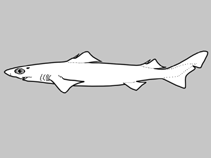 No image available for this species;
drawing shows typical species in Centrophoridae.
Google afbeelding
drawing shows typical species in Centrophoridae.
Classificatie / Namen Lokale namen | Synoniemen | Catalog of Fishes(Genus, Soort(en)) | ITIS | CoL | WoRMS | Cloffa
Elasmobranchii (haaien en roggen) (sharks and rays) > Squaliformes (Sleeper and dogfish sharks) > Centrophoridae (Gulper sharks)
Etymology: Centrophorus: centr[um] (L.), prickle or sharp point; phorus, from phoreus (Gr.), bearer or carrier, referring to grooved spines on dorsal fins (See ETYFish); lesliei: In honor of Robin Leslie, Department of Agriculture, Forestry and Fisheries (South Africa), “who has contributed greatly to our knowledge of southern African chondrichthyans and provided numerous important specimens and tissue samples for various projects” (See ETYFish).
Eponymy: Dr Robin Leslie works for the Fisheries Branch, Department of Agriculture, Forestry and Fisheries in South Africa. [...] (Ref. 128868), visit book page.
Etymology: Centrophorus: centr[um] (L.), prickle or sharp point; phorus, from phoreus (Gr.), bearer or carrier, referring to grooved spines on dorsal fins (See ETYFish); lesliei: In honor of Robin Leslie, Department of Agriculture, Forestry and Fisheries (South Africa), “who has contributed greatly to our knowledge of southern African chondrichthyans and provided numerous important specimens and tissue samples for various projects” (See ETYFish).
Eponymy: Dr Robin Leslie works for the Fisheries Branch, Department of Agriculture, Forestry and Fisheries in South Africa. [...] (Ref. 128868), visit book page.
Milieu: milieu / Klimaatzone / Diepte / verspreidingsgebied Ecologie
marien bathydemersaal; diepte 340 - 610 m (Ref. 116740). Tropical
Verspreiding Gebieden | FAO regio's | Ecosystemen | Voorkomen | Verspreidingskaart | Introducties | Faunafri
Western Indian Ocean, Mozambique Channel (Madagascar and Mozambique), and off Senegal, Côte d’Ivoire, Equatorial Guinea, and Togo; Morocco, the Canary
Islands, and Ghana.
Grootte / Gewicht / Leeftijd
Maturiteit: Lm ? range ? - ? cm
Max length : 76.5 cm TL mannelijk / geslacht onbekend; (Ref. 116740); 99.0 cm TL (female)
Max length : 76.5 cm TL mannelijk / geslacht onbekend; (Ref. 116740); 99.0 cm TL (female)
Korte beschrijving Determinatiesleutels | Morfologie | Morfometrie
This medium sized (<1 m maximum total length) species is distinguished by the following set of characters: body relatively slender; head moderately long, 21.4-26.4% TL; snout relatively short, its horizontal preorbital length 6.5-8.2% TL, rounded in dorsal view; first dorsal very long with base length 16.8-19.7% TL and soft fin length 16.0-17.4% TL, and high with height 6.5-7.8% TL, its inner margin relatively short, 5.7-7.4% TL, 2.3–2.9 in soft fin length; second dorsal fin much smaller in area to first, similar in height to first dorsal fin, its height 1.0-1.3 in first dorsal-fin height; pectoral fins are large, anterior margin length 11.9-13.4% TL, free rear tip elongate in larger individuals, 2.4-4.8% TL; lateral trunk denticles of larger individuals are sessile or not raised on pedicels, block-like, not elevated; upper teeth of larger individuals have erect to slightly oblique cusps; lower teeth of all sized specimens are much larger than upper teeth, strongly oblique, blade-like; total vertebral centra 119-122; teeth 33–42/29–31 (Ref. 116740).
Cross section: oval.
Cross section: oval.
Examined type specimens ranged in size from 31.7-95.0 cm TL, with the smallest free-swimming individual at 40.8 cm TL; a late-term embryo of 31.7 sm TL still with a small external yolk sac; an embryo of 39.5 cm TL from a pregnant female. A female of 86.3 cm TL was found to be mature and pregnant. Reported sizes of adult males 71.5-76.5 cm TL and adult females 89.0-99.0 cm TL (Ref. 116740).
Levenscyclus en paargedrag Maturiteit | Voortplanting | Paaien | Eieren | Fecunditeit | Larven
Hoofdreferentie
Upload uw referenties | Referenties | Coördinator : Compagno, Leonard J.V. | Medewerkers
White, W.T., D.A. Ebert and G.J.P. Naylor, 2017. Revision of the genus Centrophorus (Squaliformes: Centrophoridae): Part 2 - Description of two new species of Centrophorus and clarification of the status of Centrophorus lusitanicus Barbosa du Bocage & de Brito Capello, 1864. Zootaxa 4344(1):086-114. (Ref. 116740)
Status op de Rode Lijst van het IUCN (Ref. 130435: Version 2025-2 (Global))
Bedreigd (EN) (A2d); Date assessed: 27 February 2024
CITES
Not Evaluated
Gevaar voor de mens
Harmless
Gebruik door de mens
Visserij: van geen belang
FAO - Publication: search | FishSource |
Meer informatie
Trofische ecologie
Voedsel (prooien)
Dieetsamenstelling
Voedselconsumptie
Voedselrantsoenen
Predatoren
Voedsel (prooien)
Dieetsamenstelling
Voedselconsumptie
Voedselrantsoenen
Predatoren
Ecologie
Ecologie
Ecologie
Populatiedynamica
Groeiparameters
Max. leeftijden / maten
Lengte-gewicht rel.
Lengte-lengte rel.
Lengtefrequenties
Massaconversie
Rekrutering
Abundantie
Groeiparameters
Max. leeftijden / maten
Lengte-gewicht rel.
Lengte-lengte rel.
Lengtefrequenties
Massaconversie
Rekrutering
Abundantie
Levenscyclus
Voortplanting
Maturiteit
Rijpheid/kieuwen rel.
Fecunditeit
Paaien
Paaibestanden
Eieren
Ontwikkeling van de eieren
Larven
Larvale populatiedynamiek
Voortplanting
Maturiteit
Rijpheid/kieuwen rel.
Fecunditeit
Paaien
Paaibestanden
Eieren
Ontwikkeling van de eieren
Larven
Larvale populatiedynamiek
Anatomie
Kieuwoppervlak
Hersenen
Otoliet
Kieuwoppervlak
Hersenen
Otoliet
Fysiologie
Lichaamssamenstelling
Voedingsstoffen
Zuurstofverbruik
Type zwemmen
Zwemsnelheid
Visuele pigmenten
Vis geluid
Ziekten en parasieten
Toxiciteit (LC50)
Lichaamssamenstelling
Voedingsstoffen
Zuurstofverbruik
Type zwemmen
Zwemsnelheid
Visuele pigmenten
Vis geluid
Ziekten en parasieten
Toxiciteit (LC50)
Genetica
genoom
Genetica
Heterozygositeit
Erfelijkheid
Genetische diversiteit
genoom
Genetica
Heterozygositeit
Erfelijkheid
Genetische diversiteit
Menselijk gerelateerd
Aquacultuursystemen
Aquacultuurprofielen
Kweeklijnen
Ciguatera gevallen
Postzegels, munten, diversen.
Aquacultuursystemen
Aquacultuurprofielen
Kweeklijnen
Ciguatera gevallen
Postzegels, munten, diversen.
Tools
Speciale rapporten
Bekijk gegevens voor het houden in een aquarium | Bekijk Fact Sheets voor de soort | Bekijk Aquacultuur Fact Sheets
Download XML
Internetbronnen
AFORO (otoliths) | Aquatic Commons | BHL | Cloffa | Websites from users | Bekijk FishWatcher | CISTI | Catalog of Fishes: Genus, Soort(en) | DiscoverLife | ECOTOX | FAO - Publication: search | Faunafri | Fishipedia | Fishtrace | GloBI | Google Books | Google Scholar | Google | IGFA World Record | Nationale databanken | OneZoom | Open Tree of Life | Otolith Atlas of Taiwan Fishes | PubMed | Reef Life Survey | Socotra Atlas | TreeBase | Tree of Life | Wikipedia: ga naar, zoek | World Records Freshwater Fishing | Zoobank | Zoological Record
Schattingen op basis van modellen
Fylogenetische diversiteitsindex (Ref. 82804): PD50 = 0.5001 [Uniqueness, from 0.5 = low to 2.0 = high].
Bayesian length-weight: a=0.01122 (0.00514 - 0.02450), b=3.04 (2.87 - 3.21), in cm total length, based on all LWR estimates for this body shape (Ref. 93245).
Trofisch niveau (Ref. 69278): 4.3 ±0.3 se; based on size and trophs of closest relatives
Weerstandsvermogen (Ref. 120179): Zeer laag, minimale populatieverdubbelingstijd meer dan 14 jaar (Preliminary K or Fecundity.).