



Uploaden van uw Foto's en video's
Google afbeelding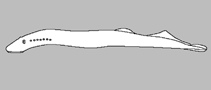 No image available for this species;
drawing shows typical species in Petromyzontidae.
Google afbeelding
drawing shows typical species in Petromyzontidae.
Classificatie / Namen Lokale namen | Synoniemen | Catalog of Fishes(Genus, Soort(en)) | ITIS | CoL | WoRMS | Cloffa
> Petromyzontiformes (Lampreys) > Petromyzontidae (Northern lampreys) > Lampetrinae
Etymology: Lampetra: lambo (L.), to lick; petra (Gr.), rock or stone, referring to their suctorial behavior (adults attach to rocks during nest building and mating) (See ETYFish); soljani: In honor of Tonko Šoljan (1907-1980), for his contribution to the knowledge and development of ichthyology in Croatia and Bosnia and Herzegovina (See ETYFish).
Eponymy: Tonko Šoljan (1907–1980) was a Croatian ichthyologist, particularly noted for his monograph Ribe Jadrana (Fishes of the Adriatic). [...] (Ref. 128868), visit book page.
Etymology: Lampetra: lambo (L.), to lick; petra (Gr.), rock or stone, referring to their suctorial behavior (adults attach to rocks during nest building and mating) (See ETYFish); soljani: In honor of Tonko Šoljan (1907-1980), for his contribution to the knowledge and development of ichthyology in Croatia and Bosnia and Herzegovina (See ETYFish).
Eponymy: Tonko Šoljan (1907–1980) was a Croatian ichthyologist, particularly noted for his monograph Ribe Jadrana (Fishes of the Adriatic). [...] (Ref. 128868), visit book page.
Taxonomic Remarks
Species information for completion.
Milieu: milieu / Klimaatzone / Diepte / verspreidingsgebied Ecologie
; zoet water demersaal. Subtropical
Verspreiding Gebieden | FAO regio's | Ecosystemen | Voorkomen | Verspreidingskaart | Introducties | Faunafri
Europe: lower Neretva River in the Adriatic Sea basin.
Grootte / Gewicht / Leeftijd
Maturiteit: Lm ? range ? - ? cm
Max length : 12.6 cm TL mannelijk / geslacht onbekend; (Ref. 115563)
Max length : 12.6 cm TL mannelijk / geslacht onbekend; (Ref. 115563)
Korte beschrijving Determinatiesleutels | Morfologie | Morfometrie
This species is distinguished from its congeners by the following characters: marmorate flank pattern in live, fully grown ammocoetes, and in some adults (vs. plain colour pattern); with 3 velar tentacles (vs. most similar species L. lanceolata with 5 and L. ninae with 5-7); without posterial teeth (vs. rarely absent, usually a single incomplete row with up to 23 teeth in L. ninae); with less trunk myomeres between last branchial opening and anus 54-57 (vs. 57-64 in L. lanceolata, 57-61 in L. ninae); less trunk myomeres between last branchial opening and first dorsal fin origin 28-32 (vs. 32-36 in L. lanceolata, 32-35 in L. ninae); less trunk myomeres between last branchial opening and second dorsal-fin origin 42-46 (vs. 46-50 in L. lanceolata, 45-49 in L. ninae); differs from L. zanandreai by lacking posterial teeth (vs. usually present, very rarely absent); differs from L. fluviatilis and L. planeri by having a bicuspid middle endolateral tooth (vs. almost always tricuspid) and the infraoral lamina with 5 teeth (vs. usually 7-9, very rarely 5-6) (Ref. 115563).
Body shape (shape guide): eel-like; Cross section: circular.
Body shape (shape guide): eel-like; Cross section: circular.
Ammocoetes of this species are found in silt, muddy or fine sandy-muddy sediment in river sections with slow or no current, in shallows at banks or backwaters at water depth of about 10-50 cm. Adults and ammocoetes are often caught together and the first post-metamorphosis individual was found in September (FSJF 2184) (Ref. 115563).
Levenscyclus en paargedrag Maturiteit | Voortplanting | Paaien | Eieren | Fecunditeit | Larven
Hoofdreferentie
Upload uw referenties | Referenties | Coördinator | Medewerkers
Tutman, P., J. Freyhif, J. Dulcic, B. Glamuzina and M. Geiger, 2017. Lampetra soljani, a new brook lamprey from the southern Adriatic Sea basin (Petromyzontiformes: Petromyzontidae). Zootaxa 4273(4):531-548. (Ref. 115563)
Status op de Rode Lijst van het IUCN (Ref. 130435: Version 2025-2 (Global))
Gevoelig (NT) (B1b(iii)); Date assessed: 09 November 2023
CITES
Not Evaluated
Gevaar voor de mens
Harmless
Gebruik door de mens
FAO - Publication: search | FishSource |
Meer informatie
Trofische ecologie
Voedsel (prooien)
Dieetsamenstelling
Voedselconsumptie
Voedselrantsoenen
Predatoren
Voedsel (prooien)
Dieetsamenstelling
Voedselconsumptie
Voedselrantsoenen
Predatoren
Ecologie
Ecologie
Ecologie
Populatiedynamica
Groeiparameters
Max. leeftijden / maten
Lengte-gewicht rel.
Lengte-lengte rel.
Lengtefrequenties
Massaconversie
Rekrutering
Abundantie
Groeiparameters
Max. leeftijden / maten
Lengte-gewicht rel.
Lengte-lengte rel.
Lengtefrequenties
Massaconversie
Rekrutering
Abundantie
Levenscyclus
Voortplanting
Maturiteit
Rijpheid/kieuwen rel.
Fecunditeit
Paaien
Paaibestanden
Eieren
Ontwikkeling van de eieren
Larven
Larvale populatiedynamiek
Voortplanting
Maturiteit
Rijpheid/kieuwen rel.
Fecunditeit
Paaien
Paaibestanden
Eieren
Ontwikkeling van de eieren
Larven
Larvale populatiedynamiek
Anatomie
Kieuwoppervlak
Hersenen
Otoliet
Kieuwoppervlak
Hersenen
Otoliet
Fysiologie
Lichaamssamenstelling
Voedingsstoffen
Zuurstofverbruik
Type zwemmen
Zwemsnelheid
Visuele pigmenten
Vis geluid
Ziekten en parasieten
Toxiciteit (LC50)
Lichaamssamenstelling
Voedingsstoffen
Zuurstofverbruik
Type zwemmen
Zwemsnelheid
Visuele pigmenten
Vis geluid
Ziekten en parasieten
Toxiciteit (LC50)
Genetica
genoom
Genetica
Heterozygositeit
Erfelijkheid
Genetische diversiteit
genoom
Genetica
Heterozygositeit
Erfelijkheid
Genetische diversiteit
Menselijk gerelateerd
Aquacultuursystemen
Aquacultuurprofielen
Kweeklijnen
Ciguatera gevallen
Postzegels, munten, diversen.
Aquacultuursystemen
Aquacultuurprofielen
Kweeklijnen
Ciguatera gevallen
Postzegels, munten, diversen.
Tools
Speciale rapporten
Bekijk gegevens voor het houden in een aquarium | Bekijk Fact Sheets voor de soort | Bekijk Aquacultuur Fact Sheets
Download XML
Internetbronnen
AFORO (otoliths) | Aquatic Commons | BHL | Cloffa | Websites from users | Bekijk FishWatcher | CISTI | Catalog of Fishes: Genus, Soort(en) | DiscoverLife | ECOTOX | FAO - Publication: search | Faunafri | Fishipedia | Fishtrace | GloBI | Google Books | Google Scholar | Google | IGFA World Record | OneZoom | Open Tree of Life | Otolith Atlas of Taiwan Fishes | PubMed | Reef Life Survey | Socotra Atlas | TreeBase | Tree of Life | Wikipedia: ga naar, zoek | World Records Freshwater Fishing | Zoobank | Zoological Record
Schattingen op basis van modellen
Fylogenetische diversiteitsindex (Ref. 82804): PD50 = 0.5010 [Uniqueness, from 0.5 = low to 2.0 = high].
Bayesian length-weight: a=0.00132 (0.00060 - 0.00290), b=2.99 (2.80 - 3.18), in cm total length, based on LWR estimates for this (Sub)family-body shape (Ref. 93245).
Trofisch niveau (Ref. 69278): 3.4 ±0.4 se; based on size and trophs of closest relatives
Weerstandsvermogen (Ref. 120179): laag, minimale populatieverdubbelingstijd 4,5-14 jaar (Semelparous species, assuming tm (= tmax) > 4).