This website uses cookies to enhance your browsing experience and ensure the functionality of our site. For more detailed information about the types of cookies we use and how we protect your privacy, please visit our Privacy Information page.
×
Cookie Settings
This website uses different types of cookies to enhance your experience. Please select your preferences below:
> Gobiiformes (Gobies) > Gobiidae (Gobies) > Gobiinae
Etymology: Grallenia:Named for Gerald R. Allen, (G+R+Allen+suffix '-ia'), in honor of his great contribution to our knowledge of the diversity of coral-reef fishes; rubrilineata:Name from Latin 'rubrilineata' meaning 'red-lined' or 'red-striped'; referring to the marking on the dorsal fin of adult males; treated as a feminine compound adjective. Eponymy: Dr Gerald Ray Allen (d: 1942) The genus was named to honour “…his great contribution to our knowledge of the diversity of coral-reef fishes.” (See Allen, GR) (Ref. 128868), visit book page.
Entorno: milieu / zona climática / rango de profundidad / gama de distribución Ecología
marino asociado a arrecife; rango de profundidad 12 - 15 m (Ref. 116128). Tropical
Western Central Pacific: Philippines and possibly Malaysia.
Tamaño / Peso / Edad
Madurez: Lm? range ? - ? cm Max length : 1.5 cm SL macho / no sexado; (Ref. 116128); 1.5 cm SL (female)
Descripción breve Claves de identificación | Morfología | Morfometría
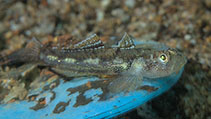
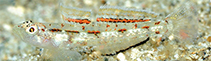
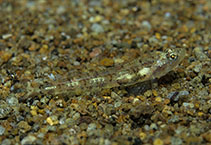
Espinas dorsales (total) : 7; Radios blandos dorsales (total) : 9 - 11; Espinas anales: 1; Radios blandos anales: 9 - 11; Vértebra: 27 - 28. This species is distinguished by the following characters: D VI+I,9-11 (usually 10); A I,9-11 (usually 10); first dorsal-fin spine is not produced into filament in either sex; no pelvic frenum nor head pores; posterior longitudinal scale 17-22, usually extending forward to at least level of second-dorsal-fin origin, body anterior to level of middle of second dorsal fin with numerous scales; body depth at pelvic-fin origin 12.8-16.4% in SL; colour in life translucent with reddish-brown markings consisting of 8-12 widely separated small spots or short irregular bars along dorsal profile of body, an interrupted stripe from upper rear edge of opercle to upper caudal peduncle (each segment progressively shorter with increasingly wider space between, proceeding posteriorly) and a longitudinal row of about 9 irregular brown blotches along ventral portion of side; adult male with both dorsal fins with distinctive basal red or red-edged black stripe and anal fin with bold black outer margin (Ref. 116128). Body shape (shape guide): elongated; Cross section: oval.
Ciclo vital y comportamiento de apareamiento Madurez | Reproducción | Puesta | Huevos | Fecundidad | Larva
Allen, G.R. and M.V. Erdmann, 2017. Descriptions of five new species of marine gobies (Teleostei: Gobiidae) of the genus Grallenia) from the tropical western Pacific Ocean. J. Ocean Sci. Found. 27:20-47. (Ref. 116128)
Situación en la Lista Roja de la UICN (Ref. 130435: Version 2025-2 (Global))
Ecología Trófica Alimentos (presas) Composición de la dieta consumo de alimento Raciones de comida Despredadores
Ecología Ecología
Dinámica de la población Coeficiente del crecimiento para Edades / tallas máximas Longitud-peso rel. Longitud-longitud rel. Longitud-frecuencias Conversión de masas Reclutamiento Abundancia
Ciclo de vida Reproducción Madurez Madurez/Gills rel. Fecundidad Puesta Agregaciones de desove Huevos Desarrollo de los huevos Larva Dinámica larvaria
Fisiología Composición corporal Nutrientes Consumo del oxígeno Tipo de natación Velocidad de natación Pigmentos visuales Sonido de peces Enfermedades y parásitos Toxicidad (CL50)
Índice de diversidad filogenética (Referencia 82804): PD50 = 0.5020 [Uniqueness, from 0.5 = low to 2.0 = high].
Bayesian length-weight: a=0.00741 (0.00347 - 0.01582), b=3.09 (2.91 - 3.27), in cm total length, based on LWR estimates for this (Sub)family-body shape (Ref. 93245).
Nivel trófico (Referencia 69278): 3.0 ±0.3 se; based on size and trophs of closest relatives
Resiliencia (Referencia 120179): Alto, población duplicada en un tiempo mínimo inferior a 15 meses (Preliminary K or Fecundity.).
Vulnerabilidad pesquera (Ref. 59153): Low vulnerability (10 of 100). 🛈