



Typhlosynbranchus luticolus (Britz, Doherty-Bone, Kouete, Sykes & Gower, 2016)
Uploaden van uw Foto's en video's
Google afbeelding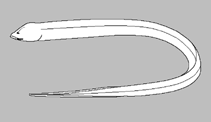 No image available for this species;
drawing shows typical species in Synbranchidae.
Google afbeelding
drawing shows typical species in Synbranchidae.
Classificatie / Namen Lokale namen | Synoniemen | Catalog of Fishes(Genus, Soort(en)) | ITIS | CoL | WoRMS | Cloffa
> Synbranchiformes (Spiny eels) > Synbranchidae (Swamp-eels)
Etymology: luticolus: The species name is derived from the Latin word for mud, lutus, and the verb colere, to dwell, referring to the habitat in which the new species was collected; a noun in apposition (Ref. 116049).
Etymology: luticolus: The species name is derived from the Latin word for mud, lutus, and the verb colere, to dwell, referring to the habitat in which the new species was collected; a noun in apposition (Ref. 116049).
Milieu: milieu / Klimaatzone / Diepte / verspreidingsgebied Ecologie
; zoet water demersaal. Tropical
Verspreiding Gebieden | FAO regio's | Ecosystemen | Voorkomen | Verspreidingskaart | Introducties | Faunafri
Africa: in the proximity of Mount Cameroon at altitudes of 35-170 m above sea level, Cameroon (Ref. 116049).
Grootte / Gewicht / Leeftijd
Maturiteit: Lm ? range ? - ? cm
Max length : 20.9 cm TL mannelijk / geslacht onbekend; (Ref. 118583)
Max length : 20.9 cm TL mannelijk / geslacht onbekend; (Ref. 118583)
Korte beschrijving Determinatiesleutels | Morfologie | Morfometrie
Diagnosis: Monopterus luticolus is assigned to the 'Amphipnous group' within the genus Monopterus based on the presence of a unique synapomorphy of the group: the spatial dissociation of ceratobranchial 1 from hypobranchial 1 and its close association with hypobranchial 2 and ceratobranchial 2 (Ref. 116049). It is distinguished from all other species of synbranchids, including the other African synbranchids Ophisternon afrum and Monopterus boueti, by having more vertebrae, 198-208 vs. 100-194 (Ref. 116049). It is further distinguished from all synbranchids except O. infernale, O. candidum, M. boueti, M. eapeni, M. roseni, and M. digressus by the lack of externally visible eyes; Monopterus luticolus is also readily distinguished further from the African synbranchid species O. afrum by having the posttemporal greatly reduced in size and removed spatially from the supracleithrum and cleithrum, as well as from the skull, vs. posttemporal large, articulating with supracleithrum and epiotic of skull; and by having five vs. six branchiostegal rays (Ref. 116049). Monopterus luticolus is most similar to the West African M. boueti, from which it differs by having fewer abdominal vertebrae, 95-101 vs. 108, and more caudal vertebrae, 98-110 vs. 79-86; it differs further from M. boueti by several osteological characters (Ref. 116049).
Body shape (shape guide): eel-like.
Body shape (shape guide): eel-like.
Obligate air-breathing (Ref. 126274); This species was found during attempts to collect caecilian amphibians; they were dug from moist to wet soil, usually inundated by the neighbouring water body; the sites were immediately adjacent to both lotic and lentic aquatic habitats (Ref. 116049).
Levenscyclus en paargedrag Maturiteit | Voortplanting | Paaien | Eieren | Fecunditeit | Larven
Hoofdreferentie
Upload uw referenties | Referenties | Coördinator : Fávorito, Sandra | Medewerkers
Britz, R., T.M. Doherty-Bone, M.T. Kouete, D. Sykes and D.J. Gower, 2016. Monopterus luticolus, a new species of swamp eel from Cameroon (Teleostei: Synbranchidae). Ichthyol. Explor. Freshwat. 27(4):309-323. (Ref. 116049)
CITES
Not Evaluated
Gevaar voor de mens
Harmless
Gebruik door de mens
FAO - Publication: search | FishSource |
Meer informatie
Trofische ecologie
Voedsel (prooien)
Dieetsamenstelling
Voedselconsumptie
Voedselrantsoenen
Predatoren
Voedsel (prooien)
Dieetsamenstelling
Voedselconsumptie
Voedselrantsoenen
Predatoren
Populatiedynamica
Groeiparameters
Max. leeftijden / maten
Lengte-gewicht rel.
Lengte-lengte rel.
Lengtefrequenties
Massaconversie
Rekrutering
Abundantie
Groeiparameters
Max. leeftijden / maten
Lengte-gewicht rel.
Lengte-lengte rel.
Lengtefrequenties
Massaconversie
Rekrutering
Abundantie
Levenscyclus
Voortplanting
Maturiteit
Rijpheid/kieuwen rel.
Fecunditeit
Paaien
Paaibestanden
Eieren
Ontwikkeling van de eieren
Larven
Larvale populatiedynamiek
Voortplanting
Maturiteit
Rijpheid/kieuwen rel.
Fecunditeit
Paaien
Paaibestanden
Eieren
Ontwikkeling van de eieren
Larven
Larvale populatiedynamiek
Anatomie
Kieuwoppervlak
Hersenen
Otoliet
Kieuwoppervlak
Hersenen
Otoliet
Fysiologie
Lichaamssamenstelling
Voedingsstoffen
Zuurstofverbruik
Type zwemmen
Zwemsnelheid
Visuele pigmenten
Vis geluid
Ziekten en parasieten
Toxiciteit (LC50)
Lichaamssamenstelling
Voedingsstoffen
Zuurstofverbruik
Type zwemmen
Zwemsnelheid
Visuele pigmenten
Vis geluid
Ziekten en parasieten
Toxiciteit (LC50)
Genetica
genoom
Genetica
Heterozygositeit
Erfelijkheid
Genetische diversiteit
genoom
Genetica
Heterozygositeit
Erfelijkheid
Genetische diversiteit
Menselijk gerelateerd
Aquacultuursystemen
Aquacultuurprofielen
Kweeklijnen
Ciguatera gevallen
Postzegels, munten, diversen.
Aquacultuursystemen
Aquacultuurprofielen
Kweeklijnen
Ciguatera gevallen
Postzegels, munten, diversen.
Tools
Speciale rapporten
Bekijk gegevens voor het houden in een aquarium | Bekijk Fact Sheets voor de soort | Bekijk Aquacultuur Fact Sheets
Download XML
Internetbronnen
AFORO (otoliths) | Aquatic Commons | BHL | Cloffa | Websites from users | Bekijk FishWatcher | CISTI | Catalog of Fishes: Genus, Soort(en) | DiscoverLife | ECOTOX | FAO - Publication: search | Faunafri | Fishipedia | Fishtrace | GloBI | Google Books | Google Scholar | Google | IGFA World Record | OneZoom | Open Tree of Life | Otolith Atlas of Taiwan Fishes | PubMed | Reef Life Survey | Socotra Atlas | TreeBase | Tree of Life | Wikipedia: ga naar, zoek | World Records Freshwater Fishing | Zoological Record
Schattingen op basis van modellen
Fylogenetische diversiteitsindex (Ref. 82804): PD50 = 0.7500 [Uniqueness, from 0.5 = low to 2.0 = high].
Bayesian length-weight: a=0.00085 (0.00040 - 0.00182), b=3.09 (2.90 - 3.28), in cm total length, based on LWR estimates for this (Sub)family-body shape (Ref. 93245).
Trofisch niveau (Ref. 69278): 3.2 ±0.3 se; based on size and trophs of closest relatives
Weerstandsvermogen (Ref. 120179): Hoog, minimale populatieverdubbelingstijd minder dan 15 maanden (Preliminary K or Fecundity.).