



Lutjanus sapphirolineatus Iwatsuki, Al-Mamry & Heemstra, 2016
Arabian blue-striped snapper
Hochladen Photos und videos
Bilder | Google Bild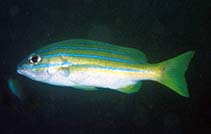 Lutjanus sapphirolineatus
Photo von Field, R.
Bilder | Google Bild
Photo von Field, R.
Klassifizierung / Names Namen | Synonyme | Catalog of Fishes(Gattung, Arten) | ITIS | CoL | WoRMS | Cloffa
> Eupercaria/misc (Various families in series Eupercaria) > Lutjanidae (Snappers) > Lutjaninae
Etymology: Lutjanus: Malay, ikan lutjan, name of a fish; sapphirolineatus: Named for its diagnostic character of four blue stripes on the body of this species.
Etymology: Lutjanus: Malay, ikan lutjan, name of a fish; sapphirolineatus: Named for its diagnostic character of four blue stripes on the body of this species.
Umwelt: Milieu / Klimazone / Tiefenbereich / Verbreitungsgebiet Ökologie
seewasser riff-verbunden. Tropical
Verbreitung Territorien | FAO Gebiete | Ökosysteme | Vorkommen | Punkt Karte | Einführungen | Faunafri
Western Indian Ocean: apparently confined to the Middle East; currently known only from Somalia and Oman; possibly to southern Red Sea and the Gulf of Aden.
Größe / Gewicht / Alter
Kurzbeschreibung Bestimmungsschlüssel | Morphologie | Morphometrie
Rückenflossenstacheln (insgesamt) : 11; Rückenflossenweichstrahlen (insgesamt) : 13; Afterflossenstacheln: 3; Afterflossenweichstrahlen: 8. This species is distinguished by the following characters: D XI, 13; A III, 8; pectoral fin 17; lateral-line scales 47-49: horizontal scale rows above lateral line 5 or 6; scale rows above lateral line rising obliquely toward dorsal profile; predorsal scales extending forward just above anterior edge of orbit; scale rows on cheek 6 or 7, no subocular extension of smaller scales; subocular extension of cheek scales irregularly present in 1 or 2 row(s) anteriorly and 3 or 4 rows posteriorly below eye, respecitvely; gill-rakers on first arch 8 or 9 + 18 or 19 = 26?28; tongue smooth, toothless; preopercular notch developed just above angle;
interopercular knob inconspicuous; belly with white with yellow spot on each scale forming narrow, longitudinal, yellow lines; dark-edged blue stripes 4, the first blue stripe almost running from above posterior nostril to the tenth dorsal fin spine base; third stripe just from upper rear edge of eye, through upper part of opercle, tapering posteriorly and extending to upper part of caudal peduncle below last soft dorsal-ray base; fourth blue stripe from just above midpoint of lower jaw, below eye and continuing through opercle, above upper pectoral-fin base to
caudal peduncle (Ref. 110188).
Body shape (shape guide): fusiform / normal; Cross section: compressed.
Body shape (shape guide): fusiform / normal; Cross section: compressed.
Lebenszyklus und Paarungsverhalten Geschlechtsreife | Fortpflanzung | Ablaichen | Eier | Fruchtbarkeit | Larven
Hauptreferenz
Laden Sie Ihre Referenzen hoch | Referenzen | Koordinator | Partner
Iwatsuki, Y., J.M. Al-Mamry and P.C. Heemstra, 2016. Validity of a blue stripe snapper, Lutjanus octolineatus (Cuvier 1828) and a related species, L. bengalensis (Bloch 1790) with a new species (Pisces; Lutjanidae) from the Arabian Sea. Zootaxa 4098(3):511-528. (Ref. 110188)
IUCN Rote Liste Status (Ref. 130435: Version 2025-2 (Global))
nicht bedroht (LC) ; Date assessed: 28 June 2018
CITES
Not Evaluated
Bedrohung für Menschen
Harmless
Nutzung durch Menschen
FAO - Publication: search | FishSource |
Mehr Information
Trophische Ökologie
Lebensmittel (Beutetiere)
Nahrungszusammensetzung
Nahrungsaufnahme
Lebensmittelrationen
Räuber
Lebensmittel (Beutetiere)
Nahrungszusammensetzung
Nahrungsaufnahme
Lebensmittelrationen
Räuber
Ökologie
Ökologie
Ökologie
Populationsdynamik
Wachstumsparameter
Max. Alter/Größen
Länge-Gewicht-Rel.
Länge-Länge-Verhältnis.
Längenhäufigkeiten
Massenkonvertierung
Rekrutierung
Dichte
Wachstumsparameter
Max. Alter/Größen
Länge-Gewicht-Rel.
Länge-Länge-Verhältnis.
Längenhäufigkeiten
Massenkonvertierung
Rekrutierung
Dichte
Lebenszyklus
Fortpflanzung
Geschlechtsreife
Reifung/Kiemen rel.
Fruchtbarkeit
Ablaichen
Laichaggregationen
Eier
Eientwicklung
Larven
Larven Pop.Dyn.
Fortpflanzung
Geschlechtsreife
Reifung/Kiemen rel.
Fruchtbarkeit
Ablaichen
Laichaggregationen
Eier
Eientwicklung
Larven
Larven Pop.Dyn.
Anatomie
Kiemenoberfläche
Gehirn
Otolith
Kiemenoberfläche
Gehirn
Otolith
Physiologie
Körperliche Zusammensetzung
Nährstoffe
Sauerstoffverbrauch
Schwimmart
Schwimmgeschwindigkeit
Visuelle Pigmente
Fischgeräusche
Krankheiten und Parasiten
Toxizität (LC50s)
Körperliche Zusammensetzung
Nährstoffe
Sauerstoffverbrauch
Schwimmart
Schwimmgeschwindigkeit
Visuelle Pigmente
Fischgeräusche
Krankheiten und Parasiten
Toxizität (LC50s)
Genetik
Genom
Genetik
Heterozygotie
Vererbbarkeit
Genetische Vielfalt
Genom
Genetik
Heterozygotie
Vererbbarkeit
Genetische Vielfalt
Menschenbezogen
Aquakultur-Systeme
Aquakultur Profile
Zuchtlinien
Ciguatera-Fälle
Briefmarken, Münzen, Verschiedenes.
Aquakultur-Systeme
Aquakultur Profile
Zuchtlinien
Ciguatera-Fälle
Briefmarken, Münzen, Verschiedenes.
Tools
Zusatzinformationen
Download XML
Zusammenfassung | Punktdaten | Namen | Photos
Internet Quellen
AFORO (otoliths) | Aquatic Commons | BHL | Cloffa | Websites from users | FishWatcher Einträge suchen | CISTI | Catalog of Fishes: Gattung, Arten | DiscoverLife | ECOTOX | FAO - Publication: search | Faunafri | Fishipedia | Fishtrace | GloBI | Google Books | Google Scholar | Google | IGFA World Record | OneZoom | Open Tree of Life | Otolith Atlas of Taiwan Fishes | PubMed | Reef Life Survey | Socotra Atlas | TreeBase | Tree of Life | Wikipedia: Gehe zu, Suchen | World Records Freshwater Fishing | Zoobank | Zoologischer Rekord
Schätzungen auf der Grundlage von Modellen
Phylogenetischer Diversitätsindex (Ref. 82804): PD50 = 0.5000 [Uniqueness, from 0.5 = low to 2.0 = high].
Bayesian length-weight: a=0.01479 (0.00706 - 0.03101), b=2.96 (2.80 - 3.12), in cm total length, based on LWR estimates for this Genus-body shape (Ref. 93245).
Trophische Ebene (Ref. 69278): 3.7 ±0.6 se; based on size and trophs of closest relatives
Widerstandsfähigkeit (Ref. 120179): hoch, Verdopplung der Population dauert weniger als 15 Monate. (Preliminary K or Fecundity.).