



Rhynchorhina mauritaniensis Séret & Naylor, 2016
False shark ray
อัพโหลดของคุณ ภาพถ่าย และ วิดีโอ
Google image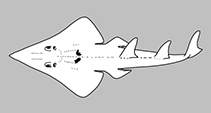 No image available for this species;
drawing shows typical species in Rhinidae.
Google image
drawing shows typical species in Rhinidae.
การจำแนกประเภท / ชื่อ ชื่อสามัญ | ชื่อพ้อง | Catalog of Fishes(สกุล, ชนิด) | ITIS | CoL | WoRMS | Cloffa
sub class Elasmobranchii (ฉลามและกระเบน) (sharks and rays) > Rhinopristiformes (Shovelnose rays) > Rhinidae (Wedgefishes)
Etymology: Rhynchorhina: Composite name from Rhynchobatus and Rhina indicating that the new genus exhibits features of both genera - with Rhynchobatus-like body with a rounded snout similar to Rhina; mauritaniensis: Named for the country Mauritania, its type locality,.
Etymology: Rhynchorhina: Composite name from Rhynchobatus and Rhina indicating that the new genus exhibits features of both genera - with Rhynchobatus-like body with a rounded snout similar to Rhina; mauritaniensis: Named for the country Mauritania, its type locality,.
สิ่งแวดล้อม : สิ่งแวดล้อม / เขตภูมิอากาศ / ระดับความลึก / ระยะการกระจายสินค้า นิเวศวิทยา
เกี่ยวกับทะเล,น้ำเค็ม pelagic-neritic. Tropical; 28°N - 14°N, 18°W - 5°W (Ref. 114953)
การแพร่กระจาย อาณาเขต | พื้นที่จำแนกตาม FAO | ระบบนิเวศหลายระบบ | การปรากฏขึ้น,การเกิดขึ้น,พบ | ตำแหน่งบนแผนที่ | การแนะนำ | Faunafri
North-East Atlantic: off Mauritania.
ขนาด / น้ำหนัก / อายุ
วัยเจริญพันธุ์: Lm ? range ? - ? cm
Max length : 224 cm TL เพศผู้/กระเทย; (Ref. 109576); 204.0 cm TL (female)
Max length : 224 cm TL เพศผู้/กระเทย; (Ref. 109576); 204.0 cm TL (female)
คำอธิบายสั้นๆ เครื่องมือที่ใช้ในการแยกชนิดสัตว์,สิ่งมีชีวิตออกจากกัน | สัณฐานวิทยา | ความยาวต่างๆ
This species with a heavy shark-like body is distinguished by the following: head somewhat flattened; snout tip broadly rounded to somewhat quadrangular; tail with a dermal fold along each lower edge; large and falcate dorsal fins 2; caudal fin with distinct upper and lower lobes; conspicuous dermal folds 2 on posterior margin of spiracles; nostrils are very large and
oblique, and are separated from each other and from the mouth; anterior nasal flap is small (not extending to inner nostril corner); jaws moderately undulated; with about 66/72 rows of oral teeth arranged in pavement; a row of pointed thorns along each rostral ridge, 2/3 additional thorns may occur on snout tip; a single row of thornlets and thorns in front of orbit extending backward to level of spiracles; a median row of about 36 large, pointed thorns from the nape to
first dorsal fin and 6 between dorsal fins, median thorns flanked by two other shorter rows on the nape-shoulder area, additional short rows of thorns may be present on the outer shoulders; body covered with small dermal denticles, the crowns with a median posterior cusp, an extension from the median ridge, and short lateral cusp; dorsal side greyish to greenish with numerous white ocelli-like spots; a large black transverse blotch on ventral snout tip (Ref. 109576). Resembles Rhynchobatus lubberti in having a similar colour pattern, but differs in having a more broadly rounded snout (similar to that of the shark-ray Rhina ancylostoma (Ref. 109576).
Body shape (shape guide): elongated; Cross section: flattened.
Body shape (shape guide): elongated; Cross section: flattened.
A benthic species with presumably very restricted distribution range (Ref. 114953). A larger male of 275 cm TL (without the caudal fin) was observed in March 1998 at Agadir (reported not collected by an IMROP fishery observer). Caught by trammel net (Ref. 109576). The species was known from a few specimens caught in shallow water in Banc d'Arguin sandy shoal (Ref. 114953).
วงจรชีวิตและพฤติกรรมการผสมพันธุ์ วัยเจริญพันธุ์ | การสืบพันธุ์ | การวางไข่ | เซลสืบพันธ์ของเพศเมีย(ไข่) | ความดกของไข่ | ตัวอ่อน
อ้างอิงหลัก
อัพโหลดข้อมูลอ้างอิงของคุณ | อ้างอิง | ผู้ประสานงาน | ผู้ร่วมมือ
Séret, B. and G.J.P. Naylor, 2016. Rhynchorhina mauritaniensis, a new genus and species of wedgefish from the eastern central Atlantic (Elasmobrachii: Batoidea: Rhinidae). Zootaxa 4138(2):291-308. (Ref. 109576)
สถานะบัญชีแดงของ IUCN (Ref. 130435: Version 2025-2 (Global))
Critically Endangered (CR) (A2d); Date assessed: 03 December 2018
ภัยคุกคามต่อมนุษย์
Harmless
การใช้ของมนุษย์
FAO - Publication: search | FishSource |
ข้อมูลเพิ่มเติม
นิเวศวิทยาเขตร้อน
รายการอาหาร (เหยื่อ)
องค์ประอบของอาหาร
การบริโภคอาหาร
การจัดสรรอาหาร
ผู้ล่า
รายการอาหาร (เหยื่อ)
องค์ประอบของอาหาร
การบริโภคอาหาร
การจัดสรรอาหาร
ผู้ล่า
นิเวศวิทยา
นิเวศวิทยา
นิเวศวิทยา
พลวัตของประชากร
พารามิเตอร์การเจริญเติบโต
อายุสูงสุด / ขนาด
ความยาว-น้ำหนักสัมพันธ์
ความยาว-ความยาวสัมพันธ์
ความยาว-ความถี่
การแปลงมวล
การทดแทนที่
อุดมสมบรูณ์
พารามิเตอร์การเจริญเติบโต
อายุสูงสุด / ขนาด
ความยาว-น้ำหนักสัมพันธ์
ความยาว-ความยาวสัมพันธ์
ความยาว-ความถี่
การแปลงมวล
การทดแทนที่
อุดมสมบรูณ์
วงจรชีวิต
การสืบพันธุ์
วัยเจริญพันธุ์
ความสมบูรณ์พันธุ์/เหงือกที่เกี่ยวข้อง
ความดกของไข่
การวางไข่
การรวมตัวของสปอน
เซลสืบพันธ์ของเพศเมีย(ไข่)
การพัฒนาไข่
ตัวอ่อน
พลวัตของสัตว์น้ำวัยอ่อน
การสืบพันธุ์
วัยเจริญพันธุ์
ความสมบูรณ์พันธุ์/เหงือกที่เกี่ยวข้อง
ความดกของไข่
การวางไข่
การรวมตัวของสปอน
เซลสืบพันธ์ของเพศเมีย(ไข่)
การพัฒนาไข่
ตัวอ่อน
พลวัตของสัตว์น้ำวัยอ่อน
การแพร่กระจาย
อาณาเขต
พื้นที่จำแนกตาม FAO
ระบบนิเวศหลายระบบ
การปรากฏขึ้น,การเกิดขึ้น,พบ
การแนะนำ
BRUVS - วิดีโอ
อาณาเขต
พื้นที่จำแนกตาม FAO
ระบบนิเวศหลายระบบ
การปรากฏขึ้น,การเกิดขึ้น,พบ
การแนะนำ
BRUVS - วิดีโอ
กายวิภาคศาสตร์
พื้นที่เหงือก
สมอง
หินโสต
พื้นที่เหงือก
สมอง
หินโสต
สรีรวิทยา
องค์ประกอบของร่างกาย
สารอาหาร
การใช้ออกซิเจน
ประเภทการว่ายน้ำ
ระดับความเร็วในการว่ายน้ำ
เม็ดสีที่มองเห็นได้
เสียงปลา
โรคและปรสิต
ความเป็นพิษ (LC50s)
องค์ประกอบของร่างกาย
สารอาหาร
การใช้ออกซิเจน
ประเภทการว่ายน้ำ
ระดับความเร็วในการว่ายน้ำ
เม็ดสีที่มองเห็นได้
เสียงปลา
โรคและปรสิต
ความเป็นพิษ (LC50s)
พันธุศาสตร์
จีโนม
พันธุศาสตร์
ความไม่สมดุลทางเชื้อชาติ
อัตราพันธุกรรม
ความหลากหลายทางพันธุกรรม
จีโนม
พันธุศาสตร์
ความไม่สมดุลทางเชื้อชาติ
อัตราพันธุกรรม
ความหลากหลายทางพันธุกรรม
เกี่ยวข้องกับมนุษย์
ระบบการเพาะเลี้ยงสัตว์น้ำ
ประวัติการเพาะเลี้ยงสัตว์น้ำ
สายพันธุ์
กรณีซิเกวเทอรา
แสตมป์ เหรียญ อื่นๆ
ระบบการเพาะเลี้ยงสัตว์น้ำ
ประวัติการเพาะเลี้ยงสัตว์น้ำ
สายพันธุ์
กรณีซิเกวเทอรา
แสตมป์ เหรียญ อื่นๆ
เครื่องมือ
หนังสืออิเล็กทรอนิกส์ | คู่มือภาคสนาม | ผู้มีความชำนาญในเรื่องความถี่ของความยาว | เครื่องมือในการศึกษาชีวประวัติ | ตำแหน่งบนแผนที่ |
จับ-MSY |
รายงานพิเศษ
ตรวจสอบการบำรุงรักษาตู้ปลา | ตรวจสอบเอกสารข้อเท็จจริงเกี่ยวกับสายพันธุ์ | ตรวจสอบเอกสารข้อเท็จจริงเกี่ยวกับการเพาะเลี้ยงสัตว์น้ำ
ดาวน์โหลด XML
หน้าสรุป | ข้อมูลสำคัญ | ชื่อสามัญ | ภาพถ่าย
แหล่งที่มาจากอินเตอร์เน็ต
AFORO (otoliths) | Aquatic Commons | BHL | Cloffa | Websites from users | Check FishWatcher | CISTI | Catalog of Fishes: สกุล, ชนิด | DiscoverLife | ECOTOX | FAO - Publication: search | Faunafri | Fishipedia | Fishtrace | GloBI | Google Books | Google Scholar | Google | IGFA World Record | OneZoom | Open Tree of Life | Otolith Atlas of Taiwan Fishes | PubMed | Reef Life Survey | Socotra Atlas | TreeBase | แผนภูมิชีวิตแบบต้นไม้ | Wikipedia: Go, ค้นหา | World Records Freshwater Fishing | Zoobank | บันทึกทางด้านสัตววิทยา
การประมาณค่าตามแบบจำลอง
|
ดัชนีความหลากหลายทางวิวัฒนาการ (อ้างอิง 82804) |
PD50 = 1.0005 [Uniqueness, from 0.5 = low to 2.0 = high]. |
| Bayesian length-weight | a=0.00363 (0.00162 - 0.00814), b=3.11 (2.90 - 3.32), in cm total length, based on LWR estimates for this (Sub)family-body shape (Ref. 93245). |
|
ระดับชั้นอาหาร (อ้างอิง 69278) |
3.5 ±0.5 se; based on size and trophs of closest relatives |
|
ความเสี่ยงต่อการตกปลา (Ref. 59153) |
High to very high vulnerability (72 of 100). 🛈 |