



Rhynchobatus cooki Last, Kyne & Compagno, 2016
Clown wedgefish
Hochladen Photos und videos
Google Bild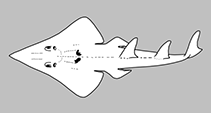 No image available for this species;
drawing shows typical species in Rhinidae.
Google Bild
drawing shows typical species in Rhinidae.
Klassifizierung / Names Namen | Synonyme | Catalog of Fishes(Gattung, Arten) | ITIS | CoL | WoRMS | Cloffa
Elasmobranchii (Haie und Rochen) (sharks and rays) > Rhinopristiformes (Shovelnose rays) > Rhinidae (Wedgefishes)
Etymology: Rhynchobatus: Greek, rhingchos = snout + Greek, batis, -idos = a sting ray (Raja sp.) (Ref. 45335).
Eponymy: Sidney ‘Sid’ F Cook (1953–1997) was a shark fishery conservationist and biologist. [...] (Ref. 128868), visit book page.
Etymology: Rhynchobatus: Greek, rhingchos = snout + Greek, batis, -idos = a sting ray (Raja sp.) (Ref. 45335).
Eponymy: Sidney ‘Sid’ F Cook (1953–1997) was a shark fishery conservationist and biologist. [...] (Ref. 128868), visit book page.
Umwelt: Milieu / Klimazone / Tiefenbereich / Verbreitungsgebiet Ökologie
seewasser pelagic-neritic; tiefenbereich ? - 70 m (Ref. 114953). Tropical
Verbreitung Territorien | FAO Gebiete | Ökosysteme | Vorkommen | Punkt Karte | Einführungen | Faunafri
Western Pacific: Singapore and Indonesia.
Größe / Gewicht / Alter
Kurzbeschreibung Bestimmungsschlüssel | Morphologie | Morphometrie
This species is the smallest of the wedgefishes (to 81 cm TL), it has also the lowest vertebral count (less than 107 centra). It is distinguished from its congeners by the following characters: a long, hastate snout; very strongly undulate anterior pectoral-fin margin; dorsal mainly dark and distinctively marked with white blotches; spots and streaks, with a dark cruciate marking on the interorbit; a prominent white border around the body margin; snout tip lacks dark blotches; absence of the black pectoral-fin marking; it is similar with the much larger Atlantic species (Rhynchobatus luebberti) with well-developed rostral spines, but these spines are confined to the snout tip (vs. being more numerous and extending in paired rows along the rostral ridges nearly to the eyes) (Ref. 109575).
Body shape (shape guide): elongated.
Body shape (shape guide): elongated.
A poorly known benthic species with restricted distribution, probably coastal. Males mature at ca. 71 cm TL, born at ca. 14 cm TL. Embryos with yolk sacs at 20.9-23.6 TL; juvenile male at 39.5 cm TL, adolescent at 64.2 cm TL and adult at size greater than 70.5 cm TL; immature females at 41.5 and 60.9 cm TL (Ref. 114953).
Lebenszyklus und Paarungsverhalten Geschlechtsreife | Fortpflanzung | Ablaichen | Eier | Fruchtbarkeit | Larven
Hauptreferenz
Laden Sie Ihre Referenzen hoch | Referenzen | Koordinator | Partner
Last, P.R., P.M. Kyne and L.J.V. Compagno, 2016. A new species of wedgefish Rhynchobatus cooki (Rhinopristoformes, Rhinidae) from the Indo-West Pacific. Zootaxa 4139(2):233-247. (Ref. 109575)
IUCN Rote Liste Status (Ref. 130435: Version 2025-2 (Global))
vom Aussterben bedroht (CR) (A2bd); Date assessed: 29 May 2019
Bedrohung für Menschen
Harmless
Nutzung durch Menschen
FAO - Publication: search | FishSource |
Mehr Information
Trophische Ökologie
Lebensmittel (Beutetiere)
Nahrungszusammensetzung
Nahrungsaufnahme
Lebensmittelrationen
Räuber
Lebensmittel (Beutetiere)
Nahrungszusammensetzung
Nahrungsaufnahme
Lebensmittelrationen
Räuber
Ökologie
Ökologie
Ökologie
Populationsdynamik
Wachstumsparameter
Max. Alter/Größen
Länge-Gewicht-Rel.
Länge-Länge-Verhältnis.
Längenhäufigkeiten
Massenkonvertierung
Rekrutierung
Dichte
Wachstumsparameter
Max. Alter/Größen
Länge-Gewicht-Rel.
Länge-Länge-Verhältnis.
Längenhäufigkeiten
Massenkonvertierung
Rekrutierung
Dichte
Lebenszyklus
Fortpflanzung
Geschlechtsreife
Reifung/Kiemen rel.
Fruchtbarkeit
Ablaichen
Laichaggregationen
Eier
Eientwicklung
Larven
Larven Pop.Dyn.
Fortpflanzung
Geschlechtsreife
Reifung/Kiemen rel.
Fruchtbarkeit
Ablaichen
Laichaggregationen
Eier
Eientwicklung
Larven
Larven Pop.Dyn.
Anatomie
Kiemenoberfläche
Gehirn
Otolith
Kiemenoberfläche
Gehirn
Otolith
Physiologie
Körperliche Zusammensetzung
Nährstoffe
Sauerstoffverbrauch
Schwimmart
Schwimmgeschwindigkeit
Visuelle Pigmente
Fischgeräusche
Krankheiten und Parasiten
Toxizität (LC50s)
Körperliche Zusammensetzung
Nährstoffe
Sauerstoffverbrauch
Schwimmart
Schwimmgeschwindigkeit
Visuelle Pigmente
Fischgeräusche
Krankheiten und Parasiten
Toxizität (LC50s)
Genetik
Genom
Genetik
Heterozygotie
Vererbbarkeit
Genetische Vielfalt
Genom
Genetik
Heterozygotie
Vererbbarkeit
Genetische Vielfalt
Menschenbezogen
Aquakultur-Systeme
Aquakultur Profile
Zuchtlinien
Ciguatera-Fälle
Briefmarken, Münzen, Verschiedenes.
Aquakultur-Systeme
Aquakultur Profile
Zuchtlinien
Ciguatera-Fälle
Briefmarken, Münzen, Verschiedenes.
Tools
Zusatzinformationen
Download XML
Zusammenfassung | Punktdaten | Namen | Photos
Internet Quellen
AFORO (otoliths) | Aquatic Commons | BHL | Cloffa | Websites from users | FishWatcher Einträge suchen | CISTI | Catalog of Fishes: Gattung, Arten | DiscoverLife | ECOTOX | FAO - Publication: search | Faunafri | Fishipedia | Fishtrace | GloBI | Google Books | Google Scholar | Google | IGFA World Record | OneZoom | Open Tree of Life | Otolith Atlas of Taiwan Fishes | PubMed | Reef Life Survey | Socotra Atlas | TreeBase | Tree of Life | Wikipedia: Gehe zu, Suchen | World Records Freshwater Fishing | Zoobank | Zoologischer Rekord
Schätzungen auf der Grundlage von Modellen
Phylogenetischer Diversitätsindex (Ref. 82804): PD50 = 0.5024 [Uniqueness, from 0.5 = low to 2.0 = high].
Bayesian length-weight: a=0.00372 (0.00166 - 0.00830), b=3.11 (2.91 - 3.31), in cm total length, based on LWR estimates for this (Sub)family-body shape (Ref. 93245).
Trophische Ebene (Ref. 69278): 3.4 ±0.6 se; based on size and trophs of closest relatives