



Uploaden van uw Foto's en video's
Google afbeelding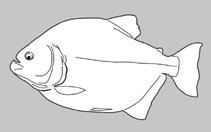 No image available for this species;
drawing shows typical species in Serrasalmidae.
Google afbeelding
drawing shows typical species in Serrasalmidae.
Classificatie / Namen Lokale namen | Synoniemen | Catalog of Fishes(Genus, Soort(en)) | ITIS | CoL | WoRMS | Cloffa
> Characiformes (Characins) > Serrasalmidae (Piranhas and pacus) > Myleinae
Etymology: Myloplus: Greek, mylos, -ou = grey mullet + Greek, plus, ploos = movement of a serpent; lucienae: Named for Luciene Maria Kassar Borges.
Eponymy: Dr Luciene Maria Kassar Borges is a zoologist and ichthyologist who has two bachelor’s degrees from the Federal University of Mato Grosso (1973 & 1976) and a master’s from the National Institute of Amazonian Research (1983). [...] (Ref. 128868), visit book page.
Etymology: Myloplus: Greek, mylos, -ou = grey mullet + Greek, plus, ploos = movement of a serpent; lucienae: Named for Luciene Maria Kassar Borges.
Eponymy: Dr Luciene Maria Kassar Borges is a zoologist and ichthyologist who has two bachelor’s degrees from the Federal University of Mato Grosso (1973 & 1976) and a master’s from the National Institute of Amazonian Research (1983). [...] (Ref. 128868), visit book page.
Milieu: milieu / Klimaatzone / Diepte / verspreidingsgebied Ecologie
; zoet water benthopelagisch. Tropical; 1°N - 3°S, 68°W - 60°W (Ref. 114774)
Verspreiding Gebieden | FAO regio's | Ecosystemen | Voorkomen | Verspreidingskaart | Introducties | Faunafri
South America: Brazil.
Grootte / Gewicht / Leeftijd
Maturiteit: Lm ? range ? - ? cm
Max length : 33.8 cm SL mannelijk / geslacht onbekend; (Ref. 114774)
Max length : 33.8 cm SL mannelijk / geslacht onbekend; (Ref. 114774)
Korte beschrijving Determinatiesleutels | Morfologie | Morfometrie
This species is distinguished from its congeners, except planquettei, zorroi, by having its anteriormost spine of prepelvic serra reaching only the middle of the abdomen between the verticals through pectoral and pelvic-fin origins (vs. reaching the vertical through pectoral-fin origin or almost so); differs from asterias, lobatus, planquettei, rhomboidalis, rubripinnis, ternetzi, zorroi by having fewer scale rows between lateral line and dorsal-fin origin 30-35 (vs. 36-61), and between lateral line and pelvic-fin origin 27-31 (vs. 32-63); from asterias, levis, tiete, torquatus, by having 18-22 branched dorsal-fin rays (vs. 24-27); from M. arnoldi by having a relatively elongate body, its body depth 53.0-64.5% of SL (vs. 69.0-76.9% of SL); from M. ternetzi by the presence of a pair of symphyseal teeth on dentary (vs. none); from M. schomburgkii by the absence of a vertical black stripe on middle portion of flank (vs. presence) (Ref. 114774).
Body shape (shape guide): short and / or deep; Cross section: compressed.
Body shape (shape guide): short and / or deep; Cross section: compressed.
Usually found in rapids, but is also recorded for slow-flowing habitats such as backwaters and lakes (Ref. 114774).
Levenscyclus en paargedrag Maturiteit | Voortplanting | Paaien | Eieren | Fecunditeit | Larven
Hoofdreferentie
Upload uw referenties | Referenties | Coördinator | Medewerkers
Andrade, M.C., R.O. Ota, D.A. Bastos and M. Jégu, 2016. A new large Myloplus Gill 1896 from rio Negro basin, Brazilian Amazon (Characiformes: Serrasalmidae). Zootaxa 4205(6):571-580. (Ref. 114774)
CITES
Not Evaluated
Gevaar voor de mens
Harmless
Gebruik door de mens
FAO - Publication: search | FishSource |
Meer informatie
Trofische ecologie
Voedsel (prooien)
Dieetsamenstelling
Voedselconsumptie
Voedselrantsoenen
Predatoren
Voedsel (prooien)
Dieetsamenstelling
Voedselconsumptie
Voedselrantsoenen
Predatoren
Ecologie
Ecologie
Ecologie
Populatiedynamica
Groeiparameters
Max. leeftijden / maten
Lengte-gewicht rel.
Lengte-lengte rel.
Lengtefrequenties
Massaconversie
Rekrutering
Abundantie
Groeiparameters
Max. leeftijden / maten
Lengte-gewicht rel.
Lengte-lengte rel.
Lengtefrequenties
Massaconversie
Rekrutering
Abundantie
Levenscyclus
Voortplanting
Maturiteit
Rijpheid/kieuwen rel.
Fecunditeit
Paaien
Paaibestanden
Eieren
Ontwikkeling van de eieren
Larven
Larvale populatiedynamiek
Voortplanting
Maturiteit
Rijpheid/kieuwen rel.
Fecunditeit
Paaien
Paaibestanden
Eieren
Ontwikkeling van de eieren
Larven
Larvale populatiedynamiek
Anatomie
Kieuwoppervlak
Hersenen
Otoliet
Kieuwoppervlak
Hersenen
Otoliet
Fysiologie
Lichaamssamenstelling
Voedingsstoffen
Zuurstofverbruik
Type zwemmen
Zwemsnelheid
Visuele pigmenten
Vis geluid
Ziekten en parasieten
Toxiciteit (LC50)
Lichaamssamenstelling
Voedingsstoffen
Zuurstofverbruik
Type zwemmen
Zwemsnelheid
Visuele pigmenten
Vis geluid
Ziekten en parasieten
Toxiciteit (LC50)
Genetica
genoom
Genetica
Heterozygositeit
Erfelijkheid
Genetische diversiteit
genoom
Genetica
Heterozygositeit
Erfelijkheid
Genetische diversiteit
Menselijk gerelateerd
Aquacultuursystemen
Aquacultuurprofielen
Kweeklijnen
Ciguatera gevallen
Postzegels, munten, diversen.
Aquacultuursystemen
Aquacultuurprofielen
Kweeklijnen
Ciguatera gevallen
Postzegels, munten, diversen.
Tools
Speciale rapporten
Bekijk gegevens voor het houden in een aquarium | Bekijk Fact Sheets voor de soort | Bekijk Aquacultuur Fact Sheets
Download XML
Internetbronnen
AFORO (otoliths) | Aquatic Commons | BHL | Cloffa | Websites from users | Bekijk FishWatcher | CISTI | Catalog of Fishes: Genus, Soort(en) | DiscoverLife | ECOTOX | FAO - Publication: search | Faunafri | Fishipedia | Fishtrace | GloBI | Google Books | Google Scholar | Google | IGFA World Record | OneZoom | Open Tree of Life | Otolith Atlas of Taiwan Fishes | PubMed | Reef Life Survey | Socotra Atlas | TreeBase | Tree of Life | Wikipedia: ga naar, zoek | World Records Freshwater Fishing | Zoobank | Zoological Record
Schattingen op basis van modellen
Fylogenetische diversiteitsindex (Ref. 82804): PD50 = 0.5001 [Uniqueness, from 0.5 = low to 2.0 = high].
Bayesian length-weight: a=0.02754 (0.01332 - 0.05696), b=2.96 (2.78 - 3.14), in cm total length, based on LWR estimates for this Genus-body shape (Ref. 93245).
Weerstandsvermogen (Ref. 120179): Hoog, minimale populatieverdubbelingstijd minder dan 15 maanden (Preliminary K or Fecundity.).