



Hochladen Photos und videos
Google Bild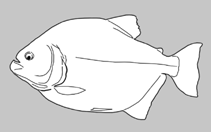 No image available for this species;
drawing shows typical species in Serrasalmidae.
Google Bild
drawing shows typical species in Serrasalmidae.
Klassifizierung / Names Namen | Synonyme | Catalog of Fishes(Gattung, Arten) | ITIS | CoL | WoRMS | Cloffa
> Characiformes (Characins) > Serrasalmidae (Piranhas and pacus) > Myleinae
Etymology: Myloplus: Greek, mylos, -ou = grey mullet + Greek, plus, ploos = movement of a serpent; zorroi: Named for Mauricio Camargo-Zorro (Instituto Federal de Educação, Ciência e Tecnologia); alludes to the Latin-American fictional character Zorro, because the special features 'masked' this fish as Tometes, concealing its true identity.
Eponymy: Dr Mauricio Camargo-Zorro is a researcher at the Instituto Federal de Educação, Ciência e Tecnologia, São Paulo. [...] (Ref. 128868), visit book page.
Etymology: Myloplus: Greek, mylos, -ou = grey mullet + Greek, plus, ploos = movement of a serpent; zorroi: Named for Mauricio Camargo-Zorro (Instituto Federal de Educação, Ciência e Tecnologia); alludes to the Latin-American fictional character Zorro, because the special features 'masked' this fish as Tometes, concealing its true identity.
Eponymy: Dr Mauricio Camargo-Zorro is a researcher at the Instituto Federal de Educação, Ciência e Tecnologia, São Paulo. [...] (Ref. 128868), visit book page.
Umwelt: Milieu / Klimazone / Tiefenbereich / Verbreitungsgebiet Ökologie
; süßwasser benthopelagisch. Tropical
Verbreitung Territorien | FAO Gebiete | Ökosysteme | Vorkommen | Punkt Karte | Einführungen | Faunafri
South America: Brazil.
Größe / Gewicht / Alter
Kurzbeschreibung Bestimmungsschlüssel | Morphologie | Morphometrie
This species is distinguished from its congeners by the following characters: absence of the abdominal keel and prepelvic serrae formed by 13-19 low spines (vs. a well-marked abdominal keel and prepelvic serrae of more than 20 high spines). It differs from asterias, levis, torquatus by having fewer branched dorsal-fin rays 20-22 (vs. 23 or more); from arnoldi, ternetzi, torquatus by having a greater number of branched anal-fin rays 32-34 (vs. 31 or fewer); differs significantly from lobatus, schomburgkii, rhomboidalis by having two rows of premaxillary teeth forming a slight arc (vs. 2 rows of premaxillary teeth forming a shape that resembles the uppercase letter 'A'; shorter dorsal-fin base 27.6-30.1% of SL (vs. 31.8% of SL or higher); differs from asterias, levis, ternetzi, torquatus in having a larger interdorsal distance 11.4-12.7% of SL (vs. 10.8% of SL or lower); differs further from M. ternetzi by the presence of a pair of symphyseal teeth (vs. none); from asterias, levis, lobatus, ternetzi by having a smaller vertical diameter of the eye 27.3-35.4% of HL (vs. 35.5% of HL or greater); from arnoldi, torquatus by having a greater number of total vertebrae 40-41 (vs. 37 or less), by having anterior dorsal-fin rays lacking pigmentation (vs. strongly dark pigmented), and the presence of a diffuse dark band at caudal-fin distal border (vs. the presence of a well-defined dark band); from M. asterias by having an elongated fontanel with similarly sized anterior and posterior portions (vs. very short posterior fontanel and rounded anterior fontanel) (Ref. 114773).
Body shape (shape guide): short and / or deep; Cross section: compressed.
Body shape (shape guide): short and / or deep; Cross section: compressed.
Lebenszyklus und Paarungsverhalten Geschlechtsreife | Fortpflanzung | Ablaichen | Eier | Fruchtbarkeit | Larven
Hauptreferenz
Laden Sie Ihre Referenzen hoch | Referenzen | Koordinator | Partner
Andrade, M.C., M. Jégu and T. Giarrizzo, 2016. A new large species of Myloplus (Characiformes: Serrasalmidae) from rio Madeira basin, Brazil. ZooKeys 571:153-167. (Ref. 114773)
CITES
Not Evaluated
Bedrohung für Menschen
Harmless
Nutzung durch Menschen
FAO - Publication: search | FishSource |
Mehr Information
Trophische Ökologie
Lebensmittel (Beutetiere)
Nahrungszusammensetzung
Nahrungsaufnahme
Lebensmittelrationen
Räuber
Lebensmittel (Beutetiere)
Nahrungszusammensetzung
Nahrungsaufnahme
Lebensmittelrationen
Räuber
Ökologie
Ökologie
Ökologie
Populationsdynamik
Wachstumsparameter
Max. Alter/Größen
Länge-Gewicht-Rel.
Länge-Länge-Verhältnis.
Längenhäufigkeiten
Massenkonvertierung
Rekrutierung
Dichte
Wachstumsparameter
Max. Alter/Größen
Länge-Gewicht-Rel.
Länge-Länge-Verhältnis.
Längenhäufigkeiten
Massenkonvertierung
Rekrutierung
Dichte
Lebenszyklus
Fortpflanzung
Geschlechtsreife
Reifung/Kiemen rel.
Fruchtbarkeit
Ablaichen
Laichaggregationen
Eier
Eientwicklung
Larven
Larven Pop.Dyn.
Fortpflanzung
Geschlechtsreife
Reifung/Kiemen rel.
Fruchtbarkeit
Ablaichen
Laichaggregationen
Eier
Eientwicklung
Larven
Larven Pop.Dyn.
Anatomie
Kiemenoberfläche
Gehirn
Otolith
Kiemenoberfläche
Gehirn
Otolith
Physiologie
Körperliche Zusammensetzung
Nährstoffe
Sauerstoffverbrauch
Schwimmart
Schwimmgeschwindigkeit
Visuelle Pigmente
Fischgeräusche
Krankheiten und Parasiten
Toxizität (LC50s)
Körperliche Zusammensetzung
Nährstoffe
Sauerstoffverbrauch
Schwimmart
Schwimmgeschwindigkeit
Visuelle Pigmente
Fischgeräusche
Krankheiten und Parasiten
Toxizität (LC50s)
Genetik
Genom
Genetik
Heterozygotie
Vererbbarkeit
Genetische Vielfalt
Genom
Genetik
Heterozygotie
Vererbbarkeit
Genetische Vielfalt
Menschenbezogen
Aquakultur-Systeme
Aquakultur Profile
Zuchtlinien
Ciguatera-Fälle
Briefmarken, Münzen, Verschiedenes.
Aquakultur-Systeme
Aquakultur Profile
Zuchtlinien
Ciguatera-Fälle
Briefmarken, Münzen, Verschiedenes.
Tools
Zusatzinformationen
Download XML
Zusammenfassung | Punktdaten | Namen | Photos
Internet Quellen
AFORO (otoliths) | Aquatic Commons | BHL | Cloffa | Websites from users | FishWatcher Einträge suchen | CISTI | Catalog of Fishes: Gattung, Arten | DiscoverLife | ECOTOX | FAO - Publication: search | Faunafri | Fishipedia | Fishtrace | GloBI | Google Books | Google Scholar | Google | IGFA World Record | OneZoom | Open Tree of Life | Otolith Atlas of Taiwan Fishes | PubMed | Reef Life Survey | Socotra Atlas | TreeBase | Tree of Life | Wikipedia: Gehe zu, Suchen | World Records Freshwater Fishing | Zoobank | Zoologischer Rekord
Schätzungen auf der Grundlage von Modellen
Phylogenetischer Diversitätsindex (Ref. 82804): PD50 = 0.5001 [Uniqueness, from 0.5 = low to 2.0 = high].
Bayesian length-weight: a=0.02754 (0.01332 - 0.05696), b=2.96 (2.78 - 3.14), in cm total length, based on LWR estimates for this Genus-body shape (Ref. 93245).
Widerstandsfähigkeit (Ref. 120179): hoch, Verdopplung der Population dauert weniger als 15 Monate. (Preliminary K or Fecundity.).