



Hochladen Photos und videos
Google Bild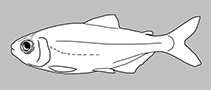 No image available for this species;
drawing shows typical species in Iguanodectidae.
Google Bild
drawing shows typical species in Iguanodectidae.
Klassifizierung / Names Namen | Synonyme | Catalog of Fishes(Gattung, Arten) | ITIS | CoL | WoRMS | Cloffa
> Characiformes (Characins) > Iguanodectidae ("Lizard bite tetras")
Etymology: Bryconops: Greek, bryko = to bite + Greek, ops = appearance (Ref. 45335); munduruku: Named in allusion to a tribe of Munduruku Indians denominated Tapajós-Tapera, who settled on the right margin of the Tapajós River, giving rise to what today is the city of Aveiro, the type locality of Bryconops munduruku (Ref. 104128).
Eponymy: The Munduruku Indians settled on the right margin of the Tapajós River, giving rise to what is now the city of Aveiro, Brazil, the type locality. (Ref. 128868), visit book page.
Etymology: Bryconops: Greek, bryko = to bite + Greek, ops = appearance (Ref. 45335); munduruku: Named in allusion to a tribe of Munduruku Indians denominated Tapajós-Tapera, who settled on the right margin of the Tapajós River, giving rise to what today is the city of Aveiro, the type locality of Bryconops munduruku (Ref. 104128).
Eponymy: The Munduruku Indians settled on the right margin of the Tapajós River, giving rise to what is now the city of Aveiro, Brazil, the type locality. (Ref. 128868), visit book page.
Umwelt: Milieu / Klimazone / Tiefenbereich / Verbreitungsgebiet Ökologie
; süßwasser benthopelagisch. Tropical
Verbreitung Territorien | FAO Gebiete | Ökosysteme | Vorkommen | Punkt Karte | Einführungen | Faunafri
South Amrerica: known from the Igarapé Açu, a tributary on the right margin of the Tapajós River, about 10 km from Aveiro, Pará State, Brazil (Ref. 104128).
Größe / Gewicht / Alter
Kurzbeschreibung Bestimmungsschlüssel | Morphologie | Morphometrie
Rückenflossenweichstrahlen (insgesamt) : 10 - 11; Afterflossenweichstrahlen: 26 - 29; Wirbelzahl: 41 - 42. Diagnosis: Bryconops munduruku differs from its congeners, except B. inpai and B. piracolina, by possessing a black adipose fin (vs. adipose fin hyaline in alcohol); it differs from B. inpai and B. piracolina by possessing a hyaline band on the black adipose-fin base (vs. entirely black adipose fin in B. piracolina and B. inpai); Bryconops munduruku differs further from B. piracolina by having a hyaline dorsal fin (vs. presence of a large black blotch on the dorsal-fin base); Bryconops munduruku differs from other species of the subgenus Creatochanes, except B. inpai, by possessing 2 humeral blotches (vs. lack of humeral blotch or humeral region with a single humeral blotch in B. humeralis and B. vibex); it differs further from B. inpai due to the uniform color pattern on the posterior portion of the side of the body (vs. presence of a dark stripe extending posteriorly from the half of the anal-fin base onto the base of the middle caudal-fin rays) (Ref. 104128).
Body shape (shape guide): fusiform / normal.
Body shape (shape guide): fusiform / normal.
Igarapé Açu presents clear water running over sandy beds; its headwaters are located within the limits of the Tapajós National Forest and are densely covered by marginal vegetation (Ref. 104128).
Lebenszyklus und Paarungsverhalten Geschlechtsreife | Fortpflanzung | Ablaichen | Eier | Fruchtbarkeit | Larven
Hauptreferenz
Laden Sie Ihre Referenzen hoch | Referenzen | Koordinator | Partner
Silva-Oliveira, C., A.L.C. Canto and F.R.V. Ribeiro, 2015. Bryconops munduruku (Characiformes: Characidae), a new species of fish from the lower Tapajós River basin, Brazil. Zootaxa 3994(1):133-141. (Ref. 104128)
CITES
Not Evaluated
Bedrohung für Menschen
Harmless
Nutzung durch Menschen
FAO - Publication: search | FishSource |
Mehr Information
Trophische Ökologie
Lebensmittel (Beutetiere)
Nahrungszusammensetzung
Nahrungsaufnahme
Lebensmittelrationen
Räuber
Lebensmittel (Beutetiere)
Nahrungszusammensetzung
Nahrungsaufnahme
Lebensmittelrationen
Räuber
Populationsdynamik
Wachstumsparameter
Max. Alter/Größen
Länge-Gewicht-Rel.
Länge-Länge-Verhältnis.
Längenhäufigkeiten
Massenkonvertierung
Rekrutierung
Dichte
Wachstumsparameter
Max. Alter/Größen
Länge-Gewicht-Rel.
Länge-Länge-Verhältnis.
Längenhäufigkeiten
Massenkonvertierung
Rekrutierung
Dichte
Lebenszyklus
Fortpflanzung
Geschlechtsreife
Reifung/Kiemen rel.
Fruchtbarkeit
Ablaichen
Laichaggregationen
Eier
Eientwicklung
Larven
Larven Pop.Dyn.
Fortpflanzung
Geschlechtsreife
Reifung/Kiemen rel.
Fruchtbarkeit
Ablaichen
Laichaggregationen
Eier
Eientwicklung
Larven
Larven Pop.Dyn.
Anatomie
Kiemenoberfläche
Gehirn
Otolith
Kiemenoberfläche
Gehirn
Otolith
Physiologie
Körperliche Zusammensetzung
Nährstoffe
Sauerstoffverbrauch
Schwimmart
Schwimmgeschwindigkeit
Visuelle Pigmente
Fischgeräusche
Krankheiten und Parasiten
Toxizität (LC50s)
Körperliche Zusammensetzung
Nährstoffe
Sauerstoffverbrauch
Schwimmart
Schwimmgeschwindigkeit
Visuelle Pigmente
Fischgeräusche
Krankheiten und Parasiten
Toxizität (LC50s)
Genetik
Genom
Genetik
Heterozygotie
Vererbbarkeit
Genetische Vielfalt
Genom
Genetik
Heterozygotie
Vererbbarkeit
Genetische Vielfalt
Menschenbezogen
Aquakultur-Systeme
Aquakultur Profile
Zuchtlinien
Ciguatera-Fälle
Briefmarken, Münzen, Verschiedenes.
Aquakultur-Systeme
Aquakultur Profile
Zuchtlinien
Ciguatera-Fälle
Briefmarken, Münzen, Verschiedenes.
Tools
Zusatzinformationen
Download XML
Zusammenfassung | Punktdaten | Namen | Photos
Internet Quellen
AFORO (otoliths) | Aquatic Commons | BHL | Cloffa | Websites from users | FishWatcher Einträge suchen | CISTI | Catalog of Fishes: Gattung, Arten | DiscoverLife | ECOTOX | FAO - Publication: search | Faunafri | Fishipedia | Fishtrace | GloBI | Google Books | Google Scholar | Google | IGFA World Record | OneZoom | Open Tree of Life | Otolith Atlas of Taiwan Fishes | PubMed | Reef Life Survey | Socotra Atlas | TreeBase | Tree of Life | Wikipedia: Gehe zu, Suchen | | Zoobank | Zoologischer Rekord
Schätzungen auf der Grundlage von Modellen
|
Phylogenetischer Diversitätsindex (Ref. 82804) |
PD50 = 0.5000 [Uniqueness, from 0.5 = low to 2.0 = high]. |
| Bayesian length-weight | a=0.00589 (0.00246 - 0.01407), b=3.18 (2.97 - 3.39), in cm total length, based on LWR estimates for this (Sub)family-body shape (Ref. 93245). |
|
Trophische Ebene (Ref. 69278) |
3.2 ±0.4 se; based on size and trophs of closest relatives |
|
Anfälligkeit der Fischerei (Ref. 59153) |
Low vulnerability (10 of 100). 🛈 |