



Adicionar o seu Fotografias e vídeos
Fotografias | Imagem do Google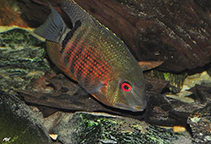 Heros liberifer
Male Fotografia de Negrini, M.
Fotografias | Imagem do Google
Male Fotografia de Negrini, M.
Classificação / Nomes Nomes comuns | Sinónimos | Catalog of Fishes(Género, Espécies) | ITIS | CoL | WoRMS | Cloffa
> Cichliformes (Cichlids, convict blennies) > Cichlidae (Cichlids) > Cichlinae
Etymology: Heros: Greek, heros = hero (Ref. 45335); liberifer: Derived from the Latin words liberi (= children) and ferre (= to carry) in reference to the oral incubation, a reproductive behaviour, which is apparently unique in the genus. A noun in apposition.
Etymology: Heros: Greek, heros = hero (Ref. 45335); liberifer: Derived from the Latin words liberi (= children) and ferre (= to carry) in reference to the oral incubation, a reproductive behaviour, which is apparently unique in the genus. A noun in apposition.
Ambiente: milieu / zona climática / intervalo de profundidade / gama de distribuição Ecologia
; Água doce bentopelágico; pH range: 4.1 - 6.1. Tropical; 27°C - ?
Distribuição Territórios | Áreas FAO | Ecossistemas | Ocorrências | Mapa dos pontos | Introduções | Faunafri
South America: Rio Orinoco basin.
Tamanho / Peso / Idade
Descrição breve Chaves de identificação | Morfologia | Morfometria
Espinhos dorsais (total) : 15 - 16; Raios dorsais moles (total) : 12 - 13; Espinhos anais: 6 - 7; Raios anais moles: 10 - 11; Vértebras: 17. Heros liberifer can be diagnosed from all its congeners by having the following characters: a pattern of several horizontal series of bright red dots on the lower half of the body sides (vs. absence of rows of red dots); distinct caudal spot in adult specimens (vs. caudal spot usually merged with bar 2 in adult specimens); and tiny dark dots on operculum and cheeks in adult males (vs. large dots or a vermicular pattern). It differs from adult specimens of the frequently syntopic Heros severus by narrow (vs. thick) lips, bar 4, which is not shortened, but extends from the anal fi n base onto the base of the dorsal fin (vs. bar 4 extending only slightly above the lower lateral line), by the first two anterior hemal spines, which are broader and partially connected (vs. the first three hemal spines connected), and a bright red (vs. brown to dark reddish) iris in live specimens (Ref. 114589).
Body shape (shape guide): elongated.
Body shape (shape guide): elongated.
This species is adapted to lentic environment with flooded forest habitats as the typical biotopes. It has no narrow habitat requirement as it is observed not only in clearwater and extreme blackwater habitats, but also in whitewater habitats. It can thrive in a wide range of physico-chemical environmental conditions (pH 4.1-6.1; conductivity 4-15 μS/cm). It spawns in the flooded riparian forest during the flood season. At the start of the dry season, it leaves the riparian forests, which mostly dry up, and spends the low-water season among submerged logs, trunks and branches. During the low-water season, it usually seeks shelter in the crevices and gaps found between the boulders (Ref. 114589).
Ciclo de vida e comportamento de acasalamento Maturidade | Reprodução | Desova | Ovos | Fecundidade | Larvas
Deposits eggs on vertical or sometimes on a horizontal surface. Hatching takes place approximately forty hours after spawning at 27° C water temperature. Both parents pick up the larvae to brood them orally (Ref. 114589).
Referência principal
Carregar as suas referências | Referências | Coordenador : Kullander, Sven O. | Colaboradores
Staeck, W. and I. Schindler, 2015. Description of a new Heros species (Teleostei, Cichlidae) from the Rio Orinoco drainage and notes on Heros severus Heckel, 1840. Bull. Fish Biol. 15(1/2):121-136. (Ref. 114589)
Categoria na Lista Vermelha da IUCN (Ref. 130435: Version 2025-2 (Global))
Preocupação menor (LC) ; Date assessed: 28 October 2020
CITES
Not Evaluated
Ameaça para o homem
Harmless
Utilização humana
FAO - Publication: search | FishSource |
Mais informação
Ecologia Trófica
Produtos alimentares (presas)
Composição da dieta
Consumo alimentar
Rações alimentares
Predadores
Produtos alimentares (presas)
Composição da dieta
Consumo alimentar
Rações alimentares
Predadores
Dinâmica das populações
Parâmetros de crescimento
Idades / tamanhos máximos
Comprimento-peso rel.
Comprimento-comprimento rel.
Frequência de comprimento
Conversão de massa
Recrutamento
Abundância
Parâmetros de crescimento
Idades / tamanhos máximos
Comprimento-peso rel.
Comprimento-comprimento rel.
Frequência de comprimento
Conversão de massa
Recrutamento
Abundância
Ciclo de vida
Reprodução
Maturidade
Maturidade/Rel. das guelras
Fecundidade
Desova
Agregações de desova
Ovos
Desenvolvimento dos ovos
Larvas
Dinâmica larvar
Reprodução
Maturidade
Maturidade/Rel. das guelras
Fecundidade
Desova
Agregações de desova
Ovos
Desenvolvimento dos ovos
Larvas
Dinâmica larvar
Anatomia
Área branquial
Cérebro
Otólitos
Área branquial
Cérebro
Otólitos
Fisiologia
Composição corporal
Nutrientes
Consumo de oxigénio
Tipo de natação
Velocidade de natação
Pigmentos visuais
Som de peixe
Doenças e Parasitas
Toxicidade (LC50s)
Composição corporal
Nutrientes
Consumo de oxigénio
Tipo de natação
Velocidade de natação
Pigmentos visuais
Som de peixe
Doenças e Parasitas
Toxicidade (LC50s)
Genética
genoma
Genética
Heterozigotia
Hereditariedade
Diversidade genética
genoma
Genética
Heterozigotia
Hereditariedade
Diversidade genética
Relacionado com o ser humano
Sistemas de aquacultura
Perfis para aquacultura
Estirpes
Casos de Ciguatera
Selos, moedas, diversos.
Sistemas de aquacultura
Perfis para aquacultura
Estirpes
Casos de Ciguatera
Selos, moedas, diversos.
Ferramentas
E-book | Guia de campo | Ferramenta auxiliar de frequências de comprimento | Ferramenta sobre a história de vida | Mapa dos pontos |
Captura-MSY |
Relatórios especiais
Descarregue XML
Fontes da internet
AFORO (otoliths) | Aquatic Commons | BHL | Cloffa | Websites from users | Consultar FishWatcher | CISTI | Catalog of Fishes: Género, Espécies | DiscoverLife | ECOTOX | FAO - Publication: search | Faunafri | Fishipedia | Fishtrace | GloBI | Google Books | Google Scholar | Google | IGFA World Record | OneZoom | Open Tree of Life | Otolith Atlas of Taiwan Fishes | PubMed | Reef Life Survey | Socotra Atlas | TreeBase | Árvore da vida | Wikipedia: ir para, procurar | World Records Freshwater Fishing | Zoobank | Registo zoológico
Estimativas baseadas em modelos
Índice de diversidade filogenética (Ref. 82804): PD50 = 0.5312 [Uniqueness, from 0.5 = low to 2.0 = high].
Bayesian length-weight: a=0.03020 (0.01328 - 0.06866), b=3.03 (2.84 - 3.22), in cm total length, based on LWR estimates for this (Sub)family-body shape (Ref. 93245).
Nível Trófico (Ref. 69278): 2.8 ±0.4 se; based on size and trophs of closest relatives
Resiliência (Ref. 120179): Elevada, tempo mínimo de duplicação da população menor que 15 meses (Preliminary K or Fecundity.).