



Petrocephalus leo Lavoué, 2016
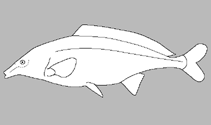
分類 / 名稱 俗名 | 同種異名 | Catalog of Fishes(屬, 種) | ITIS | CoL | WoRMS | Cloffa
Teleostei > Osteoglossiformes (Bony tongues) 骨舌魚目 (Bony tongues) > Mormyridae (Elephantfishes) 象鼻魚科 (Elephantfishes)
Etymology: Petrocephalus: Latin, petra = stone + Greek, kephale = head (Ref. 45335); leo: This species is named after the author's son Léo (Ref. 113655).
Etymology: Petrocephalus: Latin, petra = stone + Greek, kephale = head (Ref. 45335); leo: This species is named after the author's son Léo (Ref. 113655).
環境: 環境 / 氣候帶 / 深度上下限 / 配送範圍 生態學
; 淡水 底中水層性.
分布 領土 | FAO區域 | 生態系 | 發現紀錄 | 分布圖 | 簡介 | Faunafri
Africa: lower Kotto River (Ubangui River tributary, middle Congo River basin) in Central African Republic (Ref. 113655).
大小 / 重量 / 年齡
簡短描述 檢索表 | 型態特徵 | 形態測量圖
背棘 (總數) : 0; 背的軟條 (總數) : 21 - 24; 臀棘: 0; 臀鰭軟條: 26 - 28. Diagnosis: Petrocephalus leo is distinguished from all other Petrocephalus species of central Africa by the following combination of characteristics: absence of electroreceptive rosettes on head, body colouration brownish with distinct black mark at the base of pectoral fin, but no subdorsal ovoid black mark; 21 to 24 branched dorsal-fin rays and 26 to 29 branched anal-fin rays (Ref. 113655). Absence of the three typical Petrocephalus electroreceptive rosettes on the head distinguish Petrocephalus leo from most of its congeners, except P. microphthalmus, P. haullevillii, P. schoutedeni and P. zakoni; but it can be easily distinguished from these species by its unique pattern of melanin markings: a distinct black spot at the origin of the pectoral fins but no subdorsal pigmentation mark (Ref. 113655). Petrocephalus leo can be further distinguished from P. zakoni by its slender body, body depth 2.9-3.4 times in standard length vs. 2.5-2.7 times in P. zakoni; its relatively shorter dorsal fin, dorsal fin length 4.4-5.0 times in standard length vs. 4.0-4.3 times; and its smaller eye, eye diameter 3.7-4.4 times in head length vs. 3.1-3.3 times (Ref. 113655). It can be further distinguished from P. microphthalmus, P. haullevillii and P. schoutedeni, by a higher dorsal-fin ray count, 21-24 vs. less than 20 in the other species (Ref. 113655).
Body shape (shape guide): fusiform / normal; Cross section: compressed.
Body shape (shape guide): fusiform / normal; Cross section: compressed.
生命週期和交配行為 成熟度 | 繁殖 | 產卵場 | 卵 | 孕卵數 | 仔魚
主要參考資料
上傳您的推薦信 | 參考文獻 | 合作者 | 合作者
Lavoué, S., 2016. Petrocephalus leo, a new species of African electric fish (Osteoglossomorpha: Mormyridae) from the Oubangui River basin (Congo basin). Zootaxa 4121(3):319-330. (Ref. 113655)
CITES
Not Evaluated
對人類具威脅
人類使用
FAO - Publication: search | FishSource |
更多資訊
營養生態學
食物項目(獵物)
食性組成
食物消耗量
食物配給
捕食者
食物項目(獵物)
食性組成
食物消耗量
食物配給
捕食者
生態學
生態學
生態學
人口動態
成長參數
最大年齡/尺寸
長度重量比
長度關係
長度-頻率
質量轉換
入添量
豐度
成長參數
最大年齡/尺寸
長度重量比
長度關係
長度-頻率
質量轉換
入添量
豐度
解剖學
鰓區
腦部
耳石
鰓區
腦部
耳石
生理學
身體成分
營養素
耗氧量
游泳類型
游泳速度
視覺色素
魚聲
疾病與寄生蟲
毒性 (LC50s)
身體成分
營養素
耗氧量
游泳類型
游泳速度
視覺色素
魚聲
疾病與寄生蟲
毒性 (LC50s)
遺傳學
基因組
遺傳學
異種性
遺傳率
遺傳多樣性
基因組
遺傳學
異種性
遺傳率
遺傳多樣性
工具
特別的報告
下載 XML
網路資源
AFORO (otoliths) | Aquatic Commons | BHL | Cloffa | Websites from users | 檢查 FishWatcher | CISTI | Catalog of Fishes: 屬, 種 | DiscoverLife | ECOTOX | FAO - Publication: search | Faunafri | Fishipedia | Fishtrace | GloBI | Google Books | Google Scholar | Google | IGFA World Record | OneZoom | Open Tree of Life | Otolith Atlas of Taiwan Fishes | PubMed | Reef Life Survey | Socotra Atlas | TreeBase | 樹狀分類階層 | Wikipedia: 去, 搜尋 | World Records Freshwater Fishing | Zoobank | 動物學的記錄
基於模型的估計
系統發育多樣性指數 (參考文獻 82804): PD50 = 0.5000 [Uniqueness, from 0.5 = low to 2.0 = high].
Bayesian length-weight: a=0.01549 (0.00672 - 0.03569), b=2.87 (2.69 - 3.05), in cm total length, based on LWR estimates for this Genus-body shape (Ref. 93245).
營養階層 (參考文獻 69278): 3.2 ±0.4 se; based on size and trophs of closest relatives
回復力 (參考文獻 120179): 高度, 族群倍增時間少於 15個月 (Preliminary K or Fecundity.).