This website uses cookies to enhance your browsing experience and ensure the functionality of our site. For more detailed information about the types of cookies we use and how we protect your privacy, please visit our Privacy Information page.
×
Cookie Settings
This website uses different types of cookies to enhance your experience. Please select your preferences below:
> Gobiiformes (Gobies) > Gobiidae (Gobies) > Gobiinae
Etymology: Trimma:Greek, trimma, -atos = something crushed (Ref. 45335); pentherum:Name from Greek 'pentheros' meaning 'of mourning', apparently alluding to the black bar on the pectoral-fin base which, with considerable imagination, could be viewed as analogous to the black arm band worn to signify the death of a close friend or relative in certain cultures.
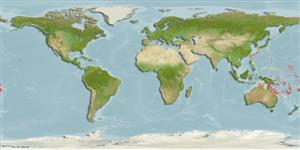
Milieu: milieu / Klimaatzone / Diepte / verspreidingsgebied Ecologie
marien rifbewoner; diepte 0 - 24 m (Ref. 100726). Tropical
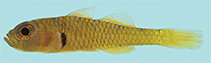
Dorsale stekels (totaal) : 7; Dorsale zachte stralen (totaal) : 8; Anale stekels: 1; Anale zachte stralen: 8. This species is distinguished by the following characters: a concave bony interorbital which is less than half pupil-diameter in width; slight or no groove posterodorsal to eye; presence of scales in the midline of the predorsal region; absence of opercular scales; the fifth pelvic ray is branched once dichotomously and more than 80% the length of the fourth ray; adults with the epaxial musculature reaching anteromedially to a point in line with the posterior margin of the eye; elongated spines in first dorsal fin absent (the second spine is longest, reaching to the region of the base of the second dorsal-fin spine); scale pockets are strongly outlined by melanophores and chromatophores; with a dark, vertical bar on the base of the pectoral fin; 6 grey saddles across the dorsum (Ref. 100726). Body shape (shape guide): fusiform / normal; Cross section: oval.
Winterbottom, R. and D.F. Hoese, 2015. A revision of the Australian species of Trimma (Actinopterygii, Gobiidae), with descriptions of six new species and redescriptions of twenty-three valid species. Zootaxa 3934(1):001-102. (Ref. 100726)
Status op de Rode Lijst van het IUCN (Ref. 130435: Version 2025-2 (Global))
Fylogenetische diversiteitsindex (Ref. 82804): PD50 = 0.5000 [Uniqueness, from 0.5 = low to 2.0 = high].
Bayesian length-weight: a=0.01023 (0.00477 - 0.02194), b=3.01 (2.83 - 3.19), in cm total length, based on LWR estimates for this (Sub)family-body shape (Ref. 93245).
Weerstandsvermogen (Ref. 120179): Hoog, minimale populatieverdubbelingstijd minder dan 15 maanden (Preliminary K or Fecundity.).
Kwetsbaarheid van de visserij (Ref. 59153): Low vulnerability (10 of 100). 🛈