



Hypsopanchax stiassnyae van der Zee, Sonnenberg & Mbimbi Mayi Munene, 2015
Hochladen Photos und videos
Bilder | Google Bild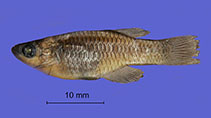 Hypsopanchax stiassnyae
Male Photo von Van der Zee, J.R.
Bilder | Google Bild
Male Photo von Van der Zee, J.R.
Klassifizierung / Names Namen | Synonyme | Catalog of Fishes(Gattung, Arten) | ITIS | CoL | WoRMS | Cloffa
> Cyprinodontiformes (Rivulines, killifishes and live bearers) > Procatopodidae (African lampeyes) > Procatopodinae
Etymology: Hypsopanchax: Greek, hypsi = high + Panchax, a word created by Meinken in 1932; stiassnyae: The species is named after Melanie L.J. Stiassny of the American Museum of Natural History, New York, who supported the authors in many ways during their studies on the systematics of the Cyprinodontiformes of the Congo basin (Ref. 103403).
Eponymy: Dr Melanie Lisa Jane Stiassny (d: 1953) is a British-born naturalized American citizen who is Herbert R. [...] (Ref. 128868), visit book page.
Etymology: Hypsopanchax: Greek, hypsi = high + Panchax, a word created by Meinken in 1932; stiassnyae: The species is named after Melanie L.J. Stiassny of the American Museum of Natural History, New York, who supported the authors in many ways during their studies on the systematics of the Cyprinodontiformes of the Congo basin (Ref. 103403).
Eponymy: Dr Melanie Lisa Jane Stiassny (d: 1953) is a British-born naturalized American citizen who is Herbert R. [...] (Ref. 128868), visit book page.
Umwelt: Milieu / Klimazone / Tiefenbereich / Verbreitungsgebiet Ökologie
; süßwasser benthopelagisch; pH range: 6.2 - 6.2. Tropical; 29°C - ? (Ref. 103403)
Verbreitung Territorien | FAO Gebiete | Ökosysteme | Vorkommen | Punkt Karte | Einführungen | Faunafri
Africa: only known from the Kambambe River (Lulua River tributary, Kasai drainage, middle Congo River basin), in Democratic Republic of the Congo (Ref. 103403).
Größe / Gewicht / Alter
Kurzbeschreibung Bestimmungsschlüssel | Morphologie | Morphometrie
Rückenflossenstacheln (insgesamt) : 0; Rückenflossenweichstrahlen (insgesamt) : 9 - 10; Afterflossenstacheln: 0; Afterflossenweichstrahlen: 15 - 16. Diagnosis: Hypsopanchax stiassnyae is distinguished from deep-bodied Hylopanchax species by its diverging supra-orbital cephalic sensory system versus parallel in Hylopanchax; it is distinguished from deep-bodied Plataplochilus species by its open supra-orbital cephalic sensory system versus a tubular system with large pores; it is distinguished from Procatopus and the northern Hypsopanchax, H. catenatus, H. platysternus and H. zebra, and Platypanchax modestus by the supra-orbital cephalic sensory system lacking a zigzag structure (Ref. 103403). Hypsopanchax differs from Hylopanchax and Plataplochilus by the lack of branchiostegal appendages in males (Ref. 103403). Hypsopanchax stiassnyae differs from H. jubbi by the shorter snout, 3.3-3.7% of standard length vs. 4.5-5.7%, the shorter anterior part of the supra-orbital cephalic sensory system, 36.5% of length of supra-orbital sensory system vs. 53.2, the absence of well developed lobes bordering the grooves of the supra-orbital sensory system, and a lower number of circumpeduncular scales, 10 vs. 11-12; it is distinguished from H. jobaerti by a straight dorsal profile vs. a convex profile, with relatively longer neural spines 6-11 in H. jobaerti, a shorter dorsal and anal fin base in females, dorsal fin base 11.8-12.1% of standard length vs. 13.2-13.8, anal fin base 15.2-16.3% of standard length vs. 16.8-19.0, and in males unpaired fins completely dark grey vs. only the distal edge of unpaired fins with dark pigmentation; in addition, they can be distinguished by a less deep body, especially in females, males 27.9-32.5% of standard length vs. 31.5-39.3, females 27.7-29.1% of standard length vs. 30.0-32.9, and slightly lower number of anal-fin rays, males 15-16 vs. 16-18, females 15 vs. 16-18 (Ref. 103403).
Body shape (shape guide): fusiform / normal.
Body shape (shape guide): fusiform / normal.
Currently only found in Kambambe River, a 2-5 meter wide, fast flowing tributary of Lulua River, bottom with sand and pebbles, bordered by gallery forest; the water is brownish with total dissolved ion concentration of 3 ppm and pH 6.2 (Ref. 103403).
Lebenszyklus und Paarungsverhalten Geschlechtsreife | Fortpflanzung | Ablaichen | Eier | Fruchtbarkeit | Larven
Hauptreferenz
Laden Sie Ihre Referenzen hoch | Referenzen | Koordinator | Partner
van der Zee, J.R., R. Sonnenberg and J.J. Mbimbi Mayi Munene, 2015. Hypsopanchax stiassnyae, a new poeciliid fish from the Lulua River (Democratic Republic of Congo) (Teleostei: Cyprinodontiformes). Ichthyol. Explor. Freshwat. 26(1):87-96. (Ref. 103403)
CITES
Not Evaluated
Bedrohung für Menschen
Harmless
Nutzung durch Menschen
FAO - Publication: search | FishSource |
Mehr Information
Trophische Ökologie
Lebensmittel (Beutetiere)
Nahrungszusammensetzung
Nahrungsaufnahme
Lebensmittelrationen
Räuber
Lebensmittel (Beutetiere)
Nahrungszusammensetzung
Nahrungsaufnahme
Lebensmittelrationen
Räuber
Populationsdynamik
Wachstumsparameter
Max. Alter/Größen
Länge-Gewicht-Rel.
Länge-Länge-Verhältnis.
Längenhäufigkeiten
Massenkonvertierung
Rekrutierung
Dichte
Wachstumsparameter
Max. Alter/Größen
Länge-Gewicht-Rel.
Länge-Länge-Verhältnis.
Längenhäufigkeiten
Massenkonvertierung
Rekrutierung
Dichte
Lebenszyklus
Fortpflanzung
Geschlechtsreife
Reifung/Kiemen rel.
Fruchtbarkeit
Ablaichen
Laichaggregationen
Eier
Eientwicklung
Larven
Larven Pop.Dyn.
Fortpflanzung
Geschlechtsreife
Reifung/Kiemen rel.
Fruchtbarkeit
Ablaichen
Laichaggregationen
Eier
Eientwicklung
Larven
Larven Pop.Dyn.
Anatomie
Kiemenoberfläche
Gehirn
Otolith
Kiemenoberfläche
Gehirn
Otolith
Physiologie
Körperliche Zusammensetzung
Nährstoffe
Sauerstoffverbrauch
Schwimmart
Schwimmgeschwindigkeit
Visuelle Pigmente
Fischgeräusche
Krankheiten und Parasiten
Toxizität (LC50s)
Körperliche Zusammensetzung
Nährstoffe
Sauerstoffverbrauch
Schwimmart
Schwimmgeschwindigkeit
Visuelle Pigmente
Fischgeräusche
Krankheiten und Parasiten
Toxizität (LC50s)
Genetik
Genom
Genetik
Heterozygotie
Vererbbarkeit
Genetische Vielfalt
Genom
Genetik
Heterozygotie
Vererbbarkeit
Genetische Vielfalt
Menschenbezogen
Aquakultur-Systeme
Aquakultur Profile
Zuchtlinien
Ciguatera-Fälle
Briefmarken, Münzen, Verschiedenes.
Aquakultur-Systeme
Aquakultur Profile
Zuchtlinien
Ciguatera-Fälle
Briefmarken, Münzen, Verschiedenes.
Tools
Zusatzinformationen
Download XML
Zusammenfassung | Punktdaten | Namen | Photos
Internet Quellen
AFORO (otoliths) | Aquatic Commons | BHL | Cloffa | Websites from users | FishWatcher Einträge suchen | CISTI | Catalog of Fishes: Gattung, Arten | DiscoverLife | ECOTOX | FAO - Publication: search | Faunafri | Fishipedia | Fishtrace | GloBI | Google Books | Google Scholar | Google | IGFA World Record | OneZoom | Open Tree of Life | Otolith Atlas of Taiwan Fishes | PubMed | Reef Life Survey | Socotra Atlas | TreeBase | Tree of Life | Wikipedia: Gehe zu, Suchen | World Records Freshwater Fishing | Zoobank | Zoologischer Rekord
Schätzungen auf der Grundlage von Modellen
Phylogenetischer Diversitätsindex (Ref. 82804): PD50 = 0.5156 [Uniqueness, from 0.5 = low to 2.0 = high].
Bayesian length-weight: a=0.00562 (0.00224 - 0.01412), b=3.07 (2.85 - 3.29), in cm total length, based on LWR estimates for this (Sub)family-body shape (Ref. 93245).
Trophische Ebene (Ref. 69278): 3.1 ±0.4 se; based on size and trophs of closest relatives